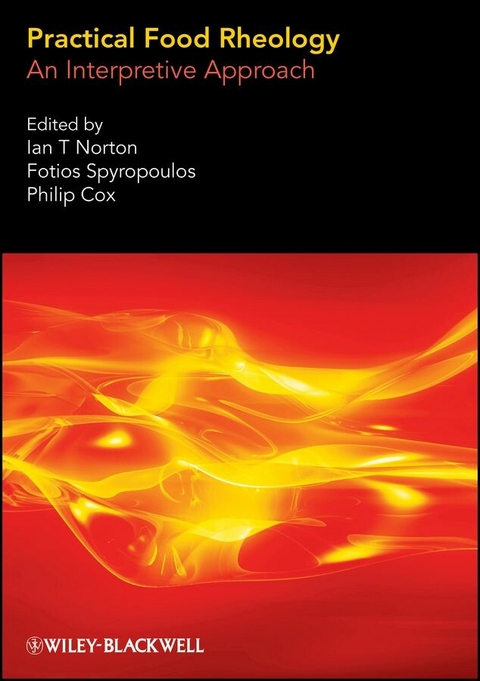
Practical Food Rheology (eBook)
John Wiley & Sons (Verlag)
978-1-4443-9104-6 (ISBN)
This book doesn't overwhelm the reader with complex mathematical equations but takes a simple and practically-focused approach, interpreting the implications of rheological data for use in different food systems. Through this approach industry-based food developers / rheologists, students, and academics are given clear, concise interpretation of rheological data which directly relates to actual perceived functionality in the food. The functionality may relate to texture, structure and mouthfeel, and may result as a function of temperature, pH, flocculation, concentration effects, and mixing.
The interpretative view is based on the principle that the food rheologist will produce a graph, for example of viscosity or gelation profiling, and then have to extract a practical meaning from it. For example, if viscosity falls with time as a function of pH, this knowledge can be used to tell the customer that the viscosity can be followed with just a pH meter and a stopwatch. Rheological measurements have shown that once the pH has dropped 1 unit after 10 minutes, the viscosity has been halved. This is the type of practical and valuable information for customers of the industrial food rheologist which the book will enable readers to access.
Key features:
- A uniquely practical approach to the often difficult science of food rheology
- Includes chapters introducing the basics of food rheology before moving on to how data can be usefully and easily interpreted by the food scientist
- Can be used as a teaching aid on academic or industry-based courses
Professor Ian T Norton, Dr Fotios Spyropoulos and Dr Philip Cox, all of Chemical Engineering, University of Birmingham, Edgbaston, Birmingham, UK.
Rheology is fundamentally important in food manufacturing in two major senses. Understanding the way in which a substance moves and behaves is essential in order to be able to transport and mix it during processing. Secondly, the rheology of a product dictates much of the consumer experience, e.g. in relation to texture and mouthfeel. This book doesn t overwhelm the reader with complex mathematical equations but takes a simple and practically-focused approach, interpreting the implications of rheological data for use in different food systems. Through this approach industry-based food developers / rheologists, students, and academics are given clear, concise interpretation of rheological data which directly relates to actual perceived functionality in the food. The functionality may relate to texture, structure and mouthfeel, and may result as a function of temperature, pH, flocculation, concentration effects, and mixing. The interpretative view is based on the principle that the food rheologist will produce a graph, for example of viscosity or gelation profiling, and then have to extract a practical meaning from it. For example, if viscosity falls with time as a function of pH, this knowledge can be used to tell the customer that the viscosity can be followed with just a pH meter and a stopwatch. Rheological measurements have shown that once the pH has dropped 1 unit after 10 minutes, the viscosity has been halved. This is the type of practical and valuable information for customers of the industrial food rheologist which the book will enable readers to access. Key features: A uniquely practical approach to the often difficult science of food rheology Includes chapters introducing the basics of food rheology before moving on to how data can be usefully and easily interpreted by the food scientist Can be used as a teaching aid on academic or industry-based courses
Professor Ian T Norton, Dr Fotios Spyropoulos and Dr Philip Cox, all of Chemical Engineering, University of Birmingham, Edgbaston, Birmingham, UK.
"This book takes a simple and practically focused approach to food
rheology, providing clear, concise interpretation of rheological
data which directly relates to actual perceived functionality in
the food." (International Food Information Service, 30 August 2011)
"Practical Food Rheology - An Interpretive Approach is a
well-orchestrated tutorial on how 'food-grade' rheological
measuring techniques can help to understand the flow behavior of
ingredients as well as can
address the interaction of food material and its perception and
tremendous health issues of an increasingly sedentary and aging
society." (Applied Rheology, 1 June 2011)
| Erscheint lt. Verlag | 23.11.2010 |
|---|---|
| Sprache | englisch |
| Themenwelt | Sachbuch/Ratgeber ► Essen / Trinken |
| Naturwissenschaften ► Biologie | |
| Technik ► Lebensmitteltechnologie | |
| Technik ► Maschinenbau | |
| Weitere Fachgebiete ► Land- / Forstwirtschaft / Fischerei | |
| Schlagworte | behaves • complex ways • concerned • consumer • Essential • Experience • flow • Food • food engineering • Foods • Food Science & Technology • hands • important • Lebensmittelforschung u. -technologie • Lebensmitteltechnik • light • Manufacturers • Materials • microstructure • mouths • New • Practical • practicebased • Rheologie • rheology • Substance |
| ISBN-10 | 1-4443-9104-6 / 1444391046 |
| ISBN-13 | 978-1-4443-9104-6 / 9781444391046 |
| Informationen gemäß Produktsicherheitsverordnung (GPSR) | |
| Haben Sie eine Frage zum Produkt? |
 PDF (Adobe DRM)
Kopierschutz: Adobe-DRM
Adobe-DRM ist ein Kopierschutz, der das eBook vor Mißbrauch schützen soll. Dabei wird das eBook bereits beim Download auf Ihre persönliche Adobe-ID autorisiert. Lesen können Sie das eBook dann nur auf den Geräten, welche ebenfalls auf Ihre Adobe-ID registriert sind.
Details zum Adobe-DRM
Dateiformat: PDF (Portable Document Format)
Mit einem festen Seitenlayout eignet sich die PDF besonders für Fachbücher mit Spalten, Tabellen und Abbildungen. Eine PDF kann auf fast allen Geräten angezeigt werden, ist aber für kleine Displays (Smartphone, eReader) nur eingeschränkt geeignet.
Systemvoraussetzungen:
PC/Mac: Mit einem PC oder Mac können Sie dieses eBook lesen. Sie benötigen eine
eReader: Dieses eBook kann mit (fast) allen eBook-Readern gelesen werden. Mit dem amazon-Kindle ist es aber nicht kompatibel.
Smartphone/Tablet: Egal ob Apple oder Android, dieses eBook können Sie lesen. Sie benötigen eine
Geräteliste und zusätzliche Hinweise
Buying eBooks from abroad
For tax law reasons we can sell eBooks just within Germany and Switzerland. Regrettably we cannot fulfill eBook-orders from other countries.
aus dem Bereich