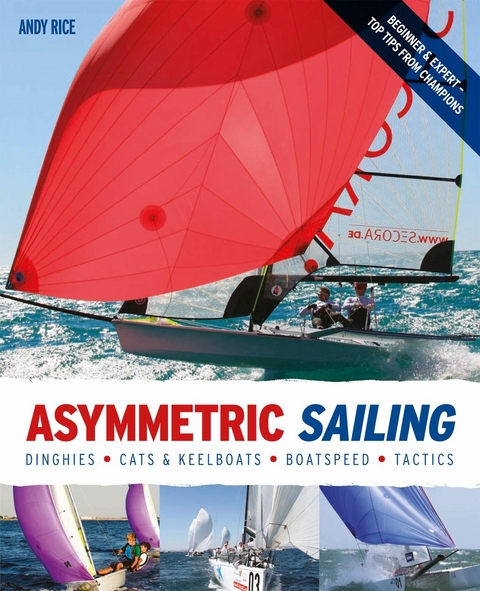
Asymmetric Sailing (eBook)
248 Seiten
Fernhurst Books Limited (Verlag)
978-1-119-95266-4 (ISBN)
Andy Rice is a championship winning dinghy sailor. A spell in the British Olympic Squad led him to sailing journalism - he now writes for a number of dinghy and yacht racing magazines including Seahorse, Yachts and Yachting, Yachting World and Sailing World. He is editor of the go-faster website SailJuice.com, aimed at sailors who want to improve their skills, and owner of Sailing Intelligence, a specialist media agency for the sailing and marine market.
Andy Rice is a championship winning dinghy sailor. A spell in the British Olympic Squad led him to sailing journalism – he now writes for a number of dinghy and yacht racing magazines including Seahorse, Yachts and Yachting, Yachting World and Sailing World. He is editor of the go-faster website SailJuice.com, aimed at sailors who want to improve their skills, and owner of Sailing Intelligence, a specialist media agency for the sailing and marine market.
CHAPTER 1
GETTING STARTED
Choosing the Right Boat
It’s not within the scope of this book to ask you too many questions about what kind of boat you plan to sail. Because asymmetrics come in many different shapes and sizes, it’s difficult to hand out any specific advice, but I just want you to be sure that you’ve thought about the following factors:
Ability
Do you have the ability to sail the boat competently? Or, let’s put it another way, do you have the potential? Now, I know sailors in their 50s and 60s who handle the 18-foot Skiff and Musto Skiff very competently, and asymmetric boats don’t get much harder than that. Ian Renilson is still knocking in top ten finishes at Musto Skiff World Championships well into his 50s, although he is a former Contender World Champion. But Ian, like most other Musto Skiff sailors, did a lot of capsizing and swimming before he reached a certain level of competence. Are you prepared to do the same? If so, great! If not, then maybe you want something a bit more stable and easier to handle.
The 18-foot Skiff is great fun if you know what you’re doing, but it will bite you if you don’t!
Team
Are you going to be sailing in a team boat? If so, how much can you rely on your team mate(s) to show up on a regular basis? Better to agree on the goals and the schedule for the year before you put down your hard cash on a boat.
Budget
Do you have the money, not just for the boat, but for its upkeep and maintenance? If you’re racing a boat where you expect to be doing a lot of capsizing and putting the equipment through quite a bit of abuse while you drag yourself up the learning curve, then it may be better to do your learning on a well-sorted secondhand boat. Even better if you can get the seller to throw in a day’s coaching to help you get to grips with the basics. It’s also a great way to check that the boat you’re buying is working properly and that you haven’t been sold a pup.
To sail a high-performance boat well, team mates need to share the same goals and ambitions
Local fleet
Is there a local fleet at a nearby sailing club, or a good racing circuit that you can get involved in? While any new boat is exciting to sail initially, the novelty will eventually wear off. But it’s the racing and the camaraderie that will keep you interested. So give this factor some serious thought before deciding which boat to sail.
Apparent Wind Sailing
Got to get up to get down. . .
One of the difficult things to get your head around when you’re discovering asymmetric sailing for the first time is the idea that if you want to get downwind you need to head up first. In planing conditions, if you want to get the bow pointing as low as possible downwind and make the best VMG (Velocity Made Good) to the next mark at the bottom of the course, then the way to do that initially is actually to head up as high away from the wind as you can. Unless you do this, you’re not really apparent wind sailing, you are just wafting downwind with the breeze and the gennaker will be caught behind the mainsail and the jib, and will never get a chance to fill properly. So, if you’re new to this, the first thing to do is to head up perhaps more than you think you need to, and get the air flowing across the gennaker from luff to leech and drafting out the back of the sail.
To create your apparent wind, first you need to luff up to build the speed
Once you do that, the apparent wind will kick in and start building on itself. As the apparent wind increases, it also moves forward and you need to sheet on the gennaker and the mainsail to compensate. And, if it’s windy, you’ll need to hike out as hard as possible to counteract the increase in power. In strong winds you’ll find those who hike out hardest actually end up sailing lowest and deepest towards the leeward mark. At first it doesn’t seem to make sense. After all, in most sailing you sit in to sail lower, but not in an asymmetric when you’ve got the power of apparent wind on your side.
How low can you go?
In light to medium airs, when there isn’t enough wind to get the boat planing, then it’s about sailing as low as possible before you experience a massive drop-off in flow across the sails. Where sailing dead downwind is an option in non-asymmetric boats, it’s never an option with asymmetrics. You always need to sail angles downwind, and in light to medium conditions the trick is finding out just how low you can go.
MELGES 24s trying to ‘soak’ low in non-planing conditions
On a keelboat you may have electronic GPS equipment which you can use to help determine your best VMG downwind. On a dinghy or a small multihull, you don’t have that luxury so you have to develop a feel for when you think the boat is travelling at the optimum VMG downwind. Quite often you can’t really work this out until you start racing other boats, when you can compare yourself to others nearby. In marginal planing conditions you’ll find there are those who like pushing high and sailing extra distance for the extra speed, while there are those who like really running deep and going slower, but sailing a shorter distance to the next mark.
Both those extremes have their place, and sometimes it pays to do a little bit of each. A lot of the time, the decision that you make about whether to sail in high, medium or low mode is based on the tactics of where the boats around you are, and where you’re aiming for next. It is also based on where you think the best breeze is. Sometimes, when you’re in a nice but narrow line of breeze, it pays to sail low to stay in it as long as possible. The temptation can be to head up, get on the plane and sail really fast – only to sail yourself out of the breeze line.
Two International 14s sailing in very different modes
So it’s really important to be able to sail in all these modes. We’ll address this in Chapter 7, Boat Speed. And it’s also important to know how and when to apply these modes on the race course, which we’ll address in Chapter 8, Racing: Strategy and Tactics.
Getting the Basics Right
How is your boat rigged: bag or chute?
If you’re using a boat with a spinnaker chute then it’s the crew who tends to do all the hoisting in a two-handed boat. The helm’s chief job is to steer the boat so that it’s upright and stable and gives the crew plenty of opportunity to hoist the spinnaker without worrying about helping to keep the boat upright.
With a boat with a chute, you might want to share out the job of hoisting the gennaker, as there are more ropes to pull. So, for example, in the Laser 5000, a typical routine would be for the helm to pull up the spinnaker halyard while the crew pulls out the pole and the tack line. So it’s a matter of dividing up the workflow in such a way that you get your gennaker up and pulling in the shortest amount of time after the windward mark.
Despite the enormous sail, the 18-foot skiff gennaker is launched and retrieved into a bag
In a boat with three or more crew, such as a Melges 24 or SB20, then you can divide up the workload even more. So in the case of a three-person SB20, the typical work pattern would be:
- Helm continues to steer while taking the mainsheet from the middle man.
- Forward hand goes to leeward to prepare the gennaker by opening up the bag. He then pulls out the bowsprit. At the helmsman’s command the forward hand hoists the gennaker and cleats it...
| Erscheint lt. Verlag | 3.8.2012 |
|---|---|
| Verlagsort | London |
| Sprache | englisch |
| Themenwelt | Sachbuch/Ratgeber ► Sport ► Segeln / Tauchen / Wassersport |
| Schlagworte | 29er • 49er • boat racing • catamaran racing • dinghy racing • F18 catamaran • genneker • Melges • Musto Skiff • Racing • RS200 • RS400 • SB20 • Spinnaker • yacht racing |
| ISBN-10 | 1-119-95266-2 / 1119952662 |
| ISBN-13 | 978-1-119-95266-4 / 9781119952664 |
| Informationen gemäß Produktsicherheitsverordnung (GPSR) | |
| Haben Sie eine Frage zum Produkt? |
 EPUB (Wasserzeichen)
DRM: Digitales Wasserzeichen
Dieses eBook enthält ein digitales Wasserzeichen und ist damit für Sie personalisiert. Bei einer missbräuchlichen Weitergabe des eBooks an Dritte ist eine Rückverfolgung an die Quelle möglich.
Dateiformat: EPUB (Electronic Publication)
EPUB ist ein offener Standard für eBooks und eignet sich besonders zur Darstellung von Belletristik und Sachbüchern. Der Fließtext wird dynamisch an die Display- und Schriftgröße angepasst. Auch für mobile Lesegeräte ist EPUB daher gut geeignet.
Systemvoraussetzungen:
PC/Mac: Mit einem PC oder Mac können Sie dieses eBook lesen. Sie benötigen dafür die kostenlose Software Adobe Digital Editions.
eReader: Dieses eBook kann mit (fast) allen eBook-Readern gelesen werden. Mit dem amazon-Kindle ist es aber nicht kompatibel.
Smartphone/Tablet: Egal ob Apple oder Android, dieses eBook können Sie lesen. Sie benötigen dafür eine kostenlose App.
Geräteliste und zusätzliche Hinweise
Buying eBooks from abroad
For tax law reasons we can sell eBooks just within Germany and Switzerland. Regrettably we cannot fulfill eBook-orders from other countries.
aus dem Bereich