


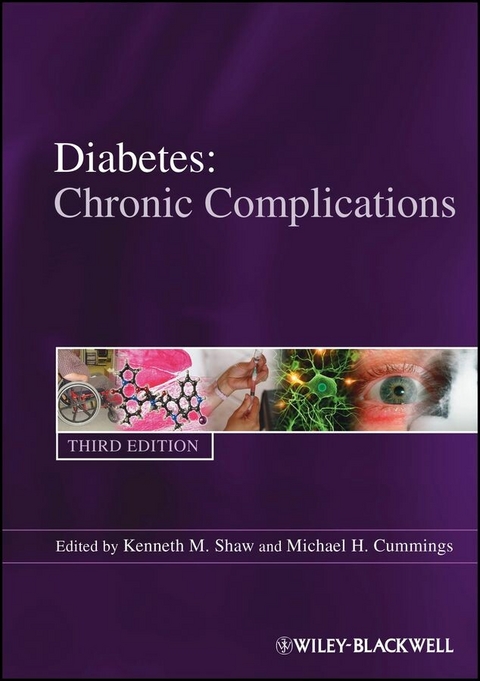
Diabetes (eBook)
John Wiley & Sons (Verlag)
978-1-118-36748-3 (ISBN)
Professor Kenneth M. Shaw MA (CANTAB) MD FRCP. Professor Shaw is Honorary Consultant Physician, specialising in general medicine, diabetes, endocrinology and metabolism; based at Queen Alexandra Hospital, Portsmouth Hospitals NHS Trust and Emeritus Professor of Medicine, University of Portsmouth. Professor Shaw leads an internationally recognised and award winning, multidisciplinary, professional diabetes team in Portsmouth. Professor Shaw is an Alumna of the University of Cambridge, UK and a Scientific Fellow of the Zoological Society of London. Professor Shaw is Editor-in-Chief of the Wiley journal, Practical Diabetes International and has authored over 200 publications. He is also Chairman of the Professional Support and Development Committee for Diabetes UK.
Michael H. Cummings MD, FRCP Portsmouth Hospitals NHS Trust & University of Portsmouth. Professor Cummings was appointed as Consultant in Diabetes and Endocrinology at Queen Alexandra Hospital in 1996. He is also Honorary Professor in Diabetes and Endocrinology at Portsmouth University. Professor Cummings has 44 articles listed on PubMed.
Professor Kenneth M. Shaw MA (CANTAB) MD FRCP. Professor Shaw is Honorary Consultant Physician, specialising in general medicine, diabetes, endocrinology and metabolism; based at Queen Alexandra Hospital, Portsmouth Hospitals NHS Trust and Emeritus Professor of Medicine, University of Portsmouth. Professor Shaw leads an internationally recognised and award winning, multidisciplinary, professional diabetes team in Portsmouth. Professor Shaw is an Alumna of the University of Cambridge, UK and a Scientific Fellow of the Zoological Society of London. Professor Shaw is Editor-in-Chief of the Wiley journal, Practical Diabetes International and has authored over 200 publications. He is also Chairman of the Professional Support and Development Committee for Diabetes UK. Michael H. Cummings MD, FRCP Portsmouth Hospitals NHS Trust & University of Portsmouth. Professor Cummings was appointed as Consultant in Diabetes and Endocrinology at Queen Alexandra Hospital in 1996. He is also Honorary Professor in Diabetes and Endocrinology at Portsmouth University. Professor Cummings has 44 articles listed on PubMed.
Contributors, vii
Preface to Third Edition, ix
1 Diabetes and the Eye, 1
Kevin Shotliff and Nigel Davies
2 Diabetic Chronic Kidney Disease, 34
Richard J MacIsaac, George Jerums and Gerald F Watts
3 Diabetes and the Liver, 67
Lisa Jones and Anna Mae Diehl
4 Diabetes and the Gastrointestinal Tract, 83
Zeeshan Ramzan and Henry P Parkman
5 Diabetes and Foot Disease, 101
Kate Marsden, Sharon Tuck and Darryl Meeking
6 Diabetes and Autonomic Neuropathy, 119
Andrew F Macleod
7 Diabetes and Sexual Health, 141
Michael H Cummings
8 Diabetes and the Heart, 165
Miles Fisher and Kenneth M Shaw
9 Diabetes and the Brain, 190
Iain Cranston
10 Diabetes and Mental Health, 214
David P Osborn and Richard IG Holt
11 Musculoskeletal Complications of Diabetes Mellitus, 239
Stratos Christianakis, Minh Chau Nguyen and Richard S Panush
12 Diabetes and Oral Health, 252
Philip M Preshaw
13 Diabetes and the Skin, 273
Hywel L Cooper, Amita Bansal and Adam E Haworth
14 Diabetes and Cancer, 294
Steven S Coughlin and Edward L Giovannucci
Multiple Choice Questions, 306
Answers, 318
Index, 327
Colour plate section is found facing page 244
"Overall, the book offers an excellent reference resource
or quick overview of management for common diabetes complications.
It is a concise and practical resource for all diabetes
specialists, specialist nurses and general practitioners with a
specialist interest in diabetes, and is an excellent addition to
the current literature." (Practical Diabetes, 1
September 2012)
CHAPTER 1
Diabetes and the Eye
Kevin Shotliff and Nigel Davies
Chelsea and Westminster Hospital, London, UK
Key points
- Of people with diabetes in the UK 2 per cent are thought to be registered blind.
- Of patients with type 1 diabetes 87–98 per cent have retinopathy seen after 30 years of the disease.
- Eighty-five per cent of those with type 2 diabetes on insulin and 60 per cent on diet or oral agents have retinopathy after 15 years of the disease.
- Optical coherence tomography (OCT) is a technique allowing visualization of retinal layers and assessment of maculopathy.
- New treatments such as intravitreal therapy and vitrectomy are emerging as treatments that maintain or improve vision but laser remains the primary treatment of choice.
Therapeutic key points
- Poor glycaemic control is associated with worsening of diabetic retinopathy and improving glycaemic control improves outcome.
- Systolic hypertension is associated with retinopathy in type 1 and type 2 diabetes; reducing this improves retinopathy.
- Reducing lipid levels with fibrates and statins has been shown to improve retinopathy.
- Intraretinal injections of vascular endothelial growth factor (VEGF) receptor blockers may improve maculopathy.
- Laser therapy remains the primary treatment of choice for sight-threatening diabetic retinopathy, both proliferative disease and maculopathy.
1.1 Introduction
Since the invention of the direct ophthalmoscope by Helmholtz in 1851 and von Yaeger’s first description of changes in the fundus of a person with diabetes 4 years later, there has been increasing interest in the retina because it contains the only part of the vasculature affected by diabetes that is easily visible. Interestingly, these first retinal changes described in 1855 were actually hypertensive, not diabetic.
Despite the target outlined in the St Vincent Declaration in 1989 to reduce blindness caused by diabetes by one-third within 5 years, and the advances made in laser therapy and vitreoretinal surgical techniques, diabetic retinopathy remains the most common cause of blindness in the working-age population of the western world. Furthermore, with predictions of a dramatic increase in the number of people diagnosed with diabetes, the detection and treatment of diabetic retinopathy continues to be a focal point for healthcare professionals. Indeed the recent National Service Framework (NSF) for Diabetes has prioritized diabetic retinopathy by setting specific targets associated with retinal screening and implementing the development of a National Screening Programme.
Visual loss from diabetic retinopathy has two main causes: maculopathy, described as disruption of the macular region of the retina, leading to impairment of central vision; and retinal ischaemia, resulting in proliferative diabetic retinopathy.
As well as the retina, other parts of the eye can also be affected in people with diabetes. Cataracts are more prevalent and are actually the most common eye abnormality seen in people with diabetes, occurring in up to 60 per cent of 30–54 year olds. The link between diabetes and primary open-angle glaucoma, however, continues to be disputed. Vitreous changes do occur in people with diabetes, such as asteroid hyalosis, seen in about 2 per cent of patients. These small spheres or star-shaped opacities in the vitreous appear to sparkle when illuminated and do not normally affect vision. Branch retinal vein occlusions and central retinal vein occlusions are associated with hypertension, hyperlipidaemia and obesity, and are often found in people with diabetes. Hypertensive retinopathy features several lesions in common with diabetic retinopathy, and care must be taken not to confuse the two conditions.
1.2 Epidemiology of Diabetic Retinopathy
Currently 2 per cent of the UK diabetic population is thought to be registered blind,1 which means that a person with diabetes has a 10- to 20-fold increased risk of blindness. The prevalence of diabetic retinopathy depends on multiple factors and, as for many microvascular complications, is more common in the ethnic minorities compared with white people.
A prevalence of 25–30 per cent for a general diabetic population is often quoted. Every year about 1 in 90 North Americans with diabetes develops proliferative retinopathy and 1 in 80 develops macular oedema.
In patients with type 1 diabetes:2,3
- <2 per cent have any lesions of diabetic retinopathy at diagnosis
- 8 per cent have it by 5 years (2 per cent proliferative)
- 87–98 per cent have abnormalities 30 years later (30 per cent of these having had proliferative retinopathy).
In patients with type 2 diabetes:4,5
- 20–37 per cent can be expected to have retinopathy at diagnosis
- 15 years later, 85 per cent of those on insulin and 60 per cent of those on diet or oral agents will have abnormalities.
The 4-year incidence of proliferative retinopathy in a large North American epidemiological study was 10.5 per cent in patients with type 1 diabetes, 7.4 per cent in patients with older-onset/type 2 diabetes taking insulin and 2.3 per cent in patients with type 2 diabetes not on insulin.2,3,5
Currently in the UK, maculopathy is a more common and therefore more significant sight-threatening complication of diabetes. This is due to the much greater number of people with type 2 diabetes compared with type 1, and the fact that maculopathy tends to occur in older people. About 75 per cent of those with maculopathy have type 2 diabetes and there is a 4-year incidence of 10.4 per cent in this group.5 Although patients with type 2 diabetes are 10 times more likely to have maculopathy than those with type 1, 14 per cent of patients with type 1 diabetes who become blind do so because of maculopathy.1
The risk factors for development/worsening of diabetic retinopathy are:
- duration of diabetes
- type of diabetes (proliferative disease in type 1 and maculopathy in type 2)
- poor diabetic/glycaemic control
- hypertension
- diabetic nephropathy
- recent cataract surgery
- pregnancy
- alcohol (variable results which may be related to the type of alcohol involved, e.g. effects are worse in Scotland than in Italy)
- smoking (variable results, but appears worse in young people with exudates and older women with proliferative disease)
- ethnic origin.
1.3 Retinal Anatomy
To understand how diabetic retinopathy is classified and treated, a basic grasp of retinal anatomy is essential. The retina is the innermost of three successive layers of the globe of the eye, the others being:
- the sclera – the rigid outer covering of the eye, which includes the cornea
- the choroid – the highly vascularized middle layer of the eye, which has the largest blood flow in the entire body.
The retina comprises two parts: the neurosensory retina, the photoreceptive part composed of nine layers and the retinal pigment epithelium (Figure 1.1).
Figure 1.1 Cross-section of the retina illustrating the 10 layers of the retina: inner limiting membrane (glial cell fibres forming the barrier between the retina and the vitreous body), optic nerve fibres (axons of the third neuron), ganglion cells (cell nuclei of multipolar ganglion cells of the third neuron), inner plexiform layer (synapses between axons of the second neuron and dendrites of the third neuron), inner nuclear layer (cell nuclei of the amacrine cells, bipolar cells and horizontal cells), outer plexiform layer (synapses between axons of the first neuron and dendrites of the second neuron), outer nuclear layer (cell nuclei of rods and cones, the first neuron), outer limiting membrane (porous plate of processes of glial cells, which rods and cones project through), rods and cones (true photoreceptors), retinal pigment epithelium (single layer of pigmented epithelial cells) and Bruch’s membrane.
The normal retina is completely transparent to visible wavelengths of light, its bright red/orange reflex the result of the underlying vasculature of the choroid. The retina has a number of distinct features. The optic nerve (often described as the optic disc) is a circular structure varying in colour from pale pink in the young to yellow/orange in older people. It is located approximately 15° nasally from the visual axis and slightly superior (Figure 1.2). The optic nerve is essentially a ‘cable’ connecting the eye to the brain, which carries information from the retina to the visual cortex via the optic chiasma. The optic nerve may exhibit a central depression known as the optic or physiological cup. Both the central retinal vein and artery leave and enter the eye through the optic nerve. The ‘blind spot’ on visual field testing occurs because the optic disc contains no photoreceptor rod and cone cells.
Figure 1.2 Fundus photograph illustrating the normal retina with optic nerve head (optic disc) circled in white, macula circled in black and fovea circled with a broken white line.
The macula is the round area at the posterior pole within the temporal vessel arcades 3–4 mm temporal to and slightly lower than the optic disc (Figure 1.2). It is approximately 5 mm in diameter. At the centre of the macula and roughly the same size as the optic disc is the fovea, a depression in the retinal surface. The fovea is the point at which vision is sharpest; the foveola, the thinnest part of the retina and forming the base of the fovea, contains only cone cells, giving this area...
| Erscheint lt. Verlag | 25.4.2012 |
|---|---|
| Sprache | englisch |
| Themenwelt | Sachbuch/Ratgeber ► Gesundheit / Leben / Psychologie |
| Medizinische Fachgebiete ► Innere Medizin ► Diabetologie | |
| Schlagworte | brain • Chau • Chronic • complications • Cummings • David • Diabetes • Diabetic • Diehl • F • gastrointestinal • heart • Henry • Holt • iain cranston • IG • Ix • jerums • Kevin • kidney • Lisa • Medical Science • Medizin • mellitus • Miles • minh • Musculoskeletal • Nigel • P • panush • Shaw • tract |
| ISBN-10 | 1-118-36748-0 / 1118367480 |
| ISBN-13 | 978-1-118-36748-3 / 9781118367483 |
| Informationen gemäß Produktsicherheitsverordnung (GPSR) | |
| Haben Sie eine Frage zum Produkt? |
 EPUB (Adobe DRM)
Kopierschutz: Adobe-DRM
Adobe-DRM ist ein Kopierschutz, der das eBook vor Mißbrauch schützen soll. Dabei wird das eBook bereits beim Download auf Ihre persönliche Adobe-ID autorisiert. Lesen können Sie das eBook dann nur auf den Geräten, welche ebenfalls auf Ihre Adobe-ID registriert sind.
Details zum Adobe-DRM
Dateiformat: EPUB (Electronic Publication)
EPUB ist ein offener Standard für eBooks und eignet sich besonders zur Darstellung von Belletristik und Sachbüchern. Der Fließtext wird dynamisch an die Display- und Schriftgröße angepasst. Auch für mobile Lesegeräte ist EPUB daher gut geeignet.
Systemvoraussetzungen:
PC/Mac: Mit einem PC oder Mac können Sie dieses eBook lesen. Sie benötigen eine
eReader: Dieses eBook kann mit (fast) allen eBook-Readern gelesen werden. Mit dem amazon-Kindle ist es aber nicht kompatibel.
Smartphone/Tablet: Egal ob Apple oder Android, dieses eBook können Sie lesen. Sie benötigen eine
Geräteliste und zusätzliche Hinweise
Buying eBooks from abroad
For tax law reasons we can sell eBooks just within Germany and Switzerland. Regrettably we cannot fulfill eBook-orders from other countries.
aus dem Bereich


