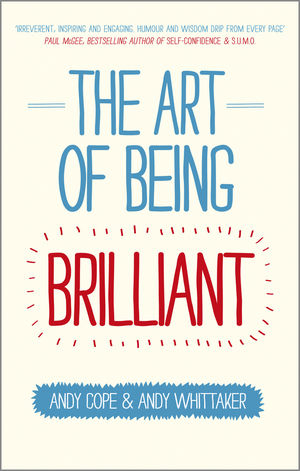
The Art of Being Brilliant (eBook)
John Wiley & Sons (Verlag)
978-0-85708-373-9 (ISBN)
This short, small, highly illustrated book will fill you to the brim with happiness, positivity, wellbeing and, most importantly, success! Andy Cope and Andy Whittaker are experts in the art of happiness and positive psychology and The Art of Being Brilliant is crammed full of good advice, instructive case studies, inspiring quotes, some funny stuff and important questions to make you think about your work, relationships and life,
You see being brilliant, successful and happy isn't about dramatic change, it's about finding out what really works for you and doing more of it! The authors lay down their six common-sense principles that will ensure you focus on what you're good at and become super brilliant both at work and at home,
- A richly illustrated, 2 colour, small book full of humour, inspiring quotes and solid advice
- A great read with a serious underlying message - how to foster positivity and bring about success in every aspect of your life
- Outlines six common-sense principles that will help you ensure you are the best you can be
Andy Cope & Andy Whittaker are the bestselling authors of The Art of Being Brilliant, Andy Cope is a teacher, trainer, prolific and sought after speaker and even has a PhD in happiness, Seriously, Andy Whitaker is a businessman, NPL trainer and part time stand-up comic, Together they run Art of Brilliance, a training company which works with businesses such as DHL, LloydsTSB, Pirelli, Ginsters, Alton Towers, Toyota, Waitrose, West Midlands Police, IKEA, and Astra Zeneca, Andy Cope, in his other life, is also the author of much loved children's book series Spy Dog which has sold well over 1 million copies!
A pep talk in your pocket This short, small, highly illustrated book will fill you to the brim with happiness, positivity, wellbeing and, most importantly, success! Andy Cope and Andy Whittaker are experts in the art of happiness and positive psychology and The Art of Being Brilliant is crammed full of good advice, instructive case studies, inspiring quotes, some funny stuff and important questions to make you think about your work, relationships and life. You see being brilliant, successful and happy isn't about dramatic change, it s about finding out what really works for you and doing more of it! The authors lay down their six common-sense principles that will ensure you focus on what you re good at and become super brilliant both at work and at home. A richly illustrated, 2 colour, small book full of humour, inspiring quotes and solid advice A great read with a serious underlying message how to foster positivity and bring about success in every aspect of your life Outlines six common-sense principles that will help you ensure you are the best you can be
Andy Cope & Andy Whittaker are the bestselling authors of The Art of Being Brilliant. Andy Cope is a teacher, trainer, prolific and sought after speaker and even has a PhD in happiness. Seriously. Andy Whitaker is a businessman, NPL trainer and part time stand-up comic. Together they run Art of Brilliance, a training company which works with businesses such as DHL, LloydsTSB, Pirelli, Ginsters, Alton Towers, Toyota, Waitrose, West Midlands Police, IKEA, and Astra Zeneca. Andy Cope, in his other life, is also the author of much loved children's book series Spy Dog which has sold well over 1 million copies!
Chapter 1. Fishing for Life 1
Chapter 2. Shiny Happy People 9
Chapter 3. Some of the People, Some of the Time 25
Chapter 4. Glowing on the Outside 41
Chapter 5. Can God Do a Handstand? 53
Chapter 6. Busyness as Usual 67
Chapter 7. Pants on the Outside 83
Chapter 8. Your Beautiful Mind 93
Chapter 9. Nellie Breaks Free 101
Chapter 10. Life Through a Lens 109
Chapter 11. The 90/10 Principle 117
Chapter 12. Tigger is a Trigger (And Eeyore is Too!) 127
Chapter 13. Beware of the Garbage Trucks 139
Chapter 14. Chumbawumba 157
Chapter 15. Share a Hugg 165
Chapter 16. Strengthening Your Strengths 177
Chapter 17. Omnipotent Handstands 185
Chapter 2
Shiny Happy People
In which we come clean about Positive Psychology, we find out why Britain fails to qualify for the ‘Happiness World Cup’, a blissful picture is painted, Woody Allen tries to depress us and we’re introduced to mood hoovers and 2%ers.
We’ve been advocates of the relatively new field of positive psychology since its inception in the late 1990s. I’ve been so enthused about it myself that I’m doing a doctorate on it! Psychology was part and parcel of my first degree. I read numerous academic tomes on depression, anxiety, eating disorders, phobias...and became an expert on all things negative! In fact, it was quite depressing studying it!
Interestingly, I was recently asked to do a talk at an NHS conference. The theme of the conference was mental health and wellbeing. Right up my street, so I agreed and they slotted me in as the final speaker on Day 3. A few days before the conference I received the agenda and it wasn’t about health and wellbeing at all! To give you a flavour, the speakers on Day 1 were talking about suicide rates in Bridgend and depression amongst social workers. Day 2 started with a corker, Prozac addiction, before moving on to sleeping disorders and the rise of youth crime. My supposedly uplifting talk, called ‘The Art of Being Brilliant’, had been slotted in after ‘Exponential Anorexia’.
My heart sank! Such a snappy title! How could I follow that?
The entire conference was devoted to mental ill-health and feeling grim. It was homing in on what was going wrong and, to be frank, it’s typical of the world of research and medicine. I’m not suggesting it’s wrong to have conferences about such subjects. I’m suggesting it’s normal. We’ve spent billions of pounds producing pills to cure depression but it seems to be getting worse!
Strap yourself in, because I feel compelled to give you the science bit. Traditional strands of psychology were couched in terms of the study of ill people. We’d spent hundreds of years studying what was wrong with people. In a nutshell, you’d only ever go and see a psychologist if you were ill. You’d never book yourself in for an appointment if you were feeling great!
‘Positive psychology’ has existed formally since the late 1980s. Its popularity mushroomed with the publication of Dr Martin Seligman’s book, Authentic Happiness in 2003. However, even the good Doctor wouldn’t claim to have invented ‘positivity’ and ‘happiness’ – they’ve been on the radar for centuries! Check out Plato and Confucius for a start. Or the big fella they call Buddha. And more recently Carl Rogers, Richard Bandura, Howard Gardiner and the God of management courses the world over, Abe Maslow (if I hear his ‘hierarchy of needs’ trotted out on any more courses I’ll scream and scream until I’m sick). All have elements of self-fulfilment, happiness and efficacy in their studies. So it’s hitting today’s headlines but I guess positive psychology is best described as having a short history with a very long past.
There’s a general acknowledgement that psychology has followed a ‘disease model’. Basically, if individuals lie on a range of wellbeing from -10 (very unwell) to +10 (very well indeed) then we’ve always been focused on getting people from, say, -7 to zero (to the point of them ‘not being ill’). Job done! Except, of course, it isn’t! Because, you see, there’s a huge difference between ‘being alive’ and ‘living’.
Positive psychology is about getting to +8 or +9. The best word I can find to describe this is ‘flourishing’ and it’s firmly established at the ‘living’ end of the spectrum.
So, positive psychology hasn’t invented happiness and wellbeing, merely brought it under one umbrella. It’s been a re-focusing exercise rather than a revolution (although we’re rather excited by it and would therefore like to whip you up into a frenzy of enthusiasm thereby leading to a revolution...more of that later).
Quite a lot of the ‘remedies’ for getting people to be happier seem intuitively obvious. Maybe even simplistic. We feel this may be a problem in terms of getting people to take the subject seriously. There’s certainly a lot of scepticism out there. Tabloids like to belittle it with headlines such as ‘happyology’ or by pouring scorn on positive psychology in schools as ‘attempts to teach teens to be happy!’ (When, of course, we should be teaching them something really useful like algebra or ox-bow lakes.)
And herein lies one of the major hurdles for the subject. ‘Happiness’ seems to be a collective term for a range of emotions. It’s subjective (which has led to the term ‘subjective wellbeing’, the theme of several major studies by the heavyweight academic community). It’s difficult to measure because how do we gauge ‘happiness’ on a scale of 1–10? And what causes happiness in one person may not cause it in another.
And another question worth pondering is why bother studying ‘happiness’ and ‘positivity’ at all? Hasn’t the research community got better things to do than tell us what we already know? I think it’s worth spending a couple of lines on the benefits of positive psychology (just in case the penny hasn’t dropped yet). It seems an obvious point but, basically, emotion drives motion (i.e., the way you feel drives your behaviour).
Here are some of Jessica Pryce-Jones’s (2010) business stats about happy people:
- They get promoted faster
- They have 180% more energy
- They are 108% more engaged in their job
- They achieve more
- They are 40% more confident
- They give better customer service
- They are more creative
I could go on, but I think it’s fairly obvious that these are the kind of people you need in your organisation.2
But the benefits spread wider than the workplace. On a societal level, happy people live longer, have fewer ailments, are more altruistic, have more friends and make other people feel great too!
At a family level, positive psychology encourages flourishing families. A bit clichéd but true, families that play together stay together. Once again, it seems an obvious point but positive parents tend to produce positive offspring. Is there a more important role that you’ll ever play?
There are even international happiness league tables! Countries are rated according to health service, education, job market, infrastructure and such like, to come up with a happiness score. I was intrigued to find out whether there was a link between happiness and income. It’s true that very poor people will feel happier if they receive more income. But once you’ve got food in your tum, a roof over your head and enough to pay the bills, more money won’t increase your happiness levels. Having said that, there is a nifty way of squeezing extra value from your happiness pound – buy an experience rather than a product. So, for example, a trip to the seaside will yield more happiness Brownie points than a new pair of shoes.
Will a lottery win make you happier? This is counter-intuitive but the short answer is ‘No’! Several studies of lottery winners have found there is a spike of happiness but that they returned to their pre-win level after a few months. Scientifically, this is called ‘habituation’ and it means we soon become accustomed to our situation and it ceases to bring happiness. It’s the same with a pay rise – the initial increase will be brilliant but the effect wears off as we get used to the change (unless, of course, you spend it entirely on trips to the seaside!).
We are obsessed with measures of economic success. The news tells us that the FTSE is up 26 points or the Dow has fallen. Or the pound is up against the euro. And the Hang Seng has reacted badly to factory output data in Shanghai. Or that ‘America has sneezed and we’ve caught a cold’. The papers have financial pages with reams of company data. It seems our indicators of ‘success’ are purely financial.
If we scratch the surface of this just for a second, we’ll find that national income goes up every time there’s a car crash or a divorce. Or after a flood. And, brilliant news, GDP shoots up in times of war. I can imagine the UK government hatching a strategy to cope with the recession...invade France (again!).
So, that begs the question, are we measuring the right things? Should we, in fact, be measuring happiness?
Looking internationally, it’s interesting that ‘Happiness’ appears in the American Declaration of Independence. Well, the pursuit of happiness actually. (So in America you have a right to chase it but never quite get there!) Closer to home, Denmark consistently ranks as the happiest nation in Europe. I did a fact-finding tour of Costa Rica, one of the world’s happiest countries, and can safely report that they’re poor, they don’t have an army, it rains every day, there are huge holes in the road...and they’re happy! Bhutan (a small and, by material standards, very poor country in the Himalayas) measures ‘Gross Domestic Happiness’. So, for them, ‘success’ isn’t about churning goods out of their factories; it’s about...
| Erscheint lt. Verlag | 13.9.2012 |
|---|---|
| Sprache | englisch |
| Themenwelt | Sachbuch/Ratgeber ► Beruf / Finanzen / Recht / Wirtschaft ► Bewerbung / Karriere |
| Sachbuch/Ratgeber ► Gesundheit / Leben / Psychologie ► Psychologie | |
| Wirtschaft ► Betriebswirtschaft / Management | |
| Schlagworte | Advice • ART • brilliant • Business & Management • Business Self-Help • Concrete • everything • full • Funny • Future • Handstand • Happy • Identify • important questions • Life • outside • People • Ratgeber Wirtschaft • reverberate positively • Strength • Time • Wirtschaft /Ratgeber • Wirtschaft u. Management • Work • Works |
| ISBN-10 | 0-85708-373-2 / 0857083732 |
| ISBN-13 | 978-0-85708-373-9 / 9780857083739 |
| Informationen gemäß Produktsicherheitsverordnung (GPSR) | |
| Haben Sie eine Frage zum Produkt? |
 EPUB (Adobe DRM)
Kopierschutz: Adobe-DRM
Adobe-DRM ist ein Kopierschutz, der das eBook vor Mißbrauch schützen soll. Dabei wird das eBook bereits beim Download auf Ihre persönliche Adobe-ID autorisiert. Lesen können Sie das eBook dann nur auf den Geräten, welche ebenfalls auf Ihre Adobe-ID registriert sind.
Details zum Adobe-DRM
Dateiformat: EPUB (Electronic Publication)
EPUB ist ein offener Standard für eBooks und eignet sich besonders zur Darstellung von Belletristik und Sachbüchern. Der Fließtext wird dynamisch an die Display- und Schriftgröße angepasst. Auch für mobile Lesegeräte ist EPUB daher gut geeignet.
Systemvoraussetzungen:
PC/Mac: Mit einem PC oder Mac können Sie dieses eBook lesen. Sie benötigen eine
eReader: Dieses eBook kann mit (fast) allen eBook-Readern gelesen werden. Mit dem amazon-Kindle ist es aber nicht kompatibel.
Smartphone/Tablet: Egal ob Apple oder Android, dieses eBook können Sie lesen. Sie benötigen eine
Geräteliste und zusätzliche Hinweise
Buying eBooks from abroad
For tax law reasons we can sell eBooks just within Germany and Switzerland. Regrettably we cannot fulfill eBook-orders from other countries.
aus dem Bereich