


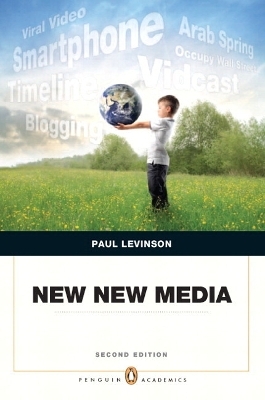
New New Media Plus MySearchLab with eText
Pearson
978-0-205-91214-8 (ISBN)
- Titel ist leider vergriffen;
keine Neuauflage - Artikel merken
Packages
Access codes for Pearson's MyLab & Mastering products may not be included when purchasing or renting from companies other than Pearson; check with the seller before completing your purchase.
Used or rental books
If you rent or purchase a used book with an access code, the access code may have been redeemed previously and you may have to purchase a new access code.
Access codes
Access codes that are purchased from sellers other than Pearson carry a higher risk of being either the wrong ISBN or a previously redeemed code. Check with the seller prior to purchase.
--Discusses how “new new media” are transforming our culture
Facebook, Twitter, YouTube, Wikipedia, Foursquare, blogging … these and other “new new media“ are used by hundreds of millions worldwide and are transforming just about every aspect of our culture from the way we elect presidents to how we watch television. New New Media details the benefits, opportunities, and dangers of these transformations.
New new media, as opposed to the traditional “new media” of email and websites, allow and encourage all consumers to become producers, readers to become writers and publishers, viewers to become performers - and have engendered such worldwide movements as The Arab Spring, The Tea Party, and Occupy Wall Street. This catalytic feature of contemporary media prompts an entirely new look at how mass media, culture, and industry are undergoing the most profound changes since the advent of the alphabet and the printing press.
Learning Goals
Upon completing this book, readers will be able to:
Discuss the impact new new media have on our society
Understand the mechanics of Twitter, YouTube, Facebook, Wikipedia and other types of new new media
Discover the newest new media - Foursquare, Pinterest, WikiLeaks, Anonymous, Goggle+
Note: MySearchLab does not come automatically packaged with this text. To purchase MySearchLab, please visit: www.mysearchlab.com or you can purchase a valuepack of the text + MySearchLab (at no additional cost): ValuePack ISBN-10: 0205912141 / ValuePack ISBN-13: 9780205912148
Paul Levinson, PhD, is Professor of Communication & Media Studies at Fordham University in New York City. His eight nonfiction books, including The Soft Edge (1997), Digital McLuhan (1999), Realspace (2003), Cellphone (2004), and New New Media (2009; 2nd edition, 2012) have been the subject of major articles in the New York Times, Wired, and the Christian Science Monitor, and have been translated into ten languages. His science fiction novels include The Silk Code (1999, winner of the Locus Award for Best First Novel), Borrowed Tides (2001), The Consciousness Plague (2002), The Pixel Eye (2003), and The Plot To Save Socrates (2006). His short stories have been nominated for Nebula, Hugo, Edgar, and Sturgeon Awards. Paul Levinson appears on "The O'Reilly Factor" (Fox News), "The CBS Evening News," "NewsHour with Jim Lehrer" (PBS), "Nightline" (ABC), Dylan Ratigan (MSNBC) and numerous national and international TV and radio programs. His 1972 LP, Twice Upon a Rhyme, was re-issued on mini-CD by Big Pink Records in 2009, and was re-issued in a vinyl remastered re-pressing by Sound of Salvation/Whiplash Records in December 2010. He reviews the best of television in his InfiniteRegress.tv blog, writes political and media commentary for Mediaite, and was listed in The Chronicle of Higher Education's "Top 10 Academic Twitterers" in 2009.
In this Section:
1) Brief Table of Contents
2) Full Table of Contents
1) Brief Table of Contents
Chapter 1: Why “New New” Media?
Chapter 2: Facebook
Chapter 3: Twitter
Chapter 4: YouTube
Chapter 5: Wikipedia
Chapter 6: Blogging
Chapter 7: Foursquare and Hardware
Chapter 8: Smaller Potatoes
Chapter 9: The Dark Side Of New New Media
Chapter 10: Politics and New New Media
--------------------------------------------------------------------------------------------------
2) Full Table of Contents
Chapter 1: Why “New New” Media?
Why “New New” Rather Than Social Media?
Guiding Principles of New New Media
New New Media Encompass Prior New Media Principles
The Order and Content of the Chapters
Speed in the Evolution of New New Media and Hardware
The Prime Methodology: Learning by Doing
Chapter 2: Facebook
The Irresistible Appeal of “Friends”
What Does Online “Friendship” Mean
Fine-Tuning Online Friendship
The Facebook “Group” and its Evolution
Facebook Friends and Groups as Knowledge-Base Resources
Facebook Friends as Real-Time Knowledge Resources
Meeting Online Friends in the Real World
Reconnecting with Old Friends Online
Protection for the “Hidden Dimension”: Cleaning Up Your Online Pages
Subjective and Objective Differences Among New New Media
The Facebook Timeline
Chapter 3: Twitter
The Epitome of Immediacy
Interpersonal + Mass Communication = Twitter
Twitter as Smart T-Shirt or Jewelry
Google+, Twitter, Facebook, and Pownce
Twitter Dangers: The Congressman Who Tweeted Too Much
The Other Congressman Who Tweeted Too Much
Twitter vs. the Mullahs in Iran
McLuhan as Microblogger
Chapter 4: YouTube
“Obama Girl”
YouTube 2008 Presidential Primary Debates
Telegenic + YouTube = Cybergenic
YouTube Undeniability and Democracy
YouTube Usurps Television as a Herald of Public Events
YouTube Is Not Only Omni-Accessible and Free to Viewers - It’s Free to Producers
Obama as the New FDR in New New Media as Well as the New New Deal?
Amateur YouTube Stars and Producers
Viral Videos
Viral Videos Gone Bad
The YouTube Revolution in Popular Culture
Roy Orbison’s Guitar
“My Guitar Gently Weeps” Through the Ages
YouTube Retrieves MTV
Will YouTube Put iTunes Out of Business?
YouTube Refutes Lewis Mumford and Turns the Videoclip into a Transcript
Tim Russert, 1950–2008
YouTube’s Achilles’ Heel: Copyright
Comments as Verifiers on YouTube: The Fleetwoods
The Pope’s Channel
YouTube as International Information Liberator
Chapter 5: Wikipedia
Pickles and Pericles
Inclusionists vs. Exclusionists: Battle Between Wikipedian Heroes
Neutrality of Editors and Conflicts of Interest
Identity Problems
All Wikipedians Are Equal, but Some Are More Equal Than Others
Transparency on Wikipedia Pages
Wikipedia vs. Britannica
Old vs. New New Media in Reporting the Death of Tim Russert
Wikipedia Wrongly Reports the “Deaths” of Ted Kennedy and Robert Byrd
Encyclopedia or Newspaper?
Does Wikipedia Make Libraries Unnecessary?
The United Kingdom vs. Wikipedia
Chapter 6: Blogging
A Thumbnail History of Electronic Writing
Blogging About Anything, Forever
Comment Moderation
Commenting on the Blogs of Others
Comments as Correctors
MySpace Message from Stringer Bell of The Wire
Changing the Words in Your Blog After Publication
Long-Range Blogging and Linking
Group Blogging
Monetizing Your Blog
Is Monetization Incompatible with the Ideals of Blogging?
Dressing Up Your Blog with Images, Videos and Widgets
Gauging the Readership of Your Blog
Different Blogging Platforms
Are Bloggers Entitled to the Same First Amendment Protection as Old-Media Journalists?
Citizen Journalists, the First Amendment, and Occupy Wall Street
Bloggers and Lobbyists
Anonymity in Blogging
Blogging for Others
Changing the World with Your Blog
A Town Supervisor and His Blog
“Bloggers in Pajamas”
Further Tensions Between New New Media and Older Forms
The Need for Old-Media Reporting in an Age of New New Media Journalism
Old Media and New New Media Symbiosis: Easter Eggs for Lost and Fringe
Chapter 7: Foursquare and Hardware
Foursquare and iPhone
Check-Ins and Truths
Privacy and Location
The Inevitability of Mobile Media
The Necessity of Hardware
The Price of Mobility
The New New Media Exile of Useless Places
Smart Phones in the Car, in the Park, and in Bed
Batteries as the Weak Spot
iPhones, iPads, Bluetooth and Brains
Chapter 8: Smaller Potatoes
MySpace
Digg and Reddit
Second Life
Podcasting
Chapter 9: The Dark Side Of New New Media
Pre-New New Media Abuses: Bullying, Flaming, and Trolling
Online Gossiping and Cyberbullying
Cyberstalking
Tweeting and Terrorism
The Craigslist Bank Heist
Spam
Old Media Overreaction to New New Abuses: The Library vs. the Blogger
Chapter 10: Politics and New New Media
Barack Obama, New New Media, and the 2008 Election
The Tea Party and Twitter in 2010
The Arab Spring and Media Determinism
Occupy Wall Street and the Resurgence of Direct Democracy
The US Election of 2012
| Erscheint lt. Verlag | 30.6.2014 |
|---|---|
| Sprache | englisch |
| Gewicht | 295 g |
| Themenwelt | Kunst / Musik / Theater ► Theater / Ballett |
| Sachbuch/Ratgeber ► Sport ► Tanzen / Tanzsport | |
| Sozialwissenschaften ► Kommunikation / Medien ► Journalistik | |
| Sozialwissenschaften ► Kommunikation / Medien ► Kommunikationswissenschaft | |
| Sozialwissenschaften ► Kommunikation / Medien ► Medienwissenschaft | |
| ISBN-10 | 0-205-91214-1 / 0205912141 |
| ISBN-13 | 978-0-205-91214-8 / 9780205912148 |
| Zustand | Neuware |
| Informationen gemäß Produktsicherheitsverordnung (GPSR) | |
| Haben Sie eine Frage zum Produkt? |


