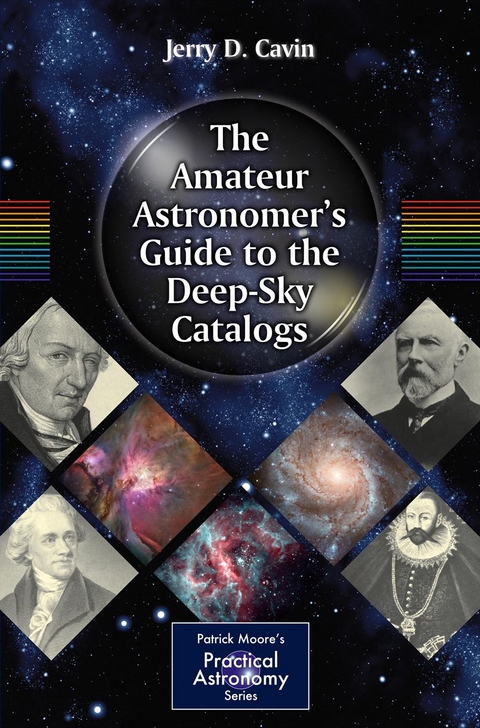
The Amateur Astronomer's Guide to the Deep-Sky Catalogs (eBook)
X, 380 Seiten
Springer New York (Verlag)
978-1-4614-0656-3 (ISBN)
Every amateur astronomer has at least heard of the many different catalogs of deep-sky objects; the most well known are the Messier, the Caldwell, the Herschel, and the NGC. All of these catalogs are, in general, readily available, but very few amateur observers are in a position to choose the best catalog for their particular deep-sky observing program, know how to use the catalog, or even realize just how many there are out there!
The Amateur Astronomer's Guide to the Deep-sky Catalogs is a single compilation of the historical and modern astronomical deep-sky catalogs. It discusses their origins, compares what's in them, explains how to interpret the data they contain, and even outlines how readers can create suitable 'custom' catalogs for their own use. The last section provides a set of three deep-sky catalogs created by the author, for observers of different levels of experience, from newcomer to expert.
Jerry Cavin first turned to amateur astronomy while growing up under the dark skies of Iowa. After leaving the farm, he completed a BS in Computer Science with a minor in Electrical Engineering at the University of Nebraska at Omaha. He worked for 10 years as the Lead Software Engineer at the Control Data Corporation specializing in real time control systems. After getting married he moved to Austin, Texas and spent over 15 years at the University of Texas at Austin working as a Research Scientist Associate on electronic warfare systems.
He is currently working as a Systems Engineer at Overwatch System and will be completing his second MSc degree in Astronomy at the Swinburne Astronomy Online, via the Centre for Astrophysics and Supercomputing in Melbourne, Australia.
Every amateur astronomer has at least heard of the many different catalogs of deep-sky objects; the most well known are the Messier, the Caldwell, the Herschel, and the NGC. All of these catalogs are, in general, readily available, but very few amateur observers are in a position to choose the best catalog for their particular deep-sky observing program, know how to use the catalog, or even realize just how many there are out there!The Amateur Astronomer's Guide to the Deep-sky Catalogs is a single compilation of the historical and modern astronomical deep-sky catalogs. It discusses their origins, compares what's in them, explains how to interpret the data they contain, and even outlines how readers can create suitable 'custom' catalogs for their own use. The last section provides a set of three deep-sky catalogs created by the author, for observers of different levels of experience, from newcomer to expert.
Jerry Cavin first turned to amateur astronomy while growing up under the dark skies of Iowa. After leaving the farm, he completed a BS in Computer Science with a minor in Electrical Engineering at the University of Nebraska at Omaha. He worked for 10 years as the Lead Software Engineer at the Control Data Corporation specializing in real time control systems. After getting married he moved to Austin, Texas and spent over 15 years at the University of Texas at Austin working as a Research Scientist Associate on electronic warfare systems.He is currently working as a Systems Engineer at Overwatch System and will be completing his second MSc degree in Astronomy at the Swinburne Astronomy Online, via the Centre for Astrophysics and Supercomputing in Melbourne, Australia.
Preface.- Chapter 1: Claudius Ptolemy and the Almagest.- Chapter 2: The Abd-al-Rahman Al-Sufi Catalog.- Chapter 3: Ulugh Beg.- Chapter 4: The Tycho Brahe Catalog.- Chapter 5: The Johannes Hevelius Catalog.- Chapter 6: The Charles Messier Catalog.- Chapter 7: The Johann Elert Bode Catalog.- Chapter 8: Christian Mayer Catalog.- Chapter 9: The Herschel Catalogs.- Chapter 10: The J.L.E. Dreyer and the NGC Catalog.- Chapter 11: Halton Arp and the Arp Catalog.- Chapter 12: The Caldwell Catalog.- References.- Appendix A.- Appendix B.- Index.
| Erscheint lt. Verlag | 27.10.2011 |
|---|---|
| Reihe/Serie | The Patrick Moore Practical Astronomy Series | The Patrick Moore Practical Astronomy Series |
| Zusatzinfo | X, 380 p. 11 illus., 3 illus. in color. |
| Verlagsort | New York |
| Sprache | englisch |
| Themenwelt | Sachbuch/Ratgeber ► Natur / Technik ► Weltraum / Astronomie |
| Naturwissenschaften ► Geowissenschaften ► Geografie / Kartografie | |
| Naturwissenschaften ► Physik / Astronomie ► Astronomie / Astrophysik | |
| Technik | |
| Schlagworte | Astronomical objects catalogs • Galaxies nebulae locations • Selecting sky catalogs • Selecting sky charts • Sky catalog features |
| ISBN-10 | 1-4614-0656-0 / 1461406560 |
| ISBN-13 | 978-1-4614-0656-3 / 9781461406563 |
| Informationen gemäß Produktsicherheitsverordnung (GPSR) | |
| Haben Sie eine Frage zum Produkt? |
 PDF (Wasserzeichen)
DRM: Digitales Wasserzeichen
Dieses eBook enthält ein digitales Wasserzeichen und ist damit für Sie personalisiert. Bei einer missbräuchlichen Weitergabe des eBooks an Dritte ist eine Rückverfolgung an die Quelle möglich.
Dateiformat: PDF (Portable Document Format)
Mit einem festen Seitenlayout eignet sich die PDF besonders für Fachbücher mit Spalten, Tabellen und Abbildungen. Eine PDF kann auf fast allen Geräten angezeigt werden, ist aber für kleine Displays (Smartphone, eReader) nur eingeschränkt geeignet.
Systemvoraussetzungen:
PC/Mac: Mit einem PC oder Mac können Sie dieses eBook lesen. Sie benötigen dafür einen PDF-Viewer - z.B. den Adobe Reader oder Adobe Digital Editions.
eReader: Dieses eBook kann mit (fast) allen eBook-Readern gelesen werden. Mit dem amazon-Kindle ist es aber nicht kompatibel.
Smartphone/Tablet: Egal ob Apple oder Android, dieses eBook können Sie lesen. Sie benötigen dafür einen PDF-Viewer - z.B. die kostenlose Adobe Digital Editions-App.
Buying eBooks from abroad
For tax law reasons we can sell eBooks just within Germany and Switzerland. Regrettably we cannot fulfill eBook-orders from other countries.
aus dem Bereich