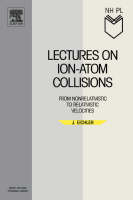
Lectures on Ion-Atom Collisions (eBook)
272 Seiten
Elsevier Science (Verlag)
978-0-08-046111-3 (ISBN)
speed of light. For the highest projectile velocities, energy can be converted into mass, so that electron-positron pairs are created. In addition to the systematic treatment, a theoretical section specializes on electron-electron
correlations and three chapters are devoted to selected highlights bordering to surface science and to physics with antiprotons.
* Simple access to the theory of collisions between ions and atoms
* Systematic treatment of basic features needed for an understanding
* Mathematical details are omitted and referred to references
* In order to bear out the essential ideas most clearly, a single active electron is assumed in most cases
* In selected examples, theoretical results are confronted with experiment
* Discussion supported by a large number of illustrations
* Selected highlights in borderline fields are presented
Atomic collisions offer some unique opportunities to study atomic structure and reaction mechanisms in experiment and theory, especially for projectiles of high atomic number provided by modern accelerators. The book is meant as an introduction into the field and provides some basic theoretical understanding of the atomic processes occurring when a projectile hits another atom. It also furnishes the tools for a mathematical description, however, without going deeper into the technical details, which can be found in the literature given. With this aim, the focus is on reactions, in which only a single active electron participates. Collisional excitation, ionization and charge transfer are discussed for collision velocities ranging from slow to comparable to thespeed of light. For the highest projectile velocities, energy can be converted into mass, so that electron-positron pairs are created. In addition to the systematic treatment, a theoretical section specializes on electron-electroncorrelations and three chapters are devoted to selected highlights bordering to surface science and to physics with antiprotons.* Simple access to the theory of collisions between ions and atoms* Systematic treatment of basic features needed for an understanding* Mathematical details are omitted and referred to references* In order to bear out the essential ideas most clearly, a single active electron is assumed in most cases* In selected examples, theoretical results are confronted with experiment* Discussion supported by a large number of illustrations* Selected highlights in borderline fields are presented
Cover 1
Contents 12
Contents 12
Nonrelativistic collisions 16
Introduction 18
Classification of collisions 20
Units 21
Quantum formulation 22
Classical description of the nuclear motion 23
Semiclassical description 25
Single-electron approximation 26
Classical-trajectory Monte Carlo calculations (CTMC) 27
Low-cncrgy collisions: Basis expansions 30
Coupled-channel description: General outline 31
Electron translation factors 34
Molecular orbital model: The Born- Oppenheimer expansion 36
Molecular orbitals: Correlation diagrams and couplings 37
Molecular orbital (MO) x-rays 42
Two levels: Landau-Zener approximation 44
Two levels: Stiickelberg oscillations 45
Molecular orbitals: Dynamical calculations 48
Two-center atomic expansions 50
Mathematical appendix: Single-center basis functions 53
High-energy collisions: Perturbation theory for direct reactions 60
The Born expansion 61
The Magnus expansion 62
The distorted-wave Born approximation (DWBA) 64
Excitation and ionization: Partial-wave expansion 66
Ionization: The CDW-EIS approximation 69
High-energy collisions: Charge transfer 74
The Oppenheimer-Brinkman-Kramers approximation 76
The Jackson-Schiff and the Strong-Potential Born approximations 78
Coulomb boundary conditions and gauge transformations 80
The boundary-corrected first Born (BIB) approximation 83
The continuum-distorted wave (CDW) approximation 85
The eikonal approximation 86
Coupled-channel calculations for transfer at high energies 88
The Thomas double-scattering mechanism 90
Relativistic collisions 94
Relativistic kinematics and fields of moving charges 96
The Lorentz transformation 96
Transformation between a moving frame and the laboratory frame 99
Transformation of differential cross sections 100
Relativistic motion of interacting point charges 102
Lienard-Wiechert potentials 103
The equivalent-photon method 106
Relativistic electron motion 110
The Dirac equation for a central potential 110
Bound states in a Coulomb potential 113
Coulomb-Dirac continuum wavefunctions 116
Relativistic ion-atom collisions: General theory 120
Dirac equation for moving Coulomb potentials 120
Perturbative transition amplitudes 122
Two-center coupled-channel methods 124
Asymptotic solutions 129
Basis states satisfying Coulomb boundary conditions 131
Numerical solutions on a lattice in position space 132
Numerical solutions on a lattice in momentum space 134
Direct reactions: Excitation and ionization 138
First-order perturbation theory 138
Long-range couplings in perturbation theory 144
Two-center coupled-channel methods 157
Calculations on a lattice 147
Relativistic electron transfer 148
The cross section in first order 149
The relativistic eikonal approximation 151
Two-center coupled-channel methods 157
Theoretical and experimental cross sections 157
Frame- and basis-set dependence 161
Radiative electron capture (REC) 166
The impulse approximation 168
Some basics: Born approximation for K-shell photoionization and REC 170
The Stobbe formula for K-shell photoionization and REC 173
Exact relativistic calculations 175
REC cross sections from exact calculations 176
Alignment and photon polarization in REC 184
Electron capture with pair production 189
Electron-positron pair production 192
Production of free electron-positron pairs 194
Bound-free pair production 199
Multiple pair production 205
Selected topics 210
Selected Topics I: Hyperspherical coordinates 212
Hyperspherical coordinates for two-electron systems 213
Adiabatic approximation 216
The hyperspherical close-coupling method and applications 217
Selected Topics II: Hollow atoms in micro-capillaries 220
Formation of hollow atoms 220
The classical over-barrier model 222
Passage through micro-capillaries in metals 225
Capillary guiding in polymer foils 227
Selected topics III: Resonant coherent excitation 230
Axes and planes in a crystal 231
The excitation process during the passage 232
Detection of the excitation 232
Impact-parameter dependence 234
Selected topics IV: Atomic physics with antiprotons 238
Collisions of antiprotons with hydrogen atoms 239
Antiprotonic helium 242
A Fundamental constants and units 248
Bibliography 250
Index 263
| Erscheint lt. Verlag | 23.9.2005 |
|---|---|
| Sprache | englisch |
| Themenwelt | Sachbuch/Ratgeber |
| Naturwissenschaften ► Physik / Astronomie ► Atom- / Kern- / Molekularphysik | |
| Technik | |
| ISBN-10 | 0-08-046111-5 / 0080461115 |
| ISBN-13 | 978-0-08-046111-3 / 9780080461113 |
| Informationen gemäß Produktsicherheitsverordnung (GPSR) | |
| Haben Sie eine Frage zum Produkt? |
 PDF (Adobe DRM)
Kopierschutz: Adobe-DRM
Adobe-DRM ist ein Kopierschutz, der das eBook vor Mißbrauch schützen soll. Dabei wird das eBook bereits beim Download auf Ihre persönliche Adobe-ID autorisiert. Lesen können Sie das eBook dann nur auf den Geräten, welche ebenfalls auf Ihre Adobe-ID registriert sind.
Details zum Adobe-DRM
Dateiformat: PDF (Portable Document Format)
Mit einem festen Seitenlayout eignet sich die PDF besonders für Fachbücher mit Spalten, Tabellen und Abbildungen. Eine PDF kann auf fast allen Geräten angezeigt werden, ist aber für kleine Displays (Smartphone, eReader) nur eingeschränkt geeignet.
Systemvoraussetzungen:
PC/Mac: Mit einem PC oder Mac können Sie dieses eBook lesen. Sie benötigen eine
eReader: Dieses eBook kann mit (fast) allen eBook-Readern gelesen werden. Mit dem amazon-Kindle ist es aber nicht kompatibel.
Smartphone/Tablet: Egal ob Apple oder Android, dieses eBook können Sie lesen. Sie benötigen eine
Geräteliste und zusätzliche Hinweise
Buying eBooks from abroad
For tax law reasons we can sell eBooks just within Germany and Switzerland. Regrettably we cannot fulfill eBook-orders from other countries.
aus dem Bereich