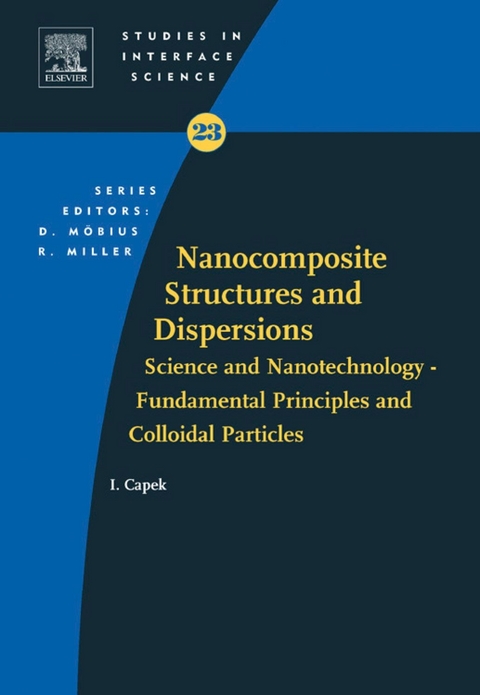
Nanocomposite Structures and Dispersions (eBook)
312 Seiten
Elsevier Science (Verlag)
9780080479590 (ISBN)
Dealing with nanoscience and nanotechnology from the viewpoint of a chemist, therefore the book describes in detail terms, definitions, theories, experiments, and techniques dealing with synthesis of polymer and metal particles.
Nanocomposite structures and dispersions is focused on both the organic (synthetic and natural) and inorganic materials, and their hybrids. The aim is to summarize the fundamentals and mechanistic approaches in preparation and characterization of colloidal nanoparticles and dispersions so as to provide the readers a systematic and coherent picture of the field. The book introduces the reader the interesting field of nanoscience based on polymer and metal colloidal nanoparticles. Placing a special emphasis on polymer, inorganic and metal nanomaterials classified as nanoparticles, nanocrystals, nanorods, nanotubes, nanobelts, etc.
* Serves as a general introduction for those just entering the field and experts seeking information in other sub-fields
* Variety of synthetic approaches is described including emulsion, miniemulsion and microemulsion approaches, hogeneous and heterogeneous nucleation approaches under mild and high temperatures.
* Focused on both the organic (synthetic and natural) and inorganic materials, and their hybrids.
Nanocomposite Structures and Dispersions summarizes the fundamentals and mechanistic approaches in preparation and characterization of colloidal nanoparticles and dispersions, providing the readers a systematic and coherent picture of the field. The book serves as an introduction to the interesting field of nanoscience based on polymer and metal colloidal nanoparticles, and also presents the basic knowledge of polymer colloids preparation. It places a special emphasis on polymer, inorganic and metal nanomaterials classified as nanoparticles, nanocrystals, nanorods, nanotubes, nanobelts, etc. deals with the chemistry of the reaction approaches by which polymer and metal particles are synthesized. The book explores both organic (synthetic and natural) and inorganic materials, as well as their hybrids. It describes in detail terms, definitions, theories, experiments, and techniques dealing with synthesis of polymer and metal particles. It also discusses a variety of synthetic approaches including emulsion, miniemulsion and microemulsion approaches, homogeneous and heterogeneous nucleation approaches under mild and high temperatures. There is also a chapter on modification and passivation of colloidal particles. This book would be of interest to chemical engineers, polymer chemists, organic chemists, colloid chemists, materials scientists and nanotechnologists. Although the text discusses nanoscience and nanotechnology from the viewpoint of a chemist, it would also appeal to those just entering the field and experts seeking information in other sub-fields. - Serves as a general introduction for those just entering the field and experts seeking information in other sub-fields- Variety of synthetic approaches is described including emulsion, miniemulsion and microemulsion approaches, hogeneous and heterogeneous nucleation approaches under mild and high temperatures- Focused on both the organic (synthetic and natural) and inorganic materials, and their hybrids
Cover 1
Title Page 4
Copyright Page 5
Table of Contents 6
Preface 8
Chapter 1 Nanotechnology and nanomaterials 12
Content 12
1.1 Introduction 12
1.2 Nanoscience and nanotechnology 18
1.3 Nanoparticles – basic component of nanotechnology 29
1.4 Nanodevices, nanoelectronics 35
1.5 Industrial aspects of nanotechnology 50
1.6 Investigative tools 59
1.7 Nano-architectures 64
References 70
Chapter 2 Preparation of polymer-based nanomaterials 82
Content 82
2.1 Introduction 82
2.2 Solution/bulk polymerization 85
2.3 Emulsion polymerization 89
2.4 Microemulsion polymerization 99
2.4.1 Micelles and microemulsion 99
2.4.2 Microemulsion polymerization 105
2.5 Miniemulsion polymerization 109
2.6 Dispersion polymerization 115
2.7 Self-assemblies 127
References 138
Chapter 3 Preparation of colloidal metal particles 148
Content 148
3.1 Introduction 148
3.2 Bottom-up approach 151
3.2.1 Precipitation 151
3.2.2 Microemulsion 158
3.2.2.1 Inverse microemulsion 158
3.2.2.2 Inverse copolymer micelles 172
3.2.3 Other approaches 177
3.2.4 Bimetalic particles 189
3.2.5 Reducing agents and processes 200
3.2.6 Recipes for magnetic colloidal particles 207
References 222
Chapter 4 Modification and passivation of colloidal particles 236
Content 236
4.1 Introduction 236
4.2 Solvents and ligands 239
4.3 Ligand exchange 253
4.4 Particle growth techniques 262
4.5 Digestive ripening process 269
4.6 Deposition 274
4.7 Recipes for nanocomposite particles 279
References 294
Index 304
| Erscheint lt. Verlag | 19.9.2006 |
|---|---|
| Sprache | englisch |
| Themenwelt | Sachbuch/Ratgeber |
| Naturwissenschaften ► Chemie ► Physikalische Chemie | |
| Naturwissenschaften ► Chemie ► Technische Chemie | |
| Technik ► Maschinenbau | |
| Wirtschaft | |
| ISBN-13 | 9780080479590 / 9780080479590 |
| Informationen gemäß Produktsicherheitsverordnung (GPSR) | |
| Haben Sie eine Frage zum Produkt? |
 PDF (Adobe DRM)
Kopierschutz: Adobe-DRM
Adobe-DRM ist ein Kopierschutz, der das eBook vor Mißbrauch schützen soll. Dabei wird das eBook bereits beim Download auf Ihre persönliche Adobe-ID autorisiert. Lesen können Sie das eBook dann nur auf den Geräten, welche ebenfalls auf Ihre Adobe-ID registriert sind.
Details zum Adobe-DRM
Dateiformat: PDF (Portable Document Format)
Mit einem festen Seitenlayout eignet sich die PDF besonders für Fachbücher mit Spalten, Tabellen und Abbildungen. Eine PDF kann auf fast allen Geräten angezeigt werden, ist aber für kleine Displays (Smartphone, eReader) nur eingeschränkt geeignet.
Systemvoraussetzungen:
PC/Mac: Mit einem PC oder Mac können Sie dieses eBook lesen. Sie benötigen eine
eReader: Dieses eBook kann mit (fast) allen eBook-Readern gelesen werden. Mit dem amazon-Kindle ist es aber nicht kompatibel.
Smartphone/Tablet: Egal ob Apple oder Android, dieses eBook können Sie lesen. Sie benötigen eine
Geräteliste und zusätzliche Hinweise
Buying eBooks from abroad
For tax law reasons we can sell eBooks just within Germany and Switzerland. Regrettably we cannot fulfill eBook-orders from other countries.
aus dem Bereich