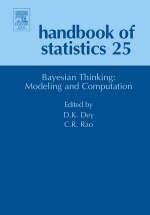
Bayesian Thinking, Modeling and Computation (eBook)
1062 Seiten
Elsevier Science (Verlag)
978-0-08-046117-5 (ISBN)
Key Features:
-Critical thinking on causal effects
-Objective Bayesian philosophy
-Nonparametric Bayesian methodology
-Simulation based computing techniques
-Bioinformatics and Biostatistics
Key Features:
?Critical thinking on causal effects
?Objective Bayesian philosophy
?Nonparametric Bayesian methodology
?Simulation based computing techniques
?Bioinformatics and Biostatistics"
This volume describes how to develop Bayesian thinking, modelling and computation both from philosophical, methodological and application point of view. It further describes parametric and nonparametric Bayesian methods for modelling and how to use modern computational methods to summarize inferences using simulation. The book covers wide range of topics including objective and subjective Bayesian inferences with a variety of applications in modelling categorical, survival, spatial, spatiotemporal, Epidemiological, software reliability, small area and micro array data. The book concludes with a chapter on how to teach Bayesian thoughts to nonstatisticians. - Critical thinking on causal effects- Objective Bayesian philosophy- Nonparametric Bayesian methodology- Simulation based computing techniques- Bioinformatics and Biostatistics
Preface 6
Table of contents 8
Contributors 18
Bayesian Inference for Causal Effects 22
Causal inference primitives 22
Units, treatments, potential outcomes 22
Replication and the Stable Unit Treatment Value Assumption - SUTVA 23
Covariates 24
Assignment mechanisms - unconfounded and strongly ignorable 24
Confounded and ignorable assignment mechanisms 25
A brief history of the potential outcomes framework 26
Before 1923 26
Neyman's (1923) notation for causal effects in randomized experiments and Fisher's (1925) proposal to actually randomize treatments to units 27
The observed outcome notation 27
The Rubin causal model 28
Models for the underlying data - Bayesian inference 28
The posterior distribution of causal effects 29
The posterior predictive distribution of Ymis under ignorable treatment assignment 29
Simple normal example - analytic solution 30
Simple normal example - simulation approach 31
Simple normal example with covariate - numerical example 31
Nonignorable treatment assignment 32
Complications 33
Multiple treatments 33
Unintended missing data 34
Noncompliance with assigned treatment 34
Truncation of outcomes due to death 34
Direct and indirect causal effects 34
Principal stratification 34
Combinations of complications 35
References 35
Reference Analysis 38
Introduction and notation 38
Intrinsic discrepancy and expected information 43
Reference distributions 50
One parameter models 50
Main properties 55
Approximate location parametrization 57
Numerical reference priors 59
Reference priors under regularity conditions 60
Reference priors and the likelihood principle 62
Restricted reference priors 64
One nuisance parameter 65
Many parameters 74
Discrete parameters taking an infinity of values 77
Behaviour under repeated sampling 78
Prediction and hierarchical models 80
Reference inference summaries 82
Point estimation 82
Region (interval) estimation 85
Hypothesis testing 88
Related work 92
Acknowledgements 94
References 94
Further reading 103
Probability Matching Priors 112
Introduction 112
Rationale 114
Exact probability matching priors 115
Parametric matching priors in the one-parameter case 116
One-sided parametric intervals 116
Two-sided parametric intervals 117
Nonregular cases 118
Parametric matching priors in the multiparameter case 118
Matching for an interest parameter 119
Probability matching priors in group models 121
Probability matching priors and reference priors 122
Simultaneous and joint matching priors 123
Matching priors via Bartlett corrections 125
Matching priors for highest posterior density regions 126
Nonregular cases 127
Predictive matching priors 128
One-sided predictive intervals 128
Highest predictive density regions 129
Probability matching priors for random effects 130
Invariance of matching priors 131
Concluding remarks 131
Acknowledgements 132
References 132
Model Selection and Hypothesis Testing based on Objective Probabilities and Bayes Factors 136
Introduction 136
Basics of Bayes factors and posterior model probabilities 137
How to choose a model if you must? 138
Motivation for the Bayesian approach to model selection 138
Utility functions and prediction 139
Motivation for objective Bayesian model selection 139
Difficulties in objective Bayesian model selection 140
Objective Bayesian model selection methods 142
Well calibrated priors approach 144
Conventional prior approach 145
Intrinsic Bayes factor (IBF) approach 149
The intrinsic prior approach 152
The expected posterior prior (EP) approach and the empirical EP approach 156
Expected posterior prior approach. 156
Propagation of proper prior information. 156
Improper EP-priors are ratio normalized. 156
Relationship between arithmetic intrinsic priors and EP-priors. 157
The empirical EP-prior approach. 157
The fractional Bayes factor (FBF) approach 158
Fractional Bayes factor as an average of training samples for exchangeable observations. 159
Asymptotic approximation of the fractional Bayes factor. 160
Intrinsic priors of the fractional Bayes factor approach. 160
Asymptotic methods and BIC 161
Lower bounds on Bayes factors 162
More general training samples 164
Randomized and weighted training samples 164
Example of randomized training sample. 164
Prior probabilities 166
Conclusions 166
Acknowledgements 167
References 167
Role of P-values and other Measures of Evidence in Bayesian Analysis 172
Introduction 172
Conflict between P-values and lower bounds to Bayes factors and posterior probabilities: Case of a sharp null 174
Calibration of P-values 179
Jeffreys-Lindley paradox 180
Role of the choice of an asymptotic framework 180
General observations 180
Comparison of decisions via P-values and Bayes factors in Bahadur's asymptotics 182
Comparison of P-value with likelihood ratio and Bayes factor in Bahadur's asymptotics 182
Pitman alternative and rescaled priors 184
One-sided null hypothesis 184
Bayesian P-values 186
Concluding remarks 189
References 190
Bayesian Model Checking and Model Diagnostics 192
Introduction 192
Model checking overview 193
Checking that the posterior inferences are reasonable 193
Sensitivity to choice of prior distribution and likelihood 193
Checking that the model can explain the data adequately 194
Approaches for checking if the model is consistent with the data 194
Bayesian residual analysis 194
Cross-validatory predictive checks 195
Prior predictive checks 195
Posterior predictive checks 196
Partial posterior predictive checks 196
Repeated data generation and analysis 196
Posterior predictive model checking techniques 197
Description of posterior predictive model checking 197
Properties of posterior predictive p-values 198
Effect of prior distributions 199
Definition of replications 199
Discrepancy measures 200
Discussion 201
Application 1 201
Application 2 203
Direct data display 206
Item fit 207
Studying the association among the items 209
Discussion 211
Conclusions 211
References 212
The Elimination of Nuisance Parameters 214
Introduction 214
Synopsis 214
Preliminaries 215
Bayesian elimination of nuisance parameters 217
Objective Bayes analysis 220
Integrated likelihood 221
Reference prior approach 223
Comparison with other approaches 225
The Neyman and Scott class of problems 228
Semiparametric problems 234
Related issues 236
Prediction and model averaging 236
Significance tests 237
Acknowledgements 238
References 238
Bayesian Estimation of Multivariate Location Parameters 242
Introduction 242
Bayes, admissible and minimax estimation 243
Stein estimation and the James-Stein estimator 246
Bayes estimation and the James-Stein estimator for the mean of the multivariate normal distribution with identity covariance matrix 251
Generalizations for Bayes and the James-Stein estimation or the mean for the multivariate normal distribution with known covariance matrix Sigma 256
Conclusion and extensions 263
The unknown covariance case. 263
The nonnormal case. 264
Nonquadratic loss. 264
Admissibility. 264
References 264
Bayesian Nonparametric Modeling and Data Analysis: An Introduction 266
Introduction to Bayesian nonparametrics 266
Probability measures on spaces of probability measures 268
The Dirichlet process 269
Mixtures of Dirichlet processes 270
Dirichlet process mixture models 271
Fitting DPM models 273
Extensions 275
General inferences 276
Polya tree and mixtures of Polya tree models 276
The gamma process model 278
Illustrations 279
Two sample problem 279
Regression examples 282
Regression for survival data 283
Nonparametric regression with known error distribution 287
Nonparametric regression with unknown error distribution 293
Concluding remarks 294
References 295
Some Bayesian Nonparametric Models 300
Introduction 300
Parametric Bayes 301
Nonparametric Bayes 301
Random distribution functions 302
The Dirichlet process 303
Mixtures of Dirichlet processes 305
Random variate generation for NTR processes 308
Neutral to the right processes 308
Specifying prior distributions 309
The posterior distributions 310
Simulating the posterior process 311
Simulating the jump component 311
Simulating the continuous component 312
Simulating an id distribution. 312
A: simulating from Gepsilon(·). 313
B: Calculating lambdaepsilon 313
Sub-classes of random distribution functions 314
The Beta process 314
Some insights into the Beta process 319
Hazard rate processes 320
Extended-gamma process 320
The likelihood function 322
The posterior distribution 323
Right censored data 323
Left censored data 323
The computational model 323
Polya trees 324
Prior specifications and computational issues 325
Specifying the Polya tree 325
Posterior distributions 326
Beyond NTR processes and Polya trees 328
Consistency issues. 329
Wavelets, splines, density estimation, etc. 329
References 329
Bayesian Modeling in the Wavelet Domain 336
Introduction 336
Discrete wavelet transforms and wavelet shrinkage 337
Bayes and wavelets 338
An illustrative example 339
Regression problems 341
Bayesian thresholding rules 344
Bayesian wavelet methods in functional data analysis 345
The density estimation problem 348
An application in geoscience 352
Other problems 354
Acknowledgements 356
References 356
Bayesian Nonparametric Inference 360
Introduction 360
Notation 361
History 362
Outline 362
The Dirichlet process 363
Posterior distribution 365
The MDP model 367
Neutral to the right processes 369
Posterior distribution 371
Alternative representation 372
Simulation 373
Other priors 374
Log-Gaussian prior 374
Infinite-dimensional exponential family 375
Pólya trees 375
Lévy driven processes 377
Consistency 380
Illustration 384
Nonparametric regression 385
Case 1 385
Case 2 386
Reinforcement and exchangeability 386
Discussion 388
Acknowledgement 388
References 389
Bayesian Methods for Function Estimation 394
Introduction 394
Priors on infinite-dimensional spaces 395
Dirichlet process 396
Processes derived from the Dirichlet process 398
Mixtures of Dirichlet processes 398
Dirichlet mixtures 399
Invariant Dirichlet process 399
Pinned-down Dirichlet 399
Generalizations of the Dirichlet process 400
Tail-free and neutral to the right process 400
Polya tree process 401
Generalized Dirichlet process 402
Priors obtained from random series representation 402
Gaussian process 403
Independent increment process 403
Some other processes 404
Consistency and rates of convergence 405
Estimation of cumulative probability distribution 415
Dirichlet process prior 415
Tail-free and Polya tree priors 416
Right censored data 416
Density estimation 417
Dirichlet mixture 417
Mixture of normal kernels 418
Uniform scale mixtures 420
Mixtures on the half line 420
Bernstein polynomials 421
Random histograms 421
Gaussian process prior 422
Polya tree prior 422
Regression function estimation 423
Normal regression 423
Binary regression 424
Spectral density estimation 425
Bernstein polynomial prior 426
Gaussian process prior 427
Estimation of transition density 427
Concluding remarks 429
References 430
MCMC Methods to Estimate Bayesian Parametric Models 436
Motivation 436
Bayesian ingredients 437
Bayesian recipe 437
How can the Bayesian pie burn 438
MCMC methods 439
Monte Carlo integration and Markov chains 439
The Metropolis-Hastings algorithm 442
The Gibbs sampler 444
Auxiliary variables in MCMC 445
Convergence diagnostics 447
Estimating the variance of MCMC estimators 447
Reversible jump MCMC 448
Langevin algorithms 449
Adaptive MCMC and particle filters 449
Importance sampling and population Monte Carlo 451
The perfect Bayesian pie: How to avoid ``burn-in'' issues 452
Conclusions 453
References 454
Bayesian Computation: From Posterior Densities to Bayes Factors, Marginal Likelihoods, and Posterior Model Probabilities 458
Introduction 458
Posterior density estimation 459
Marginal posterior densities 459
Kernel methods 460
Conditional marginal density estimation 460
Importance weighted marginal density estimation 461
The Gibbs stopper approach 463
Estimating posterior densities from the Metropolis-Hastings output 464
Marginal posterior densities for generalized linear models 468
Savage-Dickey density ratio 470
Computing marginal likelihoods 471
Computing posterior model probabilities via informative priors 472
Simulation study. 474
Concluding remarks 477
References 477
Bayesian Modelling and Inference on Mixtures of Distributions 480
Introduction 480
The finite mixture framework 481
Definition 481
Missing data approach 483
Nonparametric approach 484
Reading 486
The mixture conundrum 487
Combinatorics 488
The EM algorithm 492
An inverse ill-posed problem 493
Identifiability 494
Choice of priors 496
Loss functions 498
Inference for mixtures models with known number of components 501
Reordering 501
Data augmentation and Gibbs sampling approximations 502
Metropolis-Hastings approximations 509
Population Monte Carlo approximations 513
Perfect sampling 517
Inference for mixture models with unknown number of components 517
Reversible jump algorithms 518
Birth-and-death processes 522
Extensions to the mixture framework 522
Acknowledgements 524
References 524
Simulation Based Optimal Design 530
Introduction 530
Monte Carlo evaluation of expected utility 532
Augmented probability simulation 532
Sequential design 534
Multiple comparisons 535
Calibrating decision rules by frequentist operating characteristics 536
Discussion 537
References 538
Variable Selection and Covariance Selection in Multivariate Regression Models 540
Introduction 540
Model description 542
Introduction 542
Prior for the regression coefficients 543
Prior for the vector of binary indicator variables 544
Prior for Omegaii 545
Prior for the partial correlation matrix C 545
Missing values 546
Permanently selected variables 546
Selecting variables in groups 546
Noninformative prior on Sigma 547
Sampling scheme 547
Real data 548
Cow milk protein data 548
Hip replacement data 550
Cow diet data 554
Pig bodyweight data 555
Simulation study 562
Cow milk protein data 568
Hip replacement data 569
Cow diet data 569
Pig bodyweight data 570
Summary 571
References 572
Dynamic Models 574
Model structure, inference and practical aspects 574
Dynamic linear models: General notation 574
Inference in DLM 576
The forecasting function and DLM design 577
Evolution and updating equations 577
Practical aspects of Bayesian forecasting 578
Variance law 578
Discount factor 579
Missing observation 579
Retrospective analysis 579
Monitoring and interventions 579
Multiprocess models 580
Dynamic nonlinear/nonnormal models 581
Dynamic generalized linear models 583
A practical example 583
Dynamic hierarchical models 584
Markov Chain Monte Carlo 585
Normal DLM 586
Componentwise sampling schemes 586
Block sampling schemes 587
Nonnormal models 591
Mixture of normals 591
Exponential-family models 591
Sequential Monte Carlo 594
SIR- and SIS-based filters 595
Auxiliary particle filter 596
Parameter estimation and sequential Monte Carlo 597
Computing predictive densities 599
Recent developments 600
Extensions 601
Dynamic spatio-temporal models 601
Multi-scale modeling 603
Connections between Gaussian Markov random fields and DLMs 604
Acknowledgements 605
References 605
Bayesian Thinking in Spatial Statistics 610
Why spatial statistics? 610
Features of spatial data and building blocks for inference 611
Small area estimation and parameter estimation in regional data 613
Geostatistical prediction 620
Covariance functions and variograms 620
Kriging: Classical spatial prediction 623
Bayesian kriging 626
Bayesian thinking in spatial point processes 629
Some spatial point processes of interest 629
Homogeneous Poisson processes 629
Heterogeneous Poisson processes 631
Cox processes 631
log Gaussian Cox processes 632
Inferential issues 632
Recent developments and future directions 638
References 639
Robust Bayesian Analysis 644
Introduction 644
Basic concepts 646
Different approaches 646
Prior robustness 647
Classes of priors 648
Priors with given functional forms. 648
Priors with specified generalised moments. 649
Neighbourhood classes. 649
epsilon-contamination class. 649
Topological neighbourhoods. 650
Other classes. 651
Global robustness 652
Local robustness 654
Model robustness 655
Classes of models 655
Finite classes. 655
Parametric classes. 655
Neighbourhood classes. 656
Nonparametric classes. 656
Model robustness approaches 656
Loss robustness 657
Classes of losses 657
epsilon-contamination class. 657
Partially known class. 657
Parametric class. 658
Mixtures of convex loss functions. 658
Bands of convex loss functions. 658
Loss robustness studies 658
Joint robustness 659
A unified approach 660
Foundations 660
The nondominated set 662
Existence of efficient sets 662
Bayes and nondominated alternatives 662
Extracting additional information 664
LxGamma-minimax alternatives 666
Stability theory 666
Robust Bayesian computations 668
General computational issues 668
Algorithms to compute ranges 669
Lavine's algorithm 669
Betrò and Guglielmi's algorithm 670
Computations for loss robustness 671
epsilon-contaminated class. 671
Parametric class. 671
Partially known class. 672
Computing nondominated alternatives 672
Convex loss functions. 673
MCMC and robustness 675
Robust Bayesian analysis and other statistical approaches 678
Robust priors 678
Robust models 678
Robust estimators 678
Frequentist robustness 679
Imprecise probability 679
Hierarchical approaches 679
Reference and objective Bayes approaches 680
Asymptotics and robustness 680
Bayesian Gamma-minimax 681
Conclusions 682
Acknowledgements 684
References 684
Elliptical Measurement Error Models - A Bayesian Approach 690
Introduction 690
Elliptical measurement error models 692
Elliptical distributions 692
Measurement error models 693
Diffuse prior distribution for the incidental parameters 694
Dependent elliptical MEM 696
Equal variances case 699
Independent elliptical MEM 701
Representable elliptical MEM 702
A WNDE Student-t model 703
A NDE Student-t model 705
Application 707
Acknowledgements 708
References 708
Bayesian Sensitivity Analysis in Skew-elliptical Models 710
Introduction 710
Definitions and properties of skew-elliptical distributions 713
The skew elliptical distribution 713
Univariate case 717
The L1-distance for posterior distribution of ( µ,sigma) under skew-normal model 719
Testing of asymmetry in linear regression model 720
Bayes factor 720
Bayes factor for representable skew elliptical linear model 725
Simulation results 726
Conclusions 727
Acknowledgements 728
Proof of Proposition 3.7 728
References 731
Bayesian Methods for DNA Microarray Data Analysis 734
Introduction 734
Review of microarray technology 735
Biological principles 735
Experimental procedure 736
Image analysis, data extraction and normalization 736
Statistical analysis of microarray data 737
Bayesian models for gene selection 738
Gene selection for binary classification 739
Gene selection for multicategory classification 742
Gene selection for survival methods 747
Weibull regression model 748
Proportional hazards model 749
Differential gene expression analysis 751
Censored models 753
Nonparametric empirical Bayes approaches 754
Nonparametric Bayesian approaches 755
Bayesian clustering methods 756
Finite mixture models 756
Infinite mixture models 757
Functional models 758
Regression for grossly overparametrized models 759
Concluding remarks 760
Acknowledgements 760
References 760
Bayesian Biostatistics 764
Introduction 764
Correlated and longitudinal data 766
Generalized linear mixed models 766
Covariance structure modeling 767
Flexible parametric and semiparametric methods 768
Time to event data 769
Continuous right-censored time to event data 769
Complications 770
Multiple event time data 772
Nonlinear modeling 773
Splines and wavelets 774
Constrained regression 774
Model averaging 776
Bioinformatics 777
Discussion 778
References 779
Innovative Bayesian Methods for Biostatistics and Epidemiology 784
Introduction 784
Meta-analysis and multicentre studies 786
Spatial analysis for environmental epidemiology 789
Adjusting for mismeasured variables 790
Adjusting for missing data 794
Sensitivity analysis for unobserved confounding 796
Ecological inference 798
Bayesian model averaging 800
Survival analysis 803
Case-control analysis 805
Bayesian applications in health economics 807
Discussion 808
References 810
Bayesian Analysis of Case-Control Studies 814
Introduction: The frequentist development 814
Early Bayesian work on a single binary exposure 817
Models with continuous and categorical exposure 819
Analysis of matched case-control studies 824
A continuous exposure: The equine epidemiology example 828
A binary exposure: Endometrial cancer study 829
Another binary exposure: Low birthweight study 830
Example of a matched case-control study with multiple disease states 832
Some equivalence results in case-control studies 834
Equivalence of retrospective and prospective analysis 834
Equivalence between conditional and marginal likelihood for analyzing matched case-control data 836
Conclusion 836
References 837
Bayesian Analysis of ROC Data 842
Introduction 842
A Bayesian hierarchical model 847
Connection to the bivariate-binormal model 851
MCMC details 852
An example 853
References 854
Modeling and Analysis for Categorical Response Data 856
Introduction 856
Elements of Markov chain Monte Carlo 856
Computation of the marginal likelihood 858
Binary responses 861
Marginal likelihood of the binary probit 864
Other link functions 865
Marginal likelihood of the student-t binary model 866
Ordinal response data 867
Marginal likelihood of the student-t ordinal model 868
Sequential ordinal model 869
Multivariate responses 871
Multivariate probit model 872
Dependence structures 873
Student-t specification 874
Estimation of the MVP model 874
Marginal likelihood of the MVP model 877
Fitting of the multivariate t-link model 878
Binary outcome with a confounded binary treatment 878
Longitudinal binary responses 879
Marginal likelihood of the panel binary models 883
Longitudinal multivariate responses 883
Conclusion 886
References 886
Bayesian Methods and Simulation-Based Computation for Contingency Tables 890
Motivation for Bayesian methods 890
Advances in simulation-based Bayesian calculation 890
Early Bayesian analyses of categorical data 891
Bayesian smoothing of contingency tables 893
Bayesian interaction analysis 897
Bayesian tests of equiprobability and independence 900
Bayes factors for GLM's with application to log-linear models 902
Use of BIC in sociological applications 905
Bayesian model search for loglinear models 906
The future 909
References 909
Multiple Events Time Data: A Bayesian Recourse 912
Introduction 912
Practical examples 913
Semiparametric models based on intensity functions 915
Frequentist methods for analyzing multiple event data 918
Prior processes in semiparametric model 920
Gamma processes 920
Correlated prior processes 921
Bayesian solution 922
Analysis of the data-example 923
Discussions and future research 925
References 926
Bayesian Survival Analysis for Discrete Data with Left-Truncation and Interval Censoring 928
Introduction 928
Likelihood functions 931
Models and latent variables 931
Reparameterization 933
Bayesian analysis 934
Informative priors 934
Priors for (delta,q). 934
Priors for (alpha,xi). 934
Priors for N. 935
Noninformative priors 935
Propriety of posterior under the noninformative priors 936
Posterior distributions and Bayesian computation 940
Applications 942
Bobwhite example 942
Simulation studies 943
Comments 948
Acknowledgements 948
References 948
Software Reliability 950
Introduction 950
Dynamic models 951
Time domain models 951
Models depending on the initial number of bugs 952
Other concatenated failure rate models 954
Record value statistics models 954
Time series models 954
Counting process models 954
Model unification 955
Bayesian inference 956
The Jelinski and Moranda model 956
Simple Bayesian approach 957
Hierarchical Bayesian approach 958
Bayesian inference and prediction for the JM model 959
The Littlewood and Verall model 960
Gibbs sampler for the LV model 960
Bayesian inference and prediction for the LV models 962
NHPP models 963
General order statistics and NHPP-I 963
Record value statistics and NHPP-II 965
Gibbs sampling for the general order statistics model 966
The exponential order statistics model. 967
The Pareto order statistics model. 967
The Weibull order statistics model. 968
The extreme value order statistics model. 968
Gibbs sampling for record value statistics models 968
The exponential process. 968
The Pareto process. 969
The Weibull process. 969
The extreme value process. 969
Bayesian inference for NHPP 970
Superposed NHPP processes 971
Gibbs sampling for the full model 972
Superposition of Musa-Okumoto and Weibull processes. 973
Polynomial intensity function. 974
Bayesian inference for the superposed models 974
Gibbs sampling for nested models 975
Bayesian inference for the nested model. 976
Model selection 977
Optimal release policy 979
Remarks 980
References 980
Bayesian Aspects of Small Areasmall area Estimation 986
Introduction 986
Some areas of application 986
Socio-economic application. 987
Health application. 987
Small area models 987
Basic area level model 988
Basic unit level model 988
Generalized linear mixed models 989
Inference from small area models 989
Empirical Bayes small area estimation 990
An example 994
Hierarchical Bayes small area estimation 994
Model MII 1000
An illustration with lip cancer data 1001
Conclusion 1001
Acknowledgements 1002
References 1002
Teaching Bayesian Thought to Nonstatisticians 1004
Introduction 1004
A brief literature review 1005
Commonalities across groups in teaching Bayesian methods 1005
Motivation and conceptual explanations: One solution 1007
Conceptual mapping 1009
Active learning and repetition 1009
Assessment 1011
Conclusions 1012
References 1012
Colour figures 1014
Subject Index 1026
Contents of Previous Volumes 1038
| Erscheint lt. Verlag | 29.11.2005 |
|---|---|
| Sprache | englisch |
| Themenwelt | Sachbuch/Ratgeber |
| Mathematik / Informatik ► Mathematik ► Statistik | |
| Technik | |
| ISBN-10 | 0-08-046117-4 / 0080461174 |
| ISBN-13 | 978-0-08-046117-5 / 9780080461175 |
| Informationen gemäß Produktsicherheitsverordnung (GPSR) | |
| Haben Sie eine Frage zum Produkt? |
 PDF (Adobe DRM)
Kopierschutz: Adobe-DRM
Adobe-DRM ist ein Kopierschutz, der das eBook vor Mißbrauch schützen soll. Dabei wird das eBook bereits beim Download auf Ihre persönliche Adobe-ID autorisiert. Lesen können Sie das eBook dann nur auf den Geräten, welche ebenfalls auf Ihre Adobe-ID registriert sind.
Details zum Adobe-DRM
Dateiformat: PDF (Portable Document Format)
Mit einem festen Seitenlayout eignet sich die PDF besonders für Fachbücher mit Spalten, Tabellen und Abbildungen. Eine PDF kann auf fast allen Geräten angezeigt werden, ist aber für kleine Displays (Smartphone, eReader) nur eingeschränkt geeignet.
Systemvoraussetzungen:
PC/Mac: Mit einem PC oder Mac können Sie dieses eBook lesen. Sie benötigen eine
eReader: Dieses eBook kann mit (fast) allen eBook-Readern gelesen werden. Mit dem amazon-Kindle ist es aber nicht kompatibel.
Smartphone/Tablet: Egal ob Apple oder Android, dieses eBook können Sie lesen. Sie benötigen eine
Geräteliste und zusätzliche Hinweise
Buying eBooks from abroad
For tax law reasons we can sell eBooks just within Germany and Switzerland. Regrettably we cannot fulfill eBook-orders from other countries.
aus dem Bereich