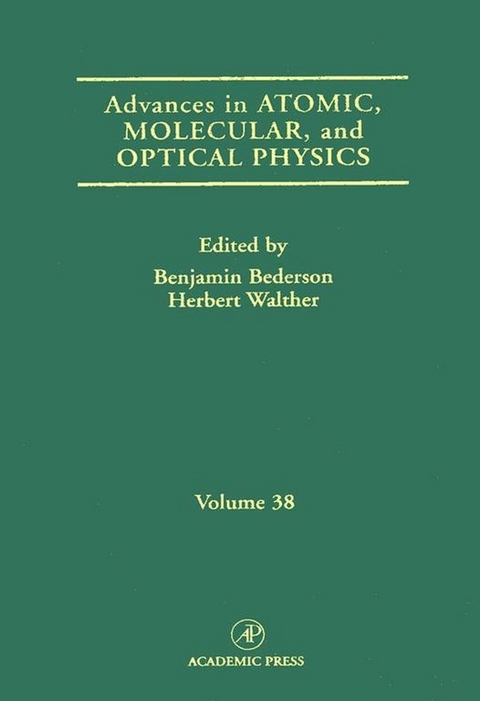
Advances in Atomic, Molecular, and Optical Physics (eBook)
256 Seiten
Elsevier Science (Verlag)
978-0-08-056149-3 (ISBN)
This volume maintains the authoritative standards of the series...The editors and publishers are to be congratulated.
--M.S. Child in Physics Bulletin
Maintains the high standards of earlier volumes in the series...All the articles are written by experts in the field, and their summaries are most timely...Strongly recommended.
--G. Herzberg in American Scientist
Praise for the Series"e;This volume maintains the authoritative standards of the series...The editors and publishers are to be congratulated."e;--M.S. Child in Physics Bulletin"e;Maintains the high standards of earlier volumes in the series...All the articles are written by experts in the field, and their summaries are most timely...Strongly recommended."e;--G. Herzberg in American Scientist
Front Cover 1
Advance in Atomic, Molecular, and Optical Physics, Volume 38 4
Copyright Page 5
Contents 6
Contributors 8
Chapter 1. Electronic Wavepackets 12
I. Introduction 12
II. Rydberg Wavepackets 16
III. Conclusions 46
IV. Acknowledgments 46
V. References 47
Chapter 2. Chiral Effects in Electron Scattering by Molecules 50
I. Introduction 51
II. Chiral Objects and Their Symmetries: True and False Chirality 55
III. Definitions and Fundamental Symmetries of Spin-Dependent Amplitudes 60
IV. Experimental Observables: Oriented Molecules 64
V. Experimental Observables: Randomly Oriented Target Systems 69
VI. Experimental Observables: Attenuation Experiments 73
VII. The Physical Cause of Chiral Effects 77
VIII. Theoretical and Computational Details 82
IX. Results of Numerical Calculations 86
X. Experimental Results 92
XI. Conclusions and Outlook 95
XII. Acknowledgments 95
XIII. References 96
Chapter 3. Optical and Magneto-Optical Spectroscopy of Point Defects in Condensed Helium 98
I. Introduction 99
II. Structure of the Point Defects 101
III. Implantation Techniques 106
IV. Optical Spectroscopy 108
V. Magnetic Resonance Spectroscopy 122
VI. Concluding Remark 128
VII. References 128
Chapter 4. Rydberg Ionization: From Field to Photon 132
I. Introduction 132
II. Dc Field Ionization 137
III. Ramped Field Ionization 142
IV. Microwave Ionization 146
V. THz Ionization 152
VI. Far Infrared Ionization 154
VII. Optical Radiation 157
VIII. Open Questions 161
IX. Acknowledgment 162
X. References 162
Chapter 5. Studies of Negative Ions in Storage Rings 166
I. Introduction 166
II. Lifetime Studies of Negative Ions 169
III. Electron-Impact Detachment From Negative Ions 183
IV. Interactions Between Photons and Negative Ions 196
V. Acknowledgments 199
VI. References 199
Chapter 6. Single-Molecule Spectroscopy and Quantum Optics in Solids 204
I. Introduction 204
II. Physical Principles and Optimal Conditions 207
III. Methods 217
IV. Quantum Optics 232
V. Problems and Promise for Room Temperature 239
VI. References 243
Subject Index 248
Contents of Volumes in This Series 258
Electronic Wavepackets
R.R. Jones rrj3c@virginia.edu Physics Department, University of Virginia. McCormick Road, Charlottesville, Tel: (804) 924-3088, Virginia 22901, USA
L.D. Noordam noordam@amolf.amolf.nl FOM Institute for Atomic and Molecular Physics, Kruislaan 407 1098 SJ Amsterdam, the Netherlands, Tel: 020-6081234, (December 14, 1996)
I Introduction
Recently, there has been a great deal of experimental and theoretical interest in wavepacket studies in atomic, molecular, and condensed matter physics as well as in physical chemistry. Using the most general definition, a “wavepacket” in any quantum system is a “non-stationary" state with time-dependent expectation values for one or more operators. The wavepacket can be described mathematically as a coherent superposition of non-degenerative, stationary-state wavefuntions, r→t=Σqaqϕqr→e−iEql a.u. The complex amplitudes, aq, are constant in the absence of any time-dependent perturbation, but the complex phase of each of the constituent stationary waves, qr→, evolves at a rate proportional to its energy, Eq. Therefore, the characteristics of the wavepacket change as different parts of the superposing waves add in or out of phase as time evolves. The energy differences between the stationary states determine the rate at which the wavepacket changes. Since most physical phenomena of interest are inherently time-dependent, it is often more intuitive to study quantum systems in the time domain, by directly monitoring the evolution of the wavefunction in analogy with classical dynamics.
This report will concentrate on a small subset of wavepacket research. Specifically, we will review work on the creation and detection of electronic wavepackets within atoms. This work is pertinent to many problems of current interest in atomic physics involving time-dependent interactions, including collisions between atoms and charged particles, the evolution of electrons in atoms exposed to strong laser fields, and collisions between electrons within multi-electron atoms. Such interactions naturally involve transitions from an initial atomic state to one or more final bound or continuum levels at different energies. The collection of final states constitutes a coherent superposition or wavepacket that is nonstationary as time evolves. Important insights into these complicated problems can be gained by monitoring the evolution of wavepackets. Since almost all time-dependent interactions between atoms and neutral or charged particles are electromagnetic in nature, essentially any physical situation can be mimicked by using an appropriate sequence of electromagnetic pulses with various properties. The form of the wavepacket that is produced depends critically on the initial state of the atom as well as the power spectrum and spectral phase of the radiation pulse, for these parameters uniquely determine the final electronic state distribution and phases. Moreover, one can imagine creating a specific wavepacket that exhibits certain temporal behavior to alter or control the outcome of subsequent atomic processes or interactions.
Creating electronic wavepackets in an atom is actually very straightforward. Assume for simplicity that the atom is initially in a stationary eigenstate. Population amplitude can be transferred to other states in the atom by exposing it to a pulse of electromagnetic radiation. The excitation is coherent as long as the duration of the pulse is short compared to any incoherent relaxation processes, which for isolated atoms is limited to spontaneous emission. A wavepacket is created irrespective of the amplitude and phase relationship between the various spectral components in the pulse. A short bright pulse of noisy white light with randomly phased spectral components will produce some wavepacket in any atom. However, the dynamics of the wavepacket depend critically on the light field characteristics as well as the absorption cross-sections of the atom. The difficult aspect of wavepacket experiments is not the excitation of some wavepacket; instead it is the creation of a particular wavepacket exhibiting specific behavior that can be reproduced on consecutive measurements. Hence, wavepacket experiments require precise control over the time-dependent electric field in the pulse that generates the superposition.
Remarkable experimental progress in creating and detecting electronic wavepackets has been made recently (Noordam et al., 1994; Noordam and Jones, 1997). This work has been made possible due to fantastic technological advances in the generation of coherent broad-band radiation pulses. It is now possible to generate laser pulses with coherent bandwidths greater than 0.1 eV (Taft et al., 1995) and peak field strengths much greater than the atomic unit, 5 × 10⁹ V/cm (Chambaret et al., 1996). Furthermore, using new electro-optic devices it is possible to independently alter the spectral phase and amplitude within these pulses to produce an enormous variety of different time-dependent fields (Weiner et al., 1990; Fermann et al., 1993). Production of pulses with arbitrary field characteristics is essential for the creation of wavepackets with specific dynamic qualities and, therefore, is the key to quantum control of atomic and molecular systems (Tannor and Rice, 1985; Brumer and Shapiro, 1986; Warren et al., 1993). Of course, even with its rapid advancement, current technology still drastically limits the types of wavepackets that can be created and monitored experimentally.
Wavepackets are produced when a radiation pulse transfers real population from some initial stationary state to several final states. The dynamics of the wavepacket will depend on how many states are excited, their energy spacings, and the spatial wavefunction of each. Wavepacket excitation can occur via single or multiphoton absorption within the coherent bandwidth of the radiation pulse. As shown in Fig. 1, several final states can be excited if the initial state is coupled to a band of states whose energy spacing is small compared to the bandwidth of the pulse. Alternatively, the initial state can be excited to a “ladder” of energy levels, which lie an integral multiple of the photon energy apart. Furthermore, if intense pulses are used, AC Stark shifts in the atom facilitate the excitation of states that cannot be resonantly excited in weaker fields (Freeman et al., 1987). These energy shifts can exceed the photon energy, allowing for excitation of a vast number of states.
With few exceptions, experimentally producing and monitoring wavepackets composed of low-lying states in atoms is extremely difficult. First, the coherent bandwidth of available pulses is insufficient for excitation of neighboring levels. A notable exception to this statement is the creation of spin-orbit wavepackets composed of fine or hyperfine structure components of a given principal and orbital angular momentum level. The technique of quantum beat spectroscopy exploits the time-dependent changes in the polarization of the emitted spontaneous emission from these dynamic states to determine lifetimes and level splittings with high resolution (Demtroder, 1982). Second, excitation of ladder systems has been studied, but these experiments are limited by ionization (Broers et al., 1992; Balling et al., 1994; Jones, 1995b). The energy spacing between the lowest energy levels in most atoms is comparable to the ionization potential. Therefore, in most atoms, only two or three ladder states may be excited below the continuum. Lastly, even though the excitation of many excited states via AC Stark shifts has been observed experimentally (de Boer and Muller, 1992; de Boer and Muller, 1993; Jones et al., 1993; Story et al., 1993), observing the dynamic evolution of this superposition has only been possible in a few special cases (Jones, 1995b; Conover and Bucksbaum, 1996). As we will discuss in more detail in a following section, experiments are generally performed with ensembles of atoms. Spatial intensity variations in the experiments combined with the intensity dependence of the excitation probability yields an ensemble of wavepackets whose evolution is spatially dependent. This inhomogeneity smears out any experimentally observable single atom response. However, it should be noted that the evolution of wavepackets in strong fields is currently a topic of great theoretical interest. The dynamic evolution of these non-stationary states is responsible for high-order harmonic generation (Krause et al., 1992; Salieres et al., 1995) and above threshold ionization in intense laser fields (Grobe and Fedorov, 1993; Yang et al., 1993; Kulander et...
| Erscheint lt. Verlag | 14.11.1997 |
|---|---|
| Mitarbeit |
Herausgeber (Serie): Benjamin Bederson, Herbert Walther |
| Sprache | englisch |
| Themenwelt | Sachbuch/Ratgeber |
| Naturwissenschaften ► Physik / Astronomie ► Astronomie / Astrophysik | |
| Naturwissenschaften ► Physik / Astronomie ► Atom- / Kern- / Molekularphysik | |
| Naturwissenschaften ► Physik / Astronomie ► Optik | |
| Technik | |
| ISBN-10 | 0-08-056149-7 / 0080561497 |
| ISBN-13 | 978-0-08-056149-3 / 9780080561493 |
| Informationen gemäß Produktsicherheitsverordnung (GPSR) | |
| Haben Sie eine Frage zum Produkt? |
 PDF (Adobe DRM)
Kopierschutz: Adobe-DRM
Adobe-DRM ist ein Kopierschutz, der das eBook vor Mißbrauch schützen soll. Dabei wird das eBook bereits beim Download auf Ihre persönliche Adobe-ID autorisiert. Lesen können Sie das eBook dann nur auf den Geräten, welche ebenfalls auf Ihre Adobe-ID registriert sind.
Details zum Adobe-DRM
Dateiformat: PDF (Portable Document Format)
Mit einem festen Seitenlayout eignet sich die PDF besonders für Fachbücher mit Spalten, Tabellen und Abbildungen. Eine PDF kann auf fast allen Geräten angezeigt werden, ist aber für kleine Displays (Smartphone, eReader) nur eingeschränkt geeignet.
Systemvoraussetzungen:
PC/Mac: Mit einem PC oder Mac können Sie dieses eBook lesen. Sie benötigen eine
eReader: Dieses eBook kann mit (fast) allen eBook-Readern gelesen werden. Mit dem amazon-Kindle ist es aber nicht kompatibel.
Smartphone/Tablet: Egal ob Apple oder Android, dieses eBook können Sie lesen. Sie benötigen eine
Geräteliste und zusätzliche Hinweise
Buying eBooks from abroad
For tax law reasons we can sell eBooks just within Germany and Switzerland. Regrettably we cannot fulfill eBook-orders from other countries.
aus dem Bereich