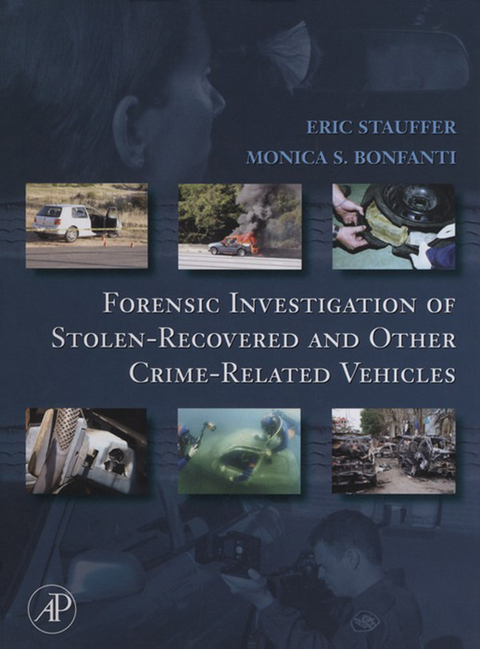
Forensic Investigation of Stolen-Recovered and Other Crime-Related Vehicles (eBook)
632 Seiten
Elsevier Science (Verlag)
978-0-08-047788-6 (ISBN)
* Extensively researched and exceptionally well-written by internationally-recognized experts in auto theft investigation and forensic science
* All the principles explained in the text are well-illustrated and demonstrated with more than 450 black and white and about 100 full-color illustrations, many directly from real cases
* Serves as both a valuable reference guide to the professional and an effective teaching tool for the forensic science student
Eric Stauffer is a criminalist presently living in Switzerland. In 1998 he obtained his Master-equivalent degree in forensic sciences from the Institut de Police Scientifique et de Criminologie at the University of Lausanne in Switzerland. In 1999 he moved to the United States and, two years later, obtained another Master's degree in forensic sciences from Florida International University in Miami, Florida. Mr. Stauffer is certified as a Diplomate and a Fellow of the American Board of Criminalistics, with a specialty in the area of fire debris analysis. He is also a Certified Fire and Explosion Investigator (CFEI) and a Certified Fire Investigation Instructor (CFII) both from the National Association of Fire Investigators (NAFI).
During his early career as a criminalist, Mr. Stauffer worked as a crime scene officer and a firearms and toolmarks examiner. In 2001, he moved to Atlanta and joined the private sector as a fire investigator and fire debris analyst. As such, his duties involved the investigation of numerous residential, commercial, and vehicle fire scenes to determine their origin and cause and, at the laboratory, the examination of fire debris samples for ignitable liquid residues. In 2006, he moved back to Switzerland to conduct research in forensic sciences, notably in fingermark enhancement techniques and fire investigation. He is currently pursuing doctoral studies at the School of Criminal Sciences at the University of Lausanne.
From 2003 to 2006, Mr. Stauffer was Chair of the Fire Laboratory Standards and Protocols committee of the Scientific Working Group on Fire and Explosives (SWGFEX). He also served as a subject matter expert for the development of the fire debris validation kit produced by the National Forensic Science Technology Center (NFSTC).
Mr. Stauffer is a recognized speaker and instructor in the field of forensic sciences and, more particularly, in fire investigation and fire debris analysis. He has presented his work at several
Forensic Investigation of Stolen-Recovered and Other Crime-Related Vehicles provides unique and detailed insights into the investigations of one of the most common crime scenes in the world. In addition to a thorough treatment of auto theft, the book covers vehicles involved in other forms of crime dealing extensively with the various procedures and dynamics of evidence as it might be left in any crime scene. An impressive collection of expert contributors covers a wide variety of subjects, including chapters on vehicle identification, examination of burned vehicles, vehicles recovered from under water, vehicles involved in terrorism, vehicle tracking, alarms, anti-theft systems, steering columns, and ignition locks. The book also covers such topics as victim and witness interviews, public and private auto theft investigations, detection of trace evidence and chemical traces, vehicle search techniques, analysis of automotive fluids, vehicle registration, document examination, and vehicle crime mapping. It is the ultimate reference guide for any auto theft investigator, crime scene technician, criminalist, police investigator, criminologist, or insurance adjuster. - Extensively researched and exceptionally well-written by internationally-recognized experts in auto theft investigation and forensic science- All the principles explained in the text are well-illustrated and demonstrated with more than 450 black and white and about 100 full-color illustrations, many directly from real cases- Serves as both a valuable reference guide to the professional and an effective teaching tool for the forensic science student
Cover 1
Title page 4
Copyright 5
Table of contents 8
Contributors 14
Foreword 26
Preface 28
Acknowledgments 32
1 THE PROBLEM OF AUTO THEFT 34
1.1 INTRODUCTION 34
1.2 OVERVIEW 35
1.2.1 Motives 35
1.2.2 Modus Operandi 38
1.2.3 Perpetrators 39
1.3 STATISTICAL DATA AND INTERNATIONAL PERSPECTIVE 39
1.3.1 Global Picture 39
1.3.2 Evolution in Number of Stolen Vehicles with Time 40
1.3.3 Comparison Between Countries 41
1.3.4 US Geographical Statistics 42
1.3.5 Most Commonly Stolen Vehicles in the United States 45
1.3.6 Recovery Rates and Other Parameters 47
1.3.7 International Trafficking 47
1.4 ENFORCEMENT AND PREVENTION STRATEGIES 49
1.4.1 Preventive Measures 49
1.4.2 Investigative Measures 50
1.5 ORGANIZATIONS 51
1.5.1 Goals 51
1.5.2 Professional Associations 51
1.5.3 Government-Sponsored Organizations 52
1.5.4 Privately Sponsored Organizations 53
ACKNOWLEDGMENTS 53
BIBLIOGRAPHY 53
2 VICTIM AND WITNESS INTERVIEWS AND COLLECTION OF CIRCUMSTANTIAL INFORMATION 56
2.1 INTRODUCTION 56
2.2 GENERAL APPROACH TO INTERVIEWS 57
2.2.1 Initial Report 57
2.2.2 Main Interview 57
2.2.3 Identities 58
2.2.4 Quality of the Interview 59
2.3 FORMS 60
2.4 COLLECTION OF INFORMATION 60
2.4.1 Principle 60
2.4.2 Information Regarding the Vehicle 62
2.4.3 Information Regarding the Theft 64
2.4.4 Information Regarding Vehicle Recovery 67
ACKNOWLEDGMENTS 69
3 GENERAL CRIME SCENE CONSIDERATIONS AND DOCUMENTATION 70
3.1 INTRODUCTION 70
3.2 NOTIFICATION AND INITIAL ASSESSMENT 70
3.3 SCENE ATTENDANCE 71
3.4 SCENE EXAMINATION 74
3.4.1 Searching Techniques and Evidence Identification 74
3.4.2 Note Recording 76
3.4.3 Sketch Plan 77
3.4.4 Photography 80
3.4.5 Further Scene Examinations 84
3.4.6 Evidence Collection 84
3.4.7 Case Management 88
3.5 REPORT PREPARATION AND COURT PRESENTATION 88
ACKNOWLEDGMENTS 89
BIBLIOGRAPHY 90
4 FORENSIC EXAMINATION OF STOLEN-RECOVERED VEHICLES 92
Part I: Technical Examination and General Forensic Traces 92
4.1 INTRODUCTION 92
4.1.1 Challenges 92
4.1.2 Crime Scene Considerations 93
4.1.3 Examination Facility 93
4.1.4 Forensic Techniques 94
4.2 DETERMINATION OF THE MODUS OPERANDI 95
4.2.1 Penetration of the Vehicle 95
4.2.2 Starting the Vehicle 103
4.3 FINGERPRINTS AND PALM PRINTS 105
4.3.1 General Considerations 105
4.3.2 Fingerprint Search 105
4.3.3 Fingerprint Development 106
4.4 BIOLOGICAL AND DNA TRACES 108
4.4.1 General Considerations and Sampling 108
4.4.2 Blood 108
4.4.3 Semen 112
4.4.4 Skin Contact Traces 114
4.4.5 Hair and Dandruff 115
4.5 MICROTRACES 115
4.5.1 General Considerations 115
4.5.2 Fibers 116
4.5.3 Glass 117
4.5.4 Paint 118
4.5.5 Soil 119
4.6 TOOLMARKS AND OTHER EVIDENCE 119
4.7 ABANDONED OBJECTS 121
4.8 VEHICLES INVOLVED IN OTHER CRIMES 121
ACKNOWLEDGMENTS 123
BIBLIOGRAPHY 123
Part II: Chemical Traces„Drugs, Explosives, and Gunshot Residue 126
4.9 INTRODUCTION 126
4.10 CHEMICAL TRACES 126
4.10.1 Illicit Drugs 126
4.10.2 Explosives 127
4.10.3 Gunshot Residue 129
4.11 CRIME SCENE EXAMINATION 129
4.11.1 Security Phase 129
4.11.2 Forensic Phase A: Outside the Vehicle 129
4.11.3 Forensic Phase B: Vehicle Entrance 130
4.11.4 Forensic Phase C: On-Site Analysis 130
4.11.5 Forensic Phase D: Sampling 132
4.11.6 Forensic Phase E: Packaging of Samples 137
4.12 LABORATORY EXAMINATION OF SAMPLES 137
4.12.1 Analysis 137
4.12.2 Interpretation of Results 138
ACKNOWLEDGMENTS 138
BIBLIOGRAPHY 138
5 TRACES AND THEIR EVIDENTIARY VALUE 142
5.1 INTRODUCTION 142
5.2 TRACE PROPERTIES 145
5.2.1 Evidence Functions 145
5.2.2 Class and Randomly-Acquired Characteristics 145
5.2.3 Requirements 146
5.2.4 Evidence Strength 146
5.2.5 Comparison Process 148
5.3 EVIDENCE LEADING TO INDIVIDUALIZATION 149
5.3.1 Fingerprints and Other Ridge Skin Impressions 149
5.3.2 Shoeprints 150
5.3.3 Tire Tracks 151
5.3.4 Toolmarks 152
5.4 CLASS EVIDENCE 153
5.4.1 Body Fluids and DNA 153
5.4.2 Paint 154
5.4.3 Fibers 155
5.4.4 Glass 156
BIBLIOGRAPHY 157
6 VEHICLE IDENTIFICATION 160
6.1 INTRODUCTION 160
6.2 VEHICLE IDENTIFICATION NUMBER FORMAT 160
6.2.1 General Structure 160
6.2.2 World Manufacturer Identifier (WMI) 162
6.2.3 Vehicle Descriptor Section (VDS) 164
6.2.4 Check Digit 164
6.2.5 Vehicle Indicator Section (VIS) 166
6.2.6 Information Resources 167
6.2.7 Examples 169
6.3 VIN PLATE LOCATIONS, TYPES, AND ATTACHMENTS 170
6.3.1 VIN Locations 170
6.3.2 General Plates 171
6.3.3 Safety Certification Label 174
6.3.4 Anti-Theft Label 175
6.3.5 Stamping of Other Parts 177
6.3.6 Window Etching 179
6.3.7 Other VIN Locations 181
6.4 SECONDARY AND CONFIDENTIAL VINS 181
6.4.1 Principle 181
6.4.2 Secondary (Nonconfidential) VIN 181
6.4.3 Confidential VINs 183
6.5 PARTICULAR VINS 185
6.5.1 Gray Market VIN 185
6.5.2 Kit Assembled Cars 187
6.5.3 Rebuilt Vehicles 187
6.6 OTHER VEHICLE MARKINGS 188
6.6.1 Air Bags 188
6.6.2 Other Parts 189
6.6.3 Engine Emission Control Label 191
6.6.4 Other Coded Date Information 192
6.6.5 Other Serial Numbers 193
6.7 VIN CHANGING (OR RE-VINING, RINGING, OR TAGGING) 194
6.7.1 Principle 194
6.7.2 Alteration of Existing VIN 195
6.7.3 VIN Plate Switching 195
6.7.4 Counterfeit VIN Plate 196
6.8 HANDS-ON VEHICLE EXAMINATION 197
6.8.1 Equipment Needed 197
6.8.2 Examination Site and Preliminary Data Collection 197
6.8.3 Examination Process 198
6.8.4 Summary 206
BIBLIOGRAPHY 207
7 RESTORATION OF SERIAL NUMBERS 210
7.1 INTRODUCTION 210
7.2 SERIAL NUMBERING METHODS 210
7.3 TECHNIQUES USED TO OBLITERATE NUMBERS 210
7.4 MATERIAL DEFORMATION AND CAUSED EFFECTS 215
7.4.1 Principle of Deformation and Restoration 215
7.4.2 Metallic Objects 217
7.4.3 Organic Solids (Plastics) 218
7.5 RESTORATION METHODS FOR METALLIC OBJECTS 220
7.5.1 Principle 220
7.5.2 Sample Preparation Techniques 220
7.5.3 Destructive Restoration Procedures for Metals 220
7.5.4 Nondestructive Restoration Procedures For Metals 226
7.6 RESTORATION METHODS FOR PLASTICS 230
7.6.1 Principle 230
7.6.2 Destructive Restoration Procedures for Plastics 230
7.6.3 Nondestructive Restoration Procedures for Plastics 232
7.7 PHOTOGRAPHY 232
7.8 EVALUATION OF METHODS 234
7.9 PRACTICAL SUGGESTIONS FOR SERIAL NUMBER RESTORATION 235
7.9.1 Inspection and Preparation 235
7.9.2 Application of a Processing Method 235
7.9.3 Recording of Results and Conclusions 235
7.9.4 Restoration from the Reverse Side of the Specimen 236
ACKNOWLEDGMENTS 236
BIBLIOGRAPHY 236
8 ANTI-THEFT SYSTEMS 240
8.1 INTRODUCTION 240
8.2 VEHICLE ANTI-THEFT SYSTEMS 242
8.2.1 Development of OEM Immobilizer and Alarm Systems 242
8.2.2 General Motors PassKey I and II Systems 243
8.2.3 GM PassLock System 245
8.2.4 Transponder or Radiofrequency Identification Systems 247
8.3 FUNCTION TESTING OEM IMMOBILIZER SYSTEMS 252
8.3.1 PassKey I and II 252
8.3.2 PassLock 252
8.3.3 Transponder 253
8.4 TRANSPONDERS 254
8.4.1 Aftermarket Programming and Servicing Tools 254
8.4.2 Transponder Key Cloning 255
8.4.3 Emergency Start Procedures 256
8.4.4 Transponders for Fraud Prevention 256
8.5 ELECTRONIC KEY AND KEYLESS IGNITION SYSTEMS 257
8.6 ALARM SYSTEMS 258
ACKNOWLEDGMENTS 259
BIBLIOGRAPHY 259
9 EXAMINATION OF STEERING COLUMNS AND IGNITION LOCKS 260
9.1 INTRODUCTION 260
9.2 VEHICLE STEERING COLUMNS 262
9.2.1 Steering Column Design 262
9.2.2 Separate-Component Column 263
9.2.3 Single-Component Column (Ignition Lock-Column Lock-Starter Switch Assembly) 268
9.2.4 Nonlocking Column 269
9.3 VEHICLE IGNITION LOCKS 270
9.3.1 Principle 270
9.3.2 Ignition Lock Components and Their Operation 271
9.4 DEFEATING THE IGNITION LOCK 274
9.4.1 Principle 274
9.4.2 Forced Removal of the Ignition Lock 274
9.4.3 Forced Rotation 275
9.4.4 Lock Picking 276
9.4.5 Key Impressioning 278
9.4.6 Key Picks 278
9.4.7 Master Keys 280
9.5 EXAMINATION OF STEERING COLUMN COMPONENTS ON BURNED VEHICLES 280
9.5.1 Principle 280
9.5.2 Creation of the Debris Area 283
9.5.3 Recovery of Evidence 285
9.6 EXAMINATION OF EVIDENCE 287
9.6.1 Principle 287
9.6.2 On-Site Field Examination 288
9.6.3 Laboratory Examination 288
ACKNOWLEDGMENTS 290
BIBLIOGRAPHY 290
10 EXAMINATION OF VEHICLE KEYS 292
10.1 INTRODUCTION 292
10.2 CAR KEY TYPES 292
10.2.1 Evolution and Generalities 292
10.2.2 Pin/Wafer Tumbler Keys 293
10.2.3 Sidewinder and Centerwinder Keys 294
10.2.4 Ford/Jaguar Tibbe Keys and Ford Chubb Keys 295
10.2.5 Dimple Keys 295
10.2.6 Keys With Anti-Theft System 297
10.2.7 Keyless Systems 297
10.3 KEY DUPLICATION 299
10.3.1 Key Characteristics 299
10.3.2 General Duplication Process 300
10.3.3 Key-Cutting Machines or Duplicators 301
10.4 COPY TRACES ON THE ORIGINAL KEY 306
10.4.1 Principle 306
10.4.2 Vise Jaw Marks 307
10.4.3 Depth Guide Marks 307
10.4.4 Examination Outcome 310
10.4.5 Other Indicators 310
10.5 FORENSIC EXAMINATION 310
10.5.1 Questions 310
10.5.2 Original Set 311
10.5.3 Key Functions 311
10.5.4 Key and Lock Matching 311
10.5.5 Key Originality 312
10.5.6 Key Wear and Tear 312
10.5.7 Copy Traces 313
ACKNOWLEDGMENTS 314
BIBLIOGRAPHY 314
11 ANALYSIS OF VEHICLE FLUIDS 316
11.1 INTRODUCTION 316
11.2 VEHICLE FLUIDS 317
11.2.1 Different Types of Fluids 317
11.2.2 Chemical and Physical Properties of Fluids 318
11.3 FLUID SAMPLING 320
11.3.1 Preliminary Observations and Level Check 320
11.3.2 Sampling 322
11.3.3 Information Accompanying the Samples 323
11.4 ANALYSIS OF ENGINE OIL 324
11.4.1 Oil Contamination 324
11.4.2 Oil Condition 326
11.4.3 Engine Wear 326
11.5 ANALYSIS OF ATF 327
11.6 PRACTICAL CASES 328
11.6.1 2000 Renault Espace 328
11.6.2 1997 Chevrolet Venture 328
11.6.3 2002 Ford Explorer 330
ACKNOWLEDGMENTS 331
BIBLIOGRAPHY 331
12 EXAMINATION OF BURNED VEHICLES 334
12.1 INTRODUCTION 334
12.2 BASIC PRINCIPLES OF FIRE 336
12.2.1 Fire Triangle 336
12.2.2 Combustible 337
12.2.3 Oxidizer 341
12.2.4 Thermal Energy or Source of Ignition 342
12.2.5 Heat Transfer 342
12.3 GENERAL PRINCIPLES OF FIRE INVESTIGATION 343
12.3.1 Purpose 343
12.3.2 Fire Causes 344
12.3.3 General Approach to the Fire Investigation 349
12.3.4 Interviews and Information Collection 350
12.3.5 Personnel Protection and Equipment 351
12.4 DETERMINATION OF THE ORIGIN 353
12.4.1 General Principles 353
12.4.2 Compartments 354
12.4.3 Patterns on the Vehicle Body 355
12.4.4 Narrowing the Point of Origin 359
12.4.5 Multiple Points of Origin 359
12.4.6 Other Patterns 360
12.5 DETERMINATION OF THE CAUSE 360
12.5.1 General Principles 360
12.5.2 Sources of Ignition in a Vehicle 362
12.5.3 Causes with Stolen-Recovered Vehicles 363
12.5.4 Causes with Insurance Fraud Scheme Vehicles 363
12.5.5 Fires Caused by Vandalism 365
12.6 PHYSICAL EVIDENCE 365
ACKNOWLEDGMENTS 367
BIBLIOGRAPHY 367
13 EXAMINATION OF VEHICLES RECOVERED UNDERWATER 370
13.1 INTRODUCTION 370
13.2 LIMITATIONS IN UNDERWATER CRIME SCENE INVESTIGATION 371
13.2.1 Principle 371
13.2.2 Limitations of Witness Testimonies 371
13.2.3 Physical Constraints 371
13.2.4 Physical Limitations of the Aquatic Environment 372
13.3 SEARCH METHODS: FROM SIMPLE TO SOPHISTICATED 375
13.3.1 Search from the Surface 375
13.3.2 Search in the Water 376
13.3.3 Sonar Methods 378
13.4 CRIME SCENE DELIMITATION AND SEARCH METHODOLOGY 380
13.4.1 At Discovery of the Scene 380
13.4.2 Step by Step 380
13.5 CRIME SCENE EXAMINATION AND RECORDING 383
13.5.1 Preliminary Reconnaissance 383
13.5.2 Photography and Video Recording 383
13.5.3 Sketch from the Surface 385
13.5.4 Note-Taking 385
13.6 COLLECTION OF EVIDENCE 387
13.6.1 Principle 387
13.6.2 Documents 388
13.6.3 Firearms 390
13.6.4 Electronic Devices 391
13.6.5 Trace Evidence 391
13.6.6 DNA Traces 392
13.6.7 Bodies 393
13.6.8 Fingerprints and Palm Prints 395
ACKNOWLEDGMENTS 397
BIBLIOGRAPHY 397
14 EXAMINATION OF VEHICLE LICENSE PLATES 400
14.1 INTRODUCTION 400
14.2 LICENSE PLATES REGULATIONS AND DELIVERY 400
14.2.1 Principle 400
14.2.2 General Characteristics of Different Plates 401
14.2.3 Registration in Austria 401
14.2.4 Registration in Belgium 404
14.2.5 Registration in Canada 404
14.2.6 Registration in Denmark 405
14.2.7 Registration in France 405
14.2.8 Registration in Germany 405
14.2.9 Registration in Great Britain 406
14.2.10 Registration in Italy 406
14.2.11 Registration in the Netherlands 407
14.2.12 Registration in Norway 407
14.2.13 Registration in Portugal 407
14.2.14 Registration in Spain 407
14.2.15 Registration in Sweden 407
14.2.16 Registration in Switzerland 407
14.2.17 Registration in the United States 408
14.3 MANUFACTURING OF LICENSE PLATES 410
14.3.1 Principle 410
14.3.2 Aluminum Plates 410
14.3.3 Plastic Plates 413
14.4 FORGED AND COUNTERFEIT LICENSE PLATES 413
14.4.1 Altered License Plates 413
14.4.2 Replica License Plates 413
14.4.3 Authentic Plates 413
14.5 FORENSIC APPROACH TO THE EXAMINATION OF LICENSE PLATES 414
14.5.1 Principle 414
14.5.2 Source of Information 415
14.5.3 Identification of Manufacturer and/or Embosser 416
14.5.4 Comparison of Embossing Defects 416
ACKNOWLEDGMENTS 419
BIBLIOGRAPHY 419
15 EXAMINATION OF VEHICLE REGISTRATION DOCUMENTS 422
15.1 INTRODUCTION 422
15.2 CONCEPT OF REGISTRATION OF VEHICLES 423
15.2.1 General Principle 423
15.2.2 International Standardization and Cooperation 426
15.2.3 EU Legislation 427
15.2.4 World Tour 428
15.3 SECURITY DOCUMENTS 428
15.3.1 Principle 428
15.3.2 Manufacture 429
15.3.3 Secured Personalization 435
15.3.4 Secured Issuance and Disposal 436
15.4 DOCUMENT FRAUD 437
15.4.1 Fraud Motives 437
15.4.2 Types of Fraud 437
15.4.3 Fraud Trends 439
15.5 FORENSIC EXAMINATION METHODOLOGY 443
15.5.1 Collection of Registration Documents 443
15.5.2 Equipment 443
15.5.3 Preliminary Visual Examination 444
15.5.4 Database Checks 444
15.5.5 Comparison Process 444
15.5.6 Examination Checklist 445
15.5.7 Electrostatic Detection Apparatus 445
15.5.8 Burned or Carbonized Documents 446
15.5.9 Instrumental Analysis of Paper and Inks 446
15.5.10 Fingerprint Examination 446
ACKNOWLEDGMENTS 447
BIBLIOGRAPHY 447
16 VEHICLE SEARCHING PROCEDURES 450
16.1 INTRODUCTION 450
16.2 EQUIPMENT 450
16.3 SEARCHING METHODS 451
16.3.1 Definition 451
16.3.2 Suspicious Elements 452
16.3.3 Partitions 452
16.4 OTHER VEHICLES 463
16.4.1 Tractor Trailers 463
16.4.2 Utility Vehicles 463
16.4.3 Motorcycles 463
ACKNOWLEDGMENTS 464
17 EXAMINATION OF VEHICLES INVOLVED IN TERRORISM 466
17.1 INTRODUCTION 466
17.2 USE OF STOLEN VEHICLES BY ORGANIZED CRIMINAL GROUPS AND TERRORIST ORGANIZATIONS 468
17.2.1 Organized Crime and Terrorist Organizations 468
17.2.2 Use of Stolen Vehicles to Help Fund Terrorism 470
17.2.3 Use of Stolen Vehicles for Explosives Transportation 471
17.2.4 Use of Stolen Vehicles for Surveillance and Transportation 472
17.3 PROCESSING STOLEN-RECOVERED VEHICLES 473
17.3.1 Principle 473
17.3.2 Forensic Evidence to Identify Suspects or to Cross-Link Vehicles 473
17.3.3 Processing Suspicious Vehicles 474
17.4 INVESTIGATION OF A CAR OR TRUCK BOMB CRIME SCENE 475
17.4.1 Principle 475
17.4.2 Understanding the Effects of Explosions on Vehicles 476
17.4.3 Specialists Involved in Bombing Investigations 477
17.4.4 Identifying Explosives 479
17.5 CASE STUDIES 480
17.5.1 World Trade Center, New York City, United States, 1993 480
17.5.2 Federal Courthouse, Oklahoma City, United States, 1995 481
17.5.3 Spain Assassination Case, Madrid, Spain, 2000 482
17.5.4 Sari Club and Paddy’s Pub, Bali, Indonesia, 2002 483
BIBLIOGRAPHY 485
18 INVESTIGATION FROM THE PUBLIC SIDE 490
18.1 INTRODUCTION 490
18.2 INITIAL REPORTING AND INVESTIGATION OF A STOLEN VEHICLE 491
18.3 RECOVERING STOLEN VEHICLES 492
18.3.1 Principle 492
18.3.2 Clues to Finding Stolen Vehicles 493
18.3.3 Vehicle Identification Officers 495
18.3.4 Technology 496
18.3.5 Processing Recovered Vehicles 498
18.4 INVESTIGATING AUTO THEFTS 500
18.4.1 Principle 500
18.4.2 Types of Thefts 500
18.4.3 Long-Term Versus Short-Term Cases 507
18.4.4 Utilization of Informants 508
18.4.5 Undercover Operations 509
18.4.6 Search Warrants 509
18.4.7 Bait Car Systems 510
18.5 PROSECUTION OF AUTO THEFT CASES 510
18.6 TYPES OF AUTO THEFT INVESTIGATIVE UNITS 511
BIBLIOGRAPHY 512
19 INVESTIGATION FROM THE PRIVATE SIDE 514
19.1 INTRODUCTION 514
19.2 INFORMATION IN POSSESSION OF THE INSURANCE COMPANY 514
19.3 COLLECTION OF BACKGROUND INFORMATION IN CASE OF THEFT 515
19.3.1 Insured’s Notification of Theft 515
19.3.2 First Measures Taken by the Insurance Company at Time of Theft Notification 515
19.3.3 Questionnaire 516
19.3.4 Procuration 518
19.4 INVESTIGATION 519
19.4.1 Verification of the Questionnaire 519
19.4.2 Investigation Methodology 519
19.4.3 Checklist 521
19.4.4 Case Examples 523
19.4.5 Recovery of the Vehicle 524
19.5 CLAIM SETTLEMENT 525
19.5.1 Payment of Claim 525
19.5.2 Discovery of the Fraud 526
ACKNOWLEDGMENTS 526
BIBLIOGRAPHY 526
19.6 INTRODUCTION 527
19.7 INDICATORS OF FRAUD 528
19.8 INVESTIGATION 529
19.8.1 Principle 529
19.8.2 Examinations 529
19.8.3 Use of Expert Services 531
19.8.4 Documentation and Authorizations 531
19.8.5 Sources of Information 532
19.8.6 Interviews 533
19.8.7 Timelines 534
19.8.8 Financial Background 535
19.9 CLAIM EVALUATION 535
19.9.1 Reservation of Rights or Nonwaiver 535
19.9.2 Fraud Determination 536
19.9.3 Disposition of the Claim 536
BIBLIOGRAPHY 537
20 VEHICLE TRACKING 538
20.1 INTRODUCTION 538
20.2 TYPES OF TRACKING DEVICES 539
20.2.1 Lojack 539
20.2.2 Global Positioning Systems 540
20.2.3 Ituran System 542
20.2.4 Cell Phones 542
20.3 INSTALLING TRACKING DEVICES 543
20.3.1 Vehicles Equipped With Tracking Devices 543
20.3.2 Installation in the Scope of an Investigation 543
20.3.3 Covert Installations 544
20.4 THE USE OF TRACKING DEVICES FOR INVESTIGATIONS AND RECOVERY OF VEHICLES 545
20.4.1 Principle 545
20.4.2 Verifying Sources of Information 545
20.4.3 Aiding the Surveillance of Suspects 546
20.4.4 Undercover Operations 546
20.4.5 Installation on Vehicles Cooling Off 546
20.4.6 Bait Car Operations 547
20.5 CASE STUDIES 548
20.5.1 Operation Company Car 548
20.5.2 Lojack Recovery on the Miami River 549
20.5.3 Tracking a Toyota Land Cruiser to Chicago 550
20.5.4 Out to Sea 551
BIBLIOGRAPHY 552
21 VEHICLE CRIME MAPPING 554
21.1 INTRODUCTION 554
21.2 VEHICLE CRIME: A CASE OF INFORMATION OVERLOAD? 555
21.3 WHY MAP CRIME? 556
21.3.1 Routine Activity Theory 556
21.3.2 Seeking Crime Opportunities 558
21.4 HOW DOES CRIME MAPPING WORK? 558
21.4.1 Geographic Information Systems 558
21.4.2 Geocoding 559
21.4.3 Layers 561
21.4.4 Attribute Queries 563
21.4.5 Spatial Queries 564
21.5 RECOGNIZING PATTERNS AND TRENDS 565
21.5.1 Maximizing Investigator Effort 565
21.5.2 Hotspot Mapping 566
21.5.3 Recovered Vehicle Mapping 567
21.6 HOW CAN GEOGRAPHICAL KNOWLEDGE AID LAW ENFORCEMENT? 569
21.6.1 Identifying Patterns 569
21.6.2 Targeting Crime Detection Technologies 570
21.7 A PRIMER ON MAPPING SERVICES 571
21.8 DATA CHECKLIST 572
BIBLIOGRAPHY 573
22 INTERNATIONAL COLLABORATION THROUGH INTERPOL 576
22.1 INTRODUCTION 576
22.2 HISTORY 576
22.3 EXTENT OF THE PHENOMENON 578
22.3.1 Main Picture 578
22.3.2 Measuring Vehicle Crime 578
22.3.3 Where Do All These Stolen Cars Go? 580
22.4 INTERPOL APPROACH 581
22.4.1 The Illegal Process 581
22.4.2 Methodological Considerations 582
22.4.3 Victims and Actors 586
22.4.4 International Operations 587
22.4.5 Specific Criminal Expertise 590
22.4.6 An Integrated Multidisciplinary Approach 591
22.5 TECHNOLOGY TO HELP POLICE WORK 593
22.5.1 Principles 593
22.5.2 Tracking Systems 594
22.6 THE INTERPOL TOOLS 594
22.7 CONCLUSION 596
BIBLIOGRAPHY 597
ABBREVIATIONS 598
INDEX 604
Color Plates 628
| Erscheint lt. Verlag | 11.10.2006 |
|---|---|
| Sprache | englisch |
| Themenwelt | Sachbuch/Ratgeber |
| Recht / Steuern ► EU / Internationales Recht | |
| Recht / Steuern ► Strafrecht ► Kriminologie | |
| Recht / Steuern ► Strafrecht ► Strafverfahrensrecht | |
| Sozialwissenschaften | |
| Technik ► Bauwesen | |
| Technik ► Fahrzeugbau / Schiffbau | |
| ISBN-10 | 0-08-047788-7 / 0080477887 |
| ISBN-13 | 978-0-08-047788-6 / 9780080477886 |
| Informationen gemäß Produktsicherheitsverordnung (GPSR) | |
| Haben Sie eine Frage zum Produkt? |
 PDF (Adobe DRM)
Kopierschutz: Adobe-DRM
Adobe-DRM ist ein Kopierschutz, der das eBook vor Mißbrauch schützen soll. Dabei wird das eBook bereits beim Download auf Ihre persönliche Adobe-ID autorisiert. Lesen können Sie das eBook dann nur auf den Geräten, welche ebenfalls auf Ihre Adobe-ID registriert sind.
Details zum Adobe-DRM
Dateiformat: PDF (Portable Document Format)
Mit einem festen Seitenlayout eignet sich die PDF besonders für Fachbücher mit Spalten, Tabellen und Abbildungen. Eine PDF kann auf fast allen Geräten angezeigt werden, ist aber für kleine Displays (Smartphone, eReader) nur eingeschränkt geeignet.
Systemvoraussetzungen:
PC/Mac: Mit einem PC oder Mac können Sie dieses eBook lesen. Sie benötigen eine
eReader: Dieses eBook kann mit (fast) allen eBook-Readern gelesen werden. Mit dem amazon-Kindle ist es aber nicht kompatibel.
Smartphone/Tablet: Egal ob Apple oder Android, dieses eBook können Sie lesen. Sie benötigen eine
Geräteliste und zusätzliche Hinweise
Buying eBooks from abroad
For tax law reasons we can sell eBooks just within Germany and Switzerland. Regrettably we cannot fulfill eBook-orders from other countries.
aus dem Bereich