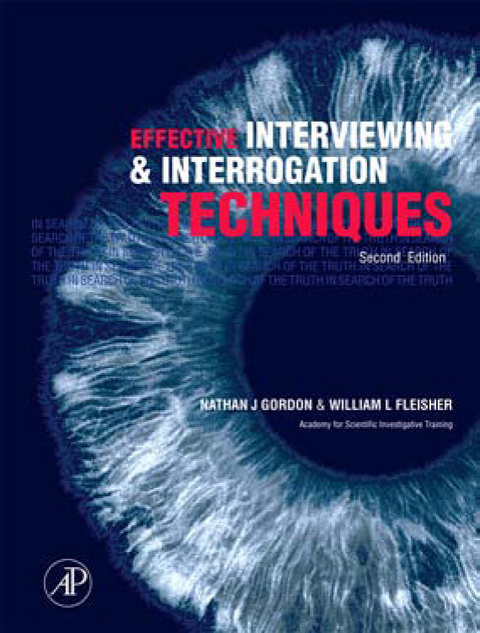
Effective Interviewing and Interrogation Techniques (eBook)
312 Seiten
Elsevier Science (Verlag)
978-0-08-047746-6 (ISBN)
Effective Interviewing and Interrogation Techniques, Second Edition, is completely revised and updated so as to cover all the information a student needs to know to obtain answers from a witness, a victim, or a suspect and how to interpret these answers with the utmost accuracy.
Building on the previous edition's ground-breaking search for truth in criminal and non-criminal investigations, this book contains five new chapters which include coverage of false confessions, interviewing the mentally challenged, and the ethics of interrogation in a post 9/11 world. This new edition includes highly illustrated chapters with topics ranging from the psycho-physiological basis of the forensic assessment to preparation for the interview/interrogation; question formulation; projective analysis of unwitting verbal clues; interviewing children and the mentally challenged; and pre-employment interviewing. Also included are several model worksheets and documents, case studies, and complete instructions for using the authors' Integrated Interrogation Technique, a 10-point, highly successful approach to obtaining confessions that can stand up in court. The book concludes with an insightful look at the future of truth verification.
This book will be of benefit to attorneys, coroners, detectives, educators, forensic psychophysiologists (lie detection), human resource professionals, intelligence professionals, and investigators as well as journalists/authors, jurists, medical professionals, psychological professionals, researchers, and students.
- Expanded coverage of Statement Analysis, including actual statements from real cases.- New photos to aid in assessing nonverbal behavior.
- Added section on assessment of written statements.
Nathan J. Gordon is Director of the Academy for Scientific Investigative Training, where he developed the Forensic Assessment Interview and Integrated Interrogation Technique. He is an expert forensic psycho-physiologist and an internationally recognized expert in the field of Forensic Assessment Interviewing and Interrogation. He has lectured and conducted seminars on these subjects to thousands of law enforcement, intelligence and private security officers throughout the United States, Africa, Europe, and Asia.
Mr. Gordon, a recognized innovator in the field of truth verification, has had his work recognized in publications among which is, Forensic Psychophysiology; Use Of The Polygraph, by James Allen Matte. He has served as President of the Pennsylvania Polygraph Association, numerous committees for the American Polygraph Association, and is a Director of the Vidocq Society. Mr. Gordon lives in Philadelphia, Pennsylvania, with his wife and three children, and grandson.
Effective Interviewing and Interrogation Techniques, Second Edition, is completely revised and updated so as to cover all the information a student needs to know to obtain answers from a witness, a victim, or a suspect and how to interpret these answers with the utmost accuracy. Building on the previous edition's ground-breaking search for truth in criminal and non-criminal investigations, this book contains five new chapters which include coverage of false confessions, interviewing the mentally challenged, and the ethics of interrogation in a post 9/11 world. This new edition includes highly illustrated chapters with topics ranging from the psycho-physiological basis of the forensic assessment to preparation for the interview/interrogation; question formulation; projective analysis of unwitting verbal clues; interviewing children and the mentally challenged; and pre-employment interviewing. Also included are several model worksheets and documents, case studies, and complete instructions for using the authors' Integrated Interrogation Technique, a 10-point, highly successful approach to obtaining confessions that can stand up in court. The book concludes with an insightful look at the future of truth verification. This book will be of benefit to attorneys, coroners, detectives, educators, forensic psychophysiologists (lie detection), human resource professionals, intelligence professionals, and investigators as well as journalists/authors, jurists, medical professionals, psychological professionals, researchers, and students. - Expanded coverage of Statement Analysis, including actual statements from real cases.- New photos to aid in assessing nonverbal behavior.- Added section on assessment of written statements.
Front cover 1
Effective Interviewing and Interrogation Techniques 4
Copyright page 5
Contents 6
Foreword 8
Preface 10
About the Authors 12
Acknowledgments 14
Companion Web Site 15
Chapter 1: The Search for Truth 16
Summary 24
References 24
Chapter 2: Truth and Lies 26
Summary 30
Reference 30
Chapter 3: Psychophysiological Basis of the Forensic Assessment 32
Summary 41
References 41
Chapter 4: Preparation for the Interview/Interrogation 42
Summary 50
Reference 50
Chapter 5: Morgan Interview Theme Technique (MITT) 52
MITT Suspect 1 61
MITT Suspect 2 64
MITT Suspect 3 67
MITT Suspect 4 69
Summary 72
References 72
Chapter 6: Forensic Statement Analysis 74
Summary 102
References 102
Chapter 7: Question Formulation: 104
Irrelevant questions 104
Relevant questions 105
Comparison questions 107
Summary 110
References 110
Chapter 8: Projective Analysis of Unwitting Verbal Cues 112
Summary 119
References 119
Chapter 9: Nonverbal Behavioral Assessment 120
General posture 125
Head and face 129
Arms and hands 138
Feet and legs 142
Grooming behaviors 142
Thinking gestures 143
Involuntary biological signs 144
Paralinguistic behaviors 145
Neurolinguistics 145
Nonverbal behavior during the interrogation surrender
Summary 154
References 154
Chapter 10: Traditional Scoring of the Faint Interview 156
Case study 1 159
Case study 2 160
Suspect A 162
Suspect B 165
Case study 3: multiple suspects 167
Summary 181
Chapter 11: The Validation of the Forensic Assessment Interview (Faint) 182
Case study 1 202
Case study 2 205
Case study 3 209
Case study 4 213
Case study 5 216
Case study 6 220
Summary 223
References 223
Chapter 12: Interviewing Children and the Mentally Challenged 224
Summary 233
References 233
Chapter 13: Report Writing 234
Summary 236
Chapter 14: Torture and False Confessions: 238
Summary 247
References 247
Chapter 15: Pre-employment Interviewing 248
Summary 253
References 253
Chapter 16: Passenger Screening with Verbal and Nonverbal Cues 254
Summary 260
References 260
Chapter 17: Legal Considerations 262
Summary 267
References 268
Chapter 18: The Integrated Interrogation Technique 270
1. Make a forceful assertion that the suspect is guilty 272
2. Do not allow the suspect to deny the act 273
3. Offer a series of possibilities of how and why this may have happened 273
4. Undermine the person's self-confidence 274
5. Offer persuasive arguments for telling the truth 275
6. Offer solutions, where possible, to alleviate the person's fear 275
7. Compliment the person 275
8. Use alternative and leading questions 276
9. Watch for the "buy" signs 277
10. Move in close and press for the confession 277
Summary 292
Reference 292
Chapter 19: Statements, Recordings, and Videos 294
Summary 297
References 297
Chapter 20: Understanding Aggressive Behavior and Dealing with Angry People 298
Intention movements of attack 306
Vacuum gestures 307
Redirection gestures 307
Preattack warning signs 309
Summary 310
Chapter 21: The Instrumental Detection of Deception: Polygraph 312
Summary 325
References 326
Chapter 22: The Search for Truth: 328
Summary 337
References 338
Appendix A: Forensic Assessment Interview 340
Appendix B: Weighted Faint Form: Forensic Assessment Interview 348
Appendix C: Pre-employment Booklet (KeystoneIntelligence Network, Inc.) 356
Appendix D: Questionnaire 374
Index 384
| Erscheint lt. Verlag | 18.1.2006 |
|---|---|
| Sprache | englisch |
| Themenwelt | Sachbuch/Ratgeber |
| Geisteswissenschaften ► Psychologie | |
| Recht / Steuern ► EU / Internationales Recht | |
| Recht / Steuern ► Strafrecht ► Kriminologie | |
| Sozialwissenschaften ► Politik / Verwaltung | |
| ISBN-10 | 0-08-047746-1 / 0080477461 |
| ISBN-13 | 978-0-08-047746-6 / 9780080477466 |
| Informationen gemäß Produktsicherheitsverordnung (GPSR) | |
| Haben Sie eine Frage zum Produkt? |
 PDF (Adobe DRM)
Kopierschutz: Adobe-DRM
Adobe-DRM ist ein Kopierschutz, der das eBook vor Mißbrauch schützen soll. Dabei wird das eBook bereits beim Download auf Ihre persönliche Adobe-ID autorisiert. Lesen können Sie das eBook dann nur auf den Geräten, welche ebenfalls auf Ihre Adobe-ID registriert sind.
Details zum Adobe-DRM
Dateiformat: PDF (Portable Document Format)
Mit einem festen Seitenlayout eignet sich die PDF besonders für Fachbücher mit Spalten, Tabellen und Abbildungen. Eine PDF kann auf fast allen Geräten angezeigt werden, ist aber für kleine Displays (Smartphone, eReader) nur eingeschränkt geeignet.
Systemvoraussetzungen:
PC/Mac: Mit einem PC oder Mac können Sie dieses eBook lesen. Sie benötigen eine
eReader: Dieses eBook kann mit (fast) allen eBook-Readern gelesen werden. Mit dem amazon-Kindle ist es aber nicht kompatibel.
Smartphone/Tablet: Egal ob Apple oder Android, dieses eBook können Sie lesen. Sie benötigen eine
Geräteliste und zusätzliche Hinweise
Buying eBooks from abroad
For tax law reasons we can sell eBooks just within Germany and Switzerland. Regrettably we cannot fulfill eBook-orders from other countries.
aus dem Bereich