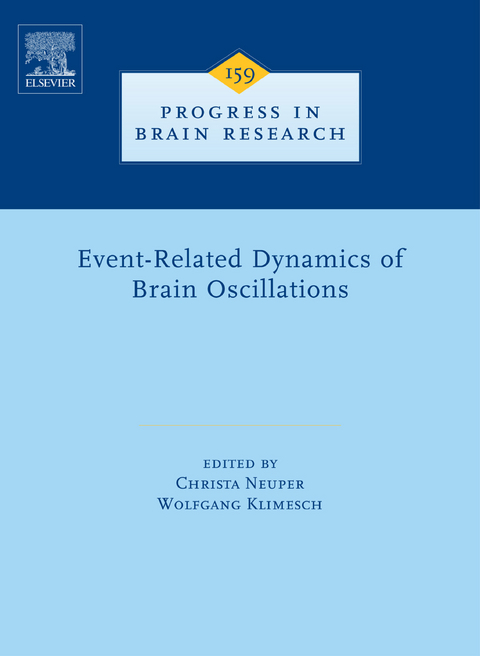
Event-Related Dynamics of Brain Oscillations (eBook)
464 Seiten
Elsevier Science (Verlag)
978-0-08-046559-3 (ISBN)
Research on brain oscillations and event-related electroencephalography (EEG) and event-related (de-) synchronization (ERD/ERS) in particular became a rapidly growing field in the last decades. A large number of laboratories worldwide are using ERD/ERS to study cognitive and motor brain function and the importance of this tool in neurocognitive research is widely recognized. This book is a summary of the most current research, methods, and applications of the study of event-related dynamics of brain oscillations. Facing the rapid progress in this field, it brings together, on the one side, fundamental questions of the underlying events, which still remain to be clarified and, on the other side, some of the most significant novel findings, which point to the key topics for future research. In particular, the chapters of this volume cover the neurophysiological fundamentals and models (Section I), new methodological approaches (Section II), current ERD research related to cognitive (Section III) and sensorimotor brain function (Section IV), invasive approaches and clinical applications (Section V), and novel developments of EEG-based brain-computer interfaces and neurofeedback (Section IV).
Cover 1
Event-Related Dynamics of Brain Oscillations 4
Copyright page 5
List of contributors 6
Introduction: 30 years of ERD/ERS research 10
The career of Gert Pfurtscheller 11
Acknowledgments 12
Selected publications 12
Contents 14
Section I: Neurophysiological Fundamentals and Theories 18
Chapter 1. Event-related neural activities: what about phase? 20
The physiology of synchronization and desynchronization 20
The concept of phase resetting 26
The concepts of phase synchrony and of phase and time delays 27
The concept of phase clustering within one signal 30
Epilogue 32
Acknowledgements 32
References 32
Chapter 2. The cortical activation model (CAM) 36
Introduction 36
Relation between ERD/ERS and CA 37
ERD/ERS depends on the level of consciousness 37
Simultaneous occurrence of ERD and ERS at one cortical location 38
Task-dependent occurrence of ERD or ERS at the same cortical locations 38
Beta ERS as marker for the CA level 40
Conclusion 42
Acknowledgments 43
References 43
Chapter 3. Source analysis of EEG oscillations using high-resolution EEG and MEG 46
Spatial properties of EEG oscillations 46
Source models for EEG oscillations 47
Spatial filtering of scalp potentials 48
Source analysis by high-resolution EEG methods 49
MEG 51
Simultaneous EEG and MEG recording 52
Spectra of average reference EEG, high-resolution EEG, and MEG 53
Spatial filtering implies temporal filtering 57
A methodological framework for interpreting the sources of EEG oscillations 58
Acknowledgments 58
References 58
Chapter 4. Principles of oscillatory brain dynamics and a treatise of recognition of faces and facial expressions 60
Introduction: aims of the study 61
The theory of the whole-brain-work: an approach to brain function by means of EEG-oscillations 62
Grandmother experiments 65
Analysis of facial expressions 69
General discussion 73
Concluding remarks 75
Acknowledgments 76
References 76
Chapter 5. Dynamic sculpting of brain functional connectivity and mental rotation aptitude 80
Oscillations and cortical integration, multiple frequencies, multiple spatial scales 80
Cognitive aptitude and functional connectivity 81
Mental rotation aptitude and functional connectivity 82
Functional connectivity topography correlated with aptitude 86
Strategy and effort as contributing factors 88
Functional connectivity sculpting 89
Neural mechanisms 91
Conclusion 91
References 91
Section II: Analysis of Dynamics of Brain Oscillations: Methodological Advances 94
Chapter 6. Quantification and visualization of event-related changes in oscillatory brain activity in the time–frequency domain 96
Introduction 96
Quantification of ERD/ERS 97
Statistical significance of ERD/ERS 99
Spatial Filters 101
Application of ERD/ERS analysis to movement-related data 103
Discussion 109
Summary and conclusion 110
Appendix 111
References 113
Chapter 7. Information-based modeling of event-related brain dynamics 116
Introduction 116
ICA history 118
ICA theory 118
ICA practice 122
ICA applications 127
Comparing IC activities across subjects 131
Summary and conclusions 136
References 137
Chapter 8. Time–frequency microstructure and statistical significance of ERD and ERS 138
Introduction 138
Time–frequency energy density 139
ERD/ERS microstructure 140
Time-frequency ERD/ERS and statistical significance 140
Other estimates of signals energy density 145
Summary 145
Acknowledgments 147
Statistics 148
Appendix C: Reproducible research 148
References 149
Chapter 9. Analyzing event-related EEG data with multivariate autoregressive parameters 152
Introduction 152
The MVAR model and its estimators 153
Derived measures 154
Statistical significance tests 156
Example: EEG data of motor imagery 158
Practical issues 160
Summary 161
References 162
Section III: ERD/ERS and Cognition 166
Chapter 10. Upper alpha ERD and absolute power: their meaning for memory performance 168
Introduction 168
Characteristic features of the event-related alpha response 169
The functional meaning of upper alpha ERD for memory 169
Alpha and cognitive performance 171
Upper alpha and memory performance: a causal or correlative relationship? 178
Conclusions: the functional meaning of ERD and ERS for task performance 179
Acknowledgements 180
References 180
Chapter 11. Sensitivity of alpha band ERD to individual differences in cognition 184
The study of individual differences in cognition „ historical accounts 184
Intelligence and neural efficiency „ the initial findings 185
Refining the neural efficiency hypothesis 185
Neurophysiological interactions of intelligence with other ability constructs 189
Conclusion 193
References 194
Chapter 12. Oscillatory neuronal dynamics during language comprehension 196
Introduction 196
Methodological framework 198
Experimental data 200
Discussion 207
Conclusion 209
Abbreviations 210
References 210
Chapter 13. Cognition- and memory-related ERD/ERS responses in the auditory stimulus modality 214
Introduction 214
Brain oscillations, EEG, and ERD/ERS 215
Basic research on cognition- and memory-related ERD/ERS responses in the auditory stimulus modality 215
Applied studies 217
Methodological studies 218
Clinical studies 219
Discussion 220
Acknowledgments 222
References 222
Section IV: ERD/ERS and Sensorimotor Processing 226
Chapter 14. ERD/ERS patterns reflecting sensorimotor activation and deactivation 228
Mu synchronization and desynchronization in voluntary movement and motor imagery 228
Beta rebound following movement and somatosensory stimulation 229
Effects of interfering sensorimotor activation and deactivation on mu ERD and beta ERS 231
Discussion and conclusions 234
Acknowledgments 238
References 238
Chapter 15. Interregional long-range and short-range synchrony: a basis for complex sensorimotor processing 240
Introduction 240
Outline 241
Abbreviations 250
References 250
Chapter 16. Cortical oscillatory changes occurring during somatosensory and thermal stimulation 254
Somatosensory ERD and ERS in the primary sensorimotor cortex and supplementary motor area 255
ERD in the secondary somatosensory cortex 257
Stimulus parameters and the somatosensory ERD/ERS 258
ERD during noxious laser stimulation 259
Warming and cooling 261
Modulation of the somatosensory ERD and ERS 262
Functional significance of ERD and ERS during somatosensory stimulation 263
Abbreviations 266
Acknowledgments 266
References 266
Chapter 17. Action–perception connection and the cortical mu rhythm 270
Introduction 270
Rolandic mu rhythm 271
Cortical oscillations and functional state of motor cortex 272
Motor cortex and mirror neurons 273
Covariation of the actor’s and observer’s motor systems 273
Action–perception loop and the mu rhythm 274
Abbreviations 275
Acknowledgments 275
References 275
Chapter 18. Converging evidence of ERD/ERS and BOLD responses in motor control research 278
Introduction 278
Tapping performance 279
Cortical control of tapping 280
Inhibiting the motor cortex 284
Conclusion and summary 286
Abbreviations 287
References 287
Section V: Invasive Approaches and Clinical Applications 290
Chapter 19. High-frequency gamma oscillations and human brain mapping with electrocorticography 292
Introduction 293
Methodological considerations 295
High-gamma ERS in sensorimotor cortex 298
High-gamma ERS in auditory and language cortices 301
Conclusions 308
Abbreviations 309
Acknowledgments 310
References 310
Chapter 20. Intracerebral study of gamma oscillations in the human sensorimotor cortex 314
Introduction 314
Subjects and methods 316
Results 317
Discussion 321
Abbreviations 325
References 325
Chapter 21. Intracerebral ERD/ERS in voluntary movement and in cognitive visuomotor task 328
Introduction 329
The cerebral location of ERD/ERS and BP in the self-paced movement paradigm 330
The cerebral location of BOLD effect (fMRI) in the self-paced movement paradigm 338
The fronto-lateral temporal location of ERD/ERS related to writing of single letters and to the executive functions 340
Conclusion 342
Abbreviations 344
Acknowledgments 345
References 345
Chapter 22. Effect of deep brain stimulation and L-Dopa on electrocortical rhythms related to movement in Parkinson’s disease 348
Introduction 348
Methods 351
Conclusion 362
Abbreviations 363
References 363
Chapter 23. Movement-related event-related desynchronization in neuropsychiatric disorders 368
Introduction 368
Conclusions 378
References 378
Section VI: Brain–Computer Interfaces and Neurofeedback 384
Chapter 24. Physiological regulation of thinking: brain–computer interface (BCI) research 386
Development of brain–computer interface (BCI) research 386
Seizure control 388
Noninvasive BCIs for communication in paralysis 391
Invasive BCIs 392
Voluntary regulation, goal-directed thinking and BCI-control in the complete locked-in patient 394
Emotional life in ALS and paralysis 397
BCIs for restoration of movement 398
The metabolic whole brain BCI 403
Concluding remarks 403
Abbreviations 404
Acknowledgments 404
References 404
Chapter 25. Motor imagery and EEG-based control of spelling devices and neuroprostheses 410
Introduction 410
Classification of ERD/ERS patterns during motor imagery 411
Usefulness of an EEG-based BCI to establish communication in severely paralyzed patients 417
Modulation of oscillatory brain signals for the restoration of movement 420
Conclusion 423
Acknowledgments 424
References 424
Chapter 26. Brain–computer interface signal processing at the Wadsworth Center: mu and sensorimotor beta rhythms 428
Introduction 428
Conclusion 435
Acknowledgments 435
References 435
Chapter 27. Validating the efficacy of neurofeedback for optimising performance 438
Introduction 438
Validation of the influence of neurofeedback training on attention in healthy participants 439
Validation of alpha–theta training 443
Implications of validation for training 445
Acknowledgement 447
References 447
Chapter 28. Future prospects of ERD/ERS in the context of brain–computer interface (BCI) developments 450
ERD/ERS patterns as a biometric measure 451
EEG-based BCI and rehabilitation after stroke 452
References 454
Subject Index 456
| Erscheint lt. Verlag | 3.12.2006 |
|---|---|
| Sprache | englisch |
| Themenwelt | Sachbuch/Ratgeber |
| Geisteswissenschaften ► Psychologie ► Biopsychologie / Neurowissenschaften | |
| Medizin / Pharmazie ► Medizinische Fachgebiete ► Neurologie | |
| Studium ► 1. Studienabschnitt (Vorklinik) ► Physiologie | |
| Naturwissenschaften ► Biologie ► Humanbiologie | |
| Naturwissenschaften ► Biologie ► Zoologie | |
| ISBN-10 | 0-08-046559-5 / 0080465595 |
| ISBN-13 | 978-0-08-046559-3 / 9780080465593 |
| Informationen gemäß Produktsicherheitsverordnung (GPSR) | |
| Haben Sie eine Frage zum Produkt? |
 PDF (Adobe DRM)
Kopierschutz: Adobe-DRM
Adobe-DRM ist ein Kopierschutz, der das eBook vor Mißbrauch schützen soll. Dabei wird das eBook bereits beim Download auf Ihre persönliche Adobe-ID autorisiert. Lesen können Sie das eBook dann nur auf den Geräten, welche ebenfalls auf Ihre Adobe-ID registriert sind.
Details zum Adobe-DRM
Dateiformat: PDF (Portable Document Format)
Mit einem festen Seitenlayout eignet sich die PDF besonders für Fachbücher mit Spalten, Tabellen und Abbildungen. Eine PDF kann auf fast allen Geräten angezeigt werden, ist aber für kleine Displays (Smartphone, eReader) nur eingeschränkt geeignet.
Systemvoraussetzungen:
PC/Mac: Mit einem PC oder Mac können Sie dieses eBook lesen. Sie benötigen eine
eReader: Dieses eBook kann mit (fast) allen eBook-Readern gelesen werden. Mit dem amazon-Kindle ist es aber nicht kompatibel.
Smartphone/Tablet: Egal ob Apple oder Android, dieses eBook können Sie lesen. Sie benötigen eine
Geräteliste und zusätzliche Hinweise
Buying eBooks from abroad
For tax law reasons we can sell eBooks just within Germany and Switzerland. Regrettably we cannot fulfill eBook-orders from other countries.
aus dem Bereich