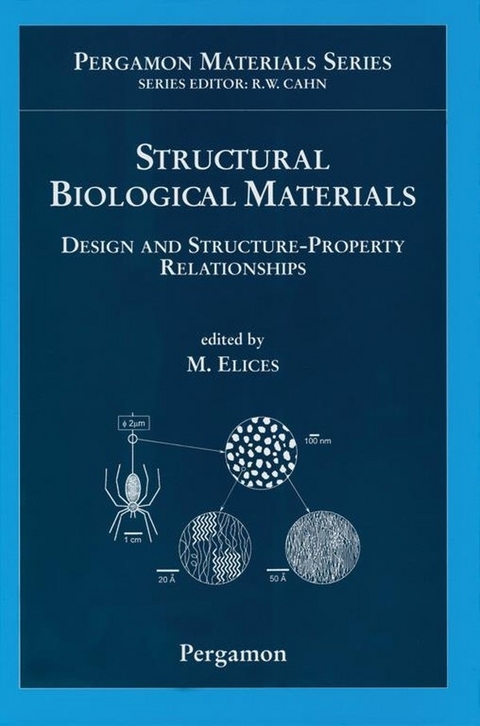
Structural Biological Materials (eBook)
380 Seiten
Elsevier Science (Verlag)
978-0-08-054190-7 (ISBN)
The materials industry has sought to observe and appreciate the relationship between structure, properties and function of these biological materials. A multidisciplinary approach, building on recent advances at the forefront of physics, chemistry and molecular biology, has been successful in producing many synthetic structures with interesting and useful properties.
Structural Biological Materials: Design and Structure-Property Relationships represents an invaluable reference in the field of biological materials science and provides an incisive view into this rapidly developing and increasingly important topic within materials science.
This book focuses on the study of three sub-groups of structural biological materials:
&bull, Hard tissue engineering, focussing on cortical bone
&bull, Soft tissue engineering
&bull, Fibrous materials, particularly engineering with silk fibers.
The fundamental relationship between structure and properties, and certain aspects of design and engineering, are explored in each of the sub-groups. The importance of these materials, both in their intrinsic properties and specific functions, are illustrated with relevant examples. These depict the successful integration of material properties, architecture and shape, providing a wide range of optimised designs, tailored to specific functions.
Edited by Manuel Elices of the Universidad Polité,cnica de Madrid, Spain, this book is Volume 4 in the Pergamon Material Series.
The ongoing process of bio-evolution has produced materials which are perfectly adapted to fulfil a specific functional role. The natural world provides us with a multitude of examples of materials with durability, strength, mechanisms of programmed self-assembly and biodegradability. The materials industry has sought to observe and appreciate the relationship between structure, properties and function of these biological materials. A multidisciplinary approach, building on recent advances at the forefront of physics, chemistry and molecular biology, has been successful in producing many synthetic structures with interesting and useful properties. Structural Biological Materials: Design and Structure-Property Relationships represents an invaluable reference in the field of biological materials science and provides an incisive view into this rapidly developing and increasingly important topic within materials science.This book focuses on the study of three sub-groups of structural biological materials:* Hard tissue engineering, focussing on cortical bone* Soft tissue engineering* Fibrous materials, particularly engineering with silk fibers.The fundamental relationship between structure and properties, and certain aspects of design and engineering, are explored in each of the sub-groups. The importance of these materials, both in their intrinsic properties and specific functions, are illustrated with relevant examples. These depict the successful integration of material properties, architecture and shape, providing a wide range of optimised designs, tailored to specific functions.Edited by Manuel Elices of the Universidad Politecnica de Madrid, Spain, this book is Volume 4 in the Pergamon Material Series.
Front Cover 1
Structural Biological Materials: Design and Structure-Property Relationships 4
Copyright Page 5
Contents 16
Series Preface 6
Acknowledgements 7
List of Contributors 8
Introduction 10
PART 1: GENERAL CONCEPTS 18
Chapter 1. Structure-Property Relationships in Biological Materials 18
Chapter 2. Design and Function of Structural Biological Materials 34
PART 2: HARD TISSUE ENGINEERING 48
Chapter 3. Structure and Mechanical Properties of Bone 48
PART 3: SOFT TISSUE ENGINEERING 90
Chapter 4. Structure-Properties of Soft Tissues. Articular Cartilage 90
Chapter 5. Bioartificial Implants: Design and Tissue Engineering 122
Chapter 6. Mechanical Characterisation of Tendons in Vitro 178
Chapter 7. Biomimicking Materials with Smart Polymers 204
PART 4: ENGINEERING WITH FIBERS 238
Chapter 8. Biological Fibrous Materials 238
Chapter 9. Computer Model for the Mechanical Properties of Fibers 286
Chapter 10. Silk Fibers: Origins, Nature and Consequences of Structure 310
Chapter 11. Modeling of the Stress-Strain Behaviour of Spider Dragline 352
Glossary 368
Subject Index 376
Structure-Property Relationships in Biological Materials
George Jeronimidis
1.1 INTRODUCTION
The study of the mechanical properties of biological materials offers a unique opportunity to understand how materials science and engineering principles are applied in Nature. It should also provide inspiration and stimulation to scientists and engineers for new materials concepts, efficient design strategies and structural optimisation. In many respects the book is aimed at the materials and engineering communities which, we believe, will benefit from ideas, concepts and solutions tuned by biological evolution.
Since the early pioneering work of D’Arcy Thompson (Thompson 1952), who studied the relationship between growth and shape of living things, the subject has been developed considerably, especially in the past twenty years. The impetus has come from a variety of disciplines and reasons: medicine and veterinary science (mechanical properties of soft and hard tissues such as skin, tendons, bone, etc., prosthetic devices, replacement materials); biology (mechanical aspects of adaptation, evolution, physiology, behaviour); agriculture and forestry (plant biomechanics in relation to crops, wood production, etc.); food industries (food quality, textural attributes related to mechanical properties, food processing and manufacture). In parallel, materials science and engineering principles, theories and techniques have also evolved and been refined providing the means to measure, interpret, analyse, quantify and model the relationships between materials, structures, design and function. The most recent addition to the list of disciplines interested in biological systems is biomimetics, the purpose of which can be summarised simply as “the abstraction of good design from Nature” (Vincent 1995).
There are several books covering various aspects of the subject (Wainwright et al. 1975, Vincent and Currey 1980 and Vincent 1990) and an increasing number of scientific papers and review articles are being published in the literature. The contribution made by James E. Gordon in the late 70’ and 80’s (Gordon 1976 and 1978) has provided perhaps the most effective catalyst for the current and growing level of interest in biological materials and structures. His books have stimulated biology, engineering, materials science and medicine to approach the subject in a truly interdisciplinary manner and to look more closely at the design aspects of biological systems for, in his words, “…nothing attracts less attention that total success”.
The most striking feature of biological systems is perhaps the way in which their mechanical properties are related to highly organised and integrated hierarchical assemblies of load-bearing units. These span many orders of magnitude, from the macromolecular level (tropocollagen units, 10− 9 m in diameter) up to whole organisms such as large animals and trees (giant redwood, 10 m. trunk diameter at the base). Stiffness, strength, toughness, etc. are modulated, tailored and optimized by controlled interactions between the hierarchies. Integrated sub-structuring is the common theme of biology, far more subtle and extensive than in any man-made material or structure.
This creates difficulties in writing on the subject because the traditional division between “materials” and “structures” in the engineering sense is far less clear-cut than in man-made artifacts and somewhat arbitrary. However, in the first two chapters of this book greater emphasis has been given on the materials aspects in the first and on the structural ones in the second. They provide a general background and examples against which the specific topics dealt with in greater detail by the various authors can be set.
The subjects covered in this publication are by no means exhaustive; they have been selected to give the reader an informed insight into new developments, state of the art scientific and technological achievements and areas of application. The common thread being the study of biological materials and structures as paradigms for the education and stimulation of material scientists and engineers (Jeronimidis and Atkins 1995 and French 1988).
1.2 BIOLOGICAL MATERIALS: SCALE, HETEROGENEITY, REPRESENTATIVE VOLUME ELEMENTS (RVE)
The most immediate reaction when studying the mechanical properties of tissues from plants and animals is, as remarked above, that the traditional distinction between “material” and “structure” is far more elusive than in man-made objects.
The nature of this dilemma is illustrated in Fig. 1.1. In practice it is convenient to be flexible and to wear the appropriate hat, material or structural, according to need, i.e. depending on the type of information sought. In fact one must be prepared to zoom in and out of the picture, as it were, analysing details or integrating data. It is true that all engineering materials, metals, plastics or ceramics, have also microstructure but, in general, their Representative Volume Element (RVE) is very small compared to the linear dimensions of the structures or structural components they are used for. The RVE of a material is the smallest volume over which the average of mechanical or physical properties, such as Young’s modulus or coefficient of thermal expansion, for example, are representative of the whole. In a metal, the grain size may be of the order of 10 μm; hence, a volume of 0.1 mm3 will contain 105 grains. Even if the grains have different orientations, with different properties in different directions, owing to anisotropy of their crystalline structure, the average value of the property over the RVE can be considered constant throughout the material. In more heterogeneous materials such as glass or carbon fibre-reinforced composites, typical fibre diameters of 5-10 μm generally mean RVEs of the order of a few mm3.
On the other hand, even a very familiar biological material such as wood offers an amazing array of hierarchies spanning in typical dimensions from nanometres (cellulose microfibrils) to the centimetre level (wood tissue). The RVEs of the various substructures cover therefore a range from 103 mm3 down to 10− 12 mm3 i.e. fifteen orders of magnitude with perhaps seven hierarchical levels: tissue, cell, laminated cell walls, individual walls, cellulose fibres, microfibrils and protofibrils. A typical wood cell (approx. 30 μm in diameter) is illustrated in Fig. 1.2 showing the fibre orientation in the various walls. The transition from wood cell to wood tissue is shown in Fig. 1.3.
This situation is common to virtually all biological materials and Figs. 1.4 to 1.6 show the hierarchical structures of tendon, muscle and bone.
For the purpose of this contribution it is convenient and more appropriate perhaps to identify the various hierarchies of biological systems using definitions such as organism, organ, tissue, cell, cell wall, etc. borrowed from by biology. The engineering equivalents, structure, component, element, material are not as effective. In the case of trees and wood, for example, the tree is the organism, trunk, branches, leaves and fruits are organs; organs are made of one or more tissues (wood, for example) and the tissues themselves are organised structures (assembly of cells and extracellular substances) made of several materials (cellulose and lignin) which, themselves are often hierarchical and heterogeneous. In bone too, one can identify the organ itself (femur, for example), the tissue (osteate, lamellar or cancellous bone), tissue components such as osteons, made of concentric lamellae, each of which contains collagen fibres and hydroxyapatite crystals. Figs. 1.7 and 1.8 show a number of hierarchies in antler, for example. In the limit one may argue that the only substances recognisable as “materials” in biology are the basic chemicals which are at the start of the assembly process of the load-bearing structures (fibres, tissues, organs, etc.). These are comparatively few. Polypeptides (collagen, elastin, keratin, muscle), polysaccarrides (cellulose, hemicelluloses,), polyphenols (lignin, tannins), hybrids such as chitin (polyacetylglucosamine) and minerals, mostly calcium salts (hydroxyapatite in bone, calcium carbonate in mollusc shells).
These material ingredients are used in a wide range of tissues such as skin and tendons (collagen, elastin, mucopolysaccharides), bone (collagen, hyrdroxyapatite), horns, feathers, nails, hooves (keratin), wood and turgid plant tissues (cellulose, hemicelluloses and lignin), soft and hard cuticles (chitin, tannins, ceramic), mollusc shells, etc. (Turner et al....
| Erscheint lt. Verlag | 8.5.2000 |
|---|---|
| Sprache | englisch |
| Themenwelt | Sachbuch/Ratgeber |
| Medizin / Pharmazie ► Physiotherapie / Ergotherapie ► Orthopädie | |
| Technik ► Maschinenbau | |
| Technik ► Medizintechnik | |
| Technik ► Umwelttechnik / Biotechnologie | |
| ISBN-10 | 0-08-054190-9 / 0080541909 |
| ISBN-13 | 978-0-08-054190-7 / 9780080541907 |
| Informationen gemäß Produktsicherheitsverordnung (GPSR) | |
| Haben Sie eine Frage zum Produkt? |
 EPUB (Adobe DRM)
Kopierschutz: Adobe-DRM
Adobe-DRM ist ein Kopierschutz, der das eBook vor Mißbrauch schützen soll. Dabei wird das eBook bereits beim Download auf Ihre persönliche Adobe-ID autorisiert. Lesen können Sie das eBook dann nur auf den Geräten, welche ebenfalls auf Ihre Adobe-ID registriert sind.
Details zum Adobe-DRM
Dateiformat: EPUB (Electronic Publication)
EPUB ist ein offener Standard für eBooks und eignet sich besonders zur Darstellung von Belletristik und Sachbüchern. Der Fließtext wird dynamisch an die Display- und Schriftgröße angepasst. Auch für mobile Lesegeräte ist EPUB daher gut geeignet.
Systemvoraussetzungen:
PC/Mac: Mit einem PC oder Mac können Sie dieses eBook lesen. Sie benötigen eine
eReader: Dieses eBook kann mit (fast) allen eBook-Readern gelesen werden. Mit dem amazon-Kindle ist es aber nicht kompatibel.
Smartphone/Tablet: Egal ob Apple oder Android, dieses eBook können Sie lesen. Sie benötigen eine
Geräteliste und zusätzliche Hinweise
Buying eBooks from abroad
For tax law reasons we can sell eBooks just within Germany and Switzerland. Regrettably we cannot fulfill eBook-orders from other countries.
aus dem Bereich