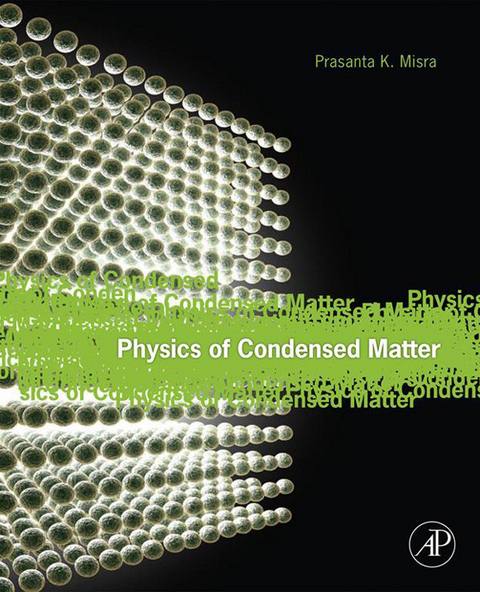
Physics of Condensed Matter (eBook)
688 Seiten
Elsevier Science (Verlag)
978-0-12-384955-7 (ISBN)
Physics of Condensed Matter is designed for a two-semester graduate course on condensed matter physics for students in physics and materials science. While the book offers fundamental ideas and topic areas of condensed matter physics, it also includes many recent topics of interest on which graduate students may choose to do further research. The text can also be used as a one-semester course for advanced undergraduate majors in physics, materials science, solid state chemistry, and electrical engineering, because it offers a breadth of topics applicable to these majors. The book begins with a clear, coherent picture of simple models of solids and properties and progresses to more advanced properties and topics later in the book. It offers a comprehensive account of the modern topics in condensed matter physics by including introductory accounts of the areas of research in which intense research is underway. The book assumes a working knowledge of quantum mechanics, statistical mechanics, electricity and magnetism and Green's function formalism (for the second-semester curriculum). - Covers many advanced topics and recent developments in condensed matter physics which are not included in other texts and are hot areas: Spintronics, Heavy fermions, Metallic nanoclusters, Zno, Graphene and graphene-based electronic, Quantum hall effect, High temperature superdonductivity, Nanotechnology- Offers a diverse number of Experimental techniques clearly simplified- Features end of chapter problems
Front Cover 1
Physics of Condensed Matter 4
Copyright 5
Dedication 6
Table of contents 8
Preface 22
Acknowledgments 24
Chapter 1. Basic Properties of Crystals 26
1.1 Crystal Lattices 27
1.2 Bravais Lattices in Two and Three Dimensions 29
1.3 Lattice Planes and Miller Indices 36
1.4 Bravais Lattices and Crystal Structures 38
1.5 Crystal Defects and Surface Effects 39
1.6 Some Simple Crystal Structures 40
1.7 Bragg Diffraction 44
1.8 Laue Method 45
1.9 Reciprocal Lattice 46
1.10 Brillouin Zones 52
1.11 Diffraction by a Crystal Lattice with a Basis 56
Problems 59
References 60
Chapter 2. Phonons and Lattice Vibrations 62
2.1 Lattice Dynamics 62
2.2 Lattice Specific Heat 73
2.3 Second Quantization 78
2.4 Quantization of Lattice Waves 86
Problems 91
References 93
Chapter 3. Free Electron Model 96
3.1 The Classical (Drude) Model of a Metal 96
3.2 Sommerfeld Model 98
3.3 Fermi Energy and the Chemical Potential 107
3.4 Specific Heat of the Electron Gas 109
3.5 DC Electrical Conductivity 111
3.6 The Hall Effect 112
3.7 Failures of the Free Electron Model 114
Problems 115
References 118
Chapter 4. Nearly Free Electron Model 120
4.1 Electrons in a Weak Periodic Potential 121
4.2 Bloch Functions and Bloch Theorem 124
4.3 Reduced, Repeated, and Extended Zone Schemes 124
4.4 Band Index 126
4.5 Effective Hamiltonian 127
4.6 Proof of Bloch’s Theorem from Translational Symmetry 128
4.7 Approximate Solution Near a Zone Boundary 130
4.8 Different Zone Schemes 134
4.9 Elementary Band Theory of Solids 136
4.10 Metals, Insulators, and Semiconductors 137
4.11 Brillouin Zones 142
4.12 Fermi Surface 144
Problems 149
References 155
Chapter 5. Band-Structure Calculations 156
5.1 Introduction 156
5.2 Tight-Binding Approximation 156
5.3 LCAO Method 160
5.4 Wannier Functions 165
5.5 Cellular Method 167
5.6 Orthogonalized Plane-Wave (OPW) Method 170
5.7 Pseudopotentials 172
5.8 Muffin-Tin Potential 174
5.9 Augmented Plane-Wave (APW) Method 175
5.10 Green’s Function (KKR) Method 177
5.11 Model Pseudopotentials 181
5.12 Empirical Pseudopotentials 182
5.13 First-Principles Pseudopotentials 183
Problems 185
References 188
Chapter 6. Static and Transport Properties of Solids 190
6.1 Band Picture 191
6.2 Bond Picture 192
6.3 Diamond Structure 193
6.4 Si and Ge 193
6.5 Zinc-Blende Semiconductors 195
6.6 Ionic Solids 197
6.7 Molecular Crystals 199
6.8 Cohesion of Solids 199
6.9 The Semiclassical Model 204
6.10 Liouville’s Theorem 207
6.11 Boltzmann Equation 208
6.12 Relaxation Time Approximation 209
6.13 Electrical Conductivity 211
6.14 Thermal Conductivity 212
6.15 Weak Scattering Theory of Conductivity 213
6.16 Resistivity Due to Scattering by Phonons 217
Problems 219
References 221
Chapter 7. Electron–Electron Interaction 224
7.1 Introduction 224
7.2 Hartree Approximation 225
7.3 Hartree–Fock Approximation 228
7.4 Effect of Screening 232
7.5 Friedel Sum Rule and Oscillations 239
7.6 Frequency and Wave-Number-Dependent Dielectric Constant 242
7.7 Mott Transition 247
7.8 Density Functional Theory 248
7.9 Fermi Liquid Theory 250
7.10 Green’s Function Method 257
Problems 260
References 266
Chapter 8. Dynamics of Bloch Electrons 268
8.1 Semiclassical Model 268
8.2 Velocity Operator 269
8.3 k · p Perturbation Theory 270
8.4 Quasiclassical Dynamics 271
8.5 Effective Mass 272
8.6 Bloch Electrons in External Fields 273
8.7 Bloch Oscillations 279
8.8 Holes 280
8.9 Zener Breakdown (Approximate Method) 283
8.10 Rigorous Calculation of Zener Tunneling 286
8.11 Electron–Phonon Interaction 289
Problems 296
References 299
Chapter 9. Semiconductors 300
9.1 Introduction 300
9.2 Electrons and Holes 303
9.3 Electron and Hole Densities in Equilibrium 304
9.4 Intrinsic Semiconductors 308
9.5 Extrinsic Semiconductors 309
9.6 Doped Semiconductors 310
9.7 Statistics of Impurity Levels in Thermal Equilibrium 313
9.8 Diluted Magnetic Semiconductors 315
9.9 Zinc Oxide 321
9.10 Amorphous Semiconductors 321
Problems 325
References 328
Chapter 10. Electronics 330
10.1 Introduction 330
10.2 p-n Junction 331
10.3 Rectification by a p-n Junction 336
10.4 Transistors 343
10.5 Integrated Circuits 350
10.6 Optoelectronic Devices 350
10.7 Graphene 354
10.8 Graphene-Based Electronics 357
Problems 358
References 361
Chapter 11. Spintronics 364
11.1 Introduction 364
11.2 Magnetoresistance 365
11.3 Giant Magnetoresistance 365
11.4 Mott’s Theory of Spin-Dependent Scattering of Electrons 367
11.5 Camley–Barnas Model 370
11.6 CPP-GMR 373
11.7 MTJ, TMR, and MRAM 377
11.8 Spin Transfer Torques and Magnetic Switching 381
11.9 Spintronics with Semiconductors 382
Problems 389
References 392
Chapter 12. Diamagnetism and Paramagnetism 394
12.1 Introduction 395
12.2 Atomic (or Ionic) Magnetic Susceptibilities 396
12.3 Magnetic Susceptibility of Free Electrons in Metals 403
12.4 Many-Body Theory of Magnetic Susceptibility of Bloch Electrons in Solids 413
12.5 Quantum Hall Effect 421
12.6 Fractional Quantum Hall Effect 425
Problems 426
References 432
Chapter 13. Magnetic Ordering 434
13.1 Introduction 435
13.2 Magnetic Dipole Moments 436
13.3 Models for Ferromagnetism and Antiferromagnetism 437
13.4 Ferromagnetism in Solids 447
13.5 Ferromagnetism in Transition Metals 452
13.6 Magnetization of Interacting Bloch Electrons 459
13.7 The Kondo Effect 464
13.8 Anderson Model 464
13.9 The Magnetic Phase Transition 465
Problems 468
References 473
Chapter 14. Superconductivity 476
14.1 Properties of Superconductors 477
14.2 Meissner–Ochsenfeld Effect 480
14.3 The London Equation 480
14.4 Ginzburg–Landau Theory 481
14.5 Flux Quantization 484
14.6 Josephson Effect 485
14.7 Microscopic Theory of Superconductivity 487
14.8 Strong-Coupling Theory 497
14.9 High-Temperature Superconductors 498
Problems 506
References 510
Chapter 15. Heavy Fermions 512
15.1 Introduction 513
15.2 Kondo-Lattice, Mixed-Valence, and Heavy Fermions 515
15.3 Mean-Field Theories 523
15.4 Fermi-Liquid Models 527
15.5 Metamagnetism in Heavy Fermions 531
15.6 Ce- and U-Based Superconducting Compounds 533
15.7 Other Heavy-Fermion Superconductors 538
15.8 Theories of Heavy-Fermion Superconductivity 541
15.9 Kondo Insulators 541
Problems 544
References 549
Chapter 16. Metallic Nanoclusters 552
16.1 Introduction 553
16.2 Electronic Shell Structure 556
16.3 Geometric Shell Structure 562
16.4 Cluster Growth on Surfaces 565
16.5 Structure of Isolated Clusters 567
16.6 Magnetism in Clusters 572
16.7 Superconducting State of Nanoclusters 583
Problems 587
References 590
Chapter 17. Complex Structures 592
17.1 Liquids 593
17.2 Superfluid 4He 595
17.3 Liquid 3He 598
17.4 Liquid Crystals 603
17.5 Quasicrystals 608
17.6 Amorphous Solids 615
Problems 619
References 622
Chapter 18. Novel Materials 624
18.1 Graphene 625
18.2 Fullerenes 633
18.3 Fullerenes and Tubules 638
18.4 Polymers 642
18.5 Solitons in Conducting Polymers 647
18.6 Photoinduced Electron Transfer 652
Problems 652
References 655
Appendix A: Elements of Group Theory 658
A.1 Symmetry and Its Consequences 658
A.2 Space Groups 659
A.3 Point Group Operations 661
Reference 664
Appendix B: Mossbauer Effect 666
B.1 Introduction 666
B.2 Recoilless Fraction 667
B.3 Average Transferred Energy 668
Reference 669
Appendix C: Introduction to Renormalization Group Approach 670
C.1 Critical Behavior 670
C.2 Theory for Scaling 671
C.3 Renormalization Group Approach 673
References 674
Index 676
Preface
This textbook is designed for a one-year (two semesters) graduate course on condensed matter physics for students in physics, materials science, solid state chemistry, and electrical engineering. It can also be used as a one-semester course for advanced undergraduate majors in physics, materials science, chemistry, and electrical engineering, and another one-semester course for graduate students in these areas. The book assumes a working knowledge of quantum mechanics, statistical mechanics, electricity and magnetism, and Green’s function formalism (for the second-semester curriculum). The book is written as a two-semester graduate-level textbook, but it can also be used as a reference book by faculty and other researchers actively engaged in research in condensed matter physics. With judicious choice of topics, the book can be divided into two parts: “Fundamental Concepts” designed to be taught in the first semester, and “Research Applications” to be taught in the second semester. Obviously, the first part can be taught to advanced undergraduate majors as an introductory course.
The later chapters are self-contained. Each research topic has a brief introduction, a review, and a summary of basic foundations for advanced research. This is done with the belief that the students will develop the skills and will be sufficiently prepared to develop an interest in one of the vast areas of the topics covered under the umbrella of “condensed matter physics.” In fact, this wide diversity of topics, the research on which has been increasing exponentially during the past decade, makes it nearly impossible to write a two-semester textbook for graduate students. Probably that is the reason for a dearth of graduate-level textbooks in condensed matter physics. This has led to an increasingly difficult task for the instructor because he or she has to prepare notes from a variety of textbooks, reference books, and review articles, especially to teach in the second-semester graduate level.
There has been slow but steady growth in the area of solid state physics after it was recognized as a separate branch of physics around 1940, probably after the publication of the book The Modern Theory of Solids by Seitz. The main reason for this growth is solid state physics is essentially the applied branch of physics with a variety of technological applications and has attracted students from other disciplines. The slow but steady growth accelerated in the 1960s because of extensive research funding due to the space program, and eventually solid state physics became the major branch of physics attracting the maximum number of faculty and students. The American Physical Society officially changed the name of its largest group from “Solid State Physics” to “Condensed Matter Physics,” thereby including liquids and other soft materials. This change in 1978 has led to explosive growth in condensed matter physics during the past 30 years, and the material for supplementing the available textbooks has risen exponentially. In addition, research in various areas has accelerated rapidly, fueled by grants and a need for fast development in computer memory and storage as well as other applications of nanoscience and nanotechnology. The subject, which has now become multidisciplinary, includes materials science, solid state chemistry, and electrical engineering.
Recently, I wrote a book called Heavy-Fermion Systems, which is a part of the book series “Handbook of Metal Physics,” of which I am the series editor. A large number of distinguished physicists and chemists contributed to the book series and I have learned much while editing their work. These are advanced research—level books, but it became obvious that there is a need for a one-year (two-semester) graduate-level textbook in condensed matter physics that includes material on some of the new topics covered in this book series as well as in many other advanced research—level books and research reviews in prestigious journals. A graduate student should have the choice to select a topic for research after being taught in the classroom in order to acquire enough background on the topic. I have endeavored to do just that in this textbook, which has been limited to 18 chapters and 3 appendices. The project has taken several years, much longer than I had originally planned. I have learned a lot during this period, including the fact that the boundaries between the various disciplines in physics, chemistry, electrical engineering, and materials science are getting blurred.
The book has three objectives:
1. To present a coherent, clear, and intelligible picture of simple models of crystalline solids in the first few chapters. The properties of real solids, which are more complicated, are dealt with in later chapters. The more advanced topics are dealt with in the later part of each chapter (after the first few introductory chapters). Each chapter includes a collection of problems in order to enable students to have a grasp of the topics taught in the chapter. The problems at the end of each chapter are designed to make the students derive some of the formulas of analytical development with no intrinsic interest. The objective is to keep the book within a reasonable length, but more importantly, with the belief that the mathematical steps are better understood if they are derived by the students with the aid of hints and suggestions. In the second part of the book (Research Applications), some of the problems at the end of the chapter are extensions of the advanced topics covered in the chapter. In this part, some other problems are designed to make the applications of the topics more clear. It is up to the instructor to choose and assign the problems, and some instructors have their own list of problems. However, students should at least read all the problems even if they do not have any motivation or intention to solve them.
2. To present a comprehensive account of the modern topics in condensed matter physics by including introductory accounts of the areas where intense research is going on at present. To be able to do so, I have included chapters on Spintronics (Chapter 11), Heavy Fermions (Chapter 15), Metallic Nanoclusters (Chapter 16), and Novel Materials (Chapter 18). In addition, I have included sections on ZnO (Section 9.9), graphene (Section 10.7), graphene-based electronics (Section 10.8), quantum hall effect (Section 12.5), fractional quantum hall effect (Section 12.6), high-temperature superconductivity (Section 14.9), liquid 3He (Section 17.3), and quasicrystals (Section 17.5). Most of these topics are normally not included in standard textbooks in condensed matter physics. In fact, condensed matter physics is rapidly growing as an interdisciplinary subject because of its application in nanoscience and other areas of fast-growing science and technology. The objective of this book is to present the fundamental concepts as well as the methods for advanced research in this area.
3. To keep the size of the book within a reasonable length so that it can be taught as a two-semester course, I have avoided too many diagrams as well as excluded material not usually taught but included in most standard textbooks. I have also avoided including too many tables that list the properties of solids because these can be easily found in books specifically designed to provide such information. In addition, I have made a comprehensive review of many important topics such as band-structure calculations (Chapter 5), but left the details for students to learn if they are interested in doing research involving such topics.
I have consulted a large number of research papers and books while writing this textbook. It is not possible to acknowledge all these books and research papers at the appropriate places as is usually done in advanced research—level books. I have acknowledged whenever I have reprinted a figure with the permission of the author/publisher from a research paper published in a research journal or a book. I have also acknowledged at appropriate places whenever I have used any material published in research journals. There is a list of references at the end of each chapter where I have acknowledged the books and research papers I have used as primary sources of reference while writing this textbook.
Acknowledgments
I learned the skills to do research in theoretical solid state physics from Professor Laura M. Roth who was my Ph.D. advisor at Tufts University. I have improved those skills by working as a postdoctoral research associate with Professor Leonard Kleinman of the University of Texas at Austin. I learned a lot of basic techniques as well as gained physical insight to solve a variety of research problems during my 10 years of collaboration with late Professor Joseph Callaway of Louisiana State University. I am also thankful to Professor S. D. Mahanti of Michigan State University with whom I have collaborated and published several important research papers on applications of many-body theory. I am thankful to the distinguished physicists and chemists who have contributed to the book series “Hand Book of Metal Physics,” of which I had the privilege to be the Series Editor. I am thankful to the large number of colleagues and friends with whom I have consulted while writing this book, especially on their opinion as to what subjects should be included in a two-semester graduate-level textbook. I am also thankful to the graduate students who have worked on their Ph.D. theses under my...
| Erscheint lt. Verlag | 26.1.2011 |
|---|---|
| Sprache | englisch |
| Themenwelt | Sachbuch/Ratgeber |
| Mathematik / Informatik ► Mathematik | |
| Naturwissenschaften ► Physik / Astronomie ► Festkörperphysik | |
| Technik | |
| ISBN-10 | 0-12-384955-1 / 0123849551 |
| ISBN-13 | 978-0-12-384955-7 / 9780123849557 |
| Informationen gemäß Produktsicherheitsverordnung (GPSR) | |
| Haben Sie eine Frage zum Produkt? |
 PDF (Adobe DRM)
Kopierschutz: Adobe-DRM
Adobe-DRM ist ein Kopierschutz, der das eBook vor Mißbrauch schützen soll. Dabei wird das eBook bereits beim Download auf Ihre persönliche Adobe-ID autorisiert. Lesen können Sie das eBook dann nur auf den Geräten, welche ebenfalls auf Ihre Adobe-ID registriert sind.
Details zum Adobe-DRM
Dateiformat: PDF (Portable Document Format)
Mit einem festen Seitenlayout eignet sich die PDF besonders für Fachbücher mit Spalten, Tabellen und Abbildungen. Eine PDF kann auf fast allen Geräten angezeigt werden, ist aber für kleine Displays (Smartphone, eReader) nur eingeschränkt geeignet.
Systemvoraussetzungen:
PC/Mac: Mit einem PC oder Mac können Sie dieses eBook lesen. Sie benötigen eine
eReader: Dieses eBook kann mit (fast) allen eBook-Readern gelesen werden. Mit dem amazon-Kindle ist es aber nicht kompatibel.
Smartphone/Tablet: Egal ob Apple oder Android, dieses eBook können Sie lesen. Sie benötigen eine
Geräteliste und zusätzliche Hinweise
Buying eBooks from abroad
For tax law reasons we can sell eBooks just within Germany and Switzerland. Regrettably we cannot fulfill eBook-orders from other countries.
aus dem Bereich