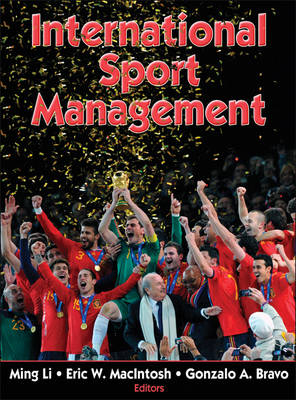
International Sport Management
Human Kinetics (Verlag)
978-0-7360-8273-0 (ISBN)
- Titel ist leider vergriffen;
keine Neuauflage - Artikel merken

Through a systematic presentation of topics and issues in international sport, this textbook offers a long-overdue guide for students in this burgeoning subfield in sport management. Editors Li, MacIntosh, and Bravo have assembled contributors from all corners of the globe to present a truly international perspective on the topic. With attention to diversity and multiple viewpoints, each chapter is authored by distinguished academics and practitioners in the field. A foreword by esteemed sport management scholar Dr. Earle Zeigler emphasizes the importance of a dedicated study of the issues in international sport management.
All chapters in the text use a global perspective to better showcase how international sport operates in various geopolitical environments and cultures. The text is arranged in five parts, each serving a unique purpose:
•To outline the issues associated with international sport management
•To examine sport using a unique perspective that emphasizes its status as a global industry
•To introduce the structure of governance in international sport
•To examine the management essentials in international sport
•To apply these strategies in the business segments of sport marketing, sport media and information technology, sport facilities and design, sport event management, and sport tourism
Written to engage students, International Sport Management contains an array of learning aids to assist with comprehension of the material. It includes case studies and sidebars that apply the concepts to real-world situations and demonstrate the varied issues, challenges, and opportunities affecting sport management worldwide. Chapter objectives, key terms, learning activities, summaries, and discussion questions guide learning in this wide-ranging subject area. In addition, extensive reference sections support the work of practitioners in the field.
With International Sport Management, both practicing and future sport managers can develop an increased understanding of the range of intercultural competencies necessary for success in the field. Using a framework of strategic and total-quality management, the text allows readers to examine global issues from an ethical perspective and uncover solutions to complex challenges that sport managers face. With this approach, readers will learn how to combine business practices with knowledge in international sport to lead their current and future careers.
International Sport Management offers readers a multifaceted view of the issues, challenges, and opportunities in international sport management as well as the major functional areas that govern international sport. The text provides students, academics, and practitioners with critical insights into the practice of business as it applies to international sport.
Ming Li, EdD, is professor in sports administration and chair of the department of sports administration in the College of Business at Ohio University, USA. Li received his doctorate in sport administration from the University of Kansas. His research interests are in financial and economic aspects of sport and management of sport business in a global context. Li is a former president of the North American Society for Sport Management (NASSM) and currently is serving as commissioner of the Commission on Sport Management Accreditation (COSMA). He is a member on the editorial board of the Journal of Sport Management and Sport Marketing Quarterly and has coauthored two books in sport management. He is guest professor of six institutions in China, including the Central University of Finance and Economics and Tianjin University of Sport. Li served as an Olympic envoy for the 1996 Atlanta Olympic Games. He also served as a consultant for the 2010 Guangzhou Asian Games Organizing Committee. Eric W. MacIntosh, PhD, is an assistant professor in the faculty of health sciences, School of Human Kinetics at the University of Ottawa, Ontario, Canada. Previously, he was assistant professor at Slippery Rock University in Pennsylvania. MacIntosh earned his doctorate in kinesiology from the University of Western Ontario with a specialization in sport management. His research focuses on organizational culture theory, and he is a frequent consultant to sport organizations regarding organizational culture. He has presented his research at sport management conferences both national and internationally and has been published in sport management journals. MacIntosh serves as the division chair of sport and tourism for the Administrative Sciences Association of Canada and is a member of the North American Society for Sport Management. He is the former student president of the North American Society for Sport Management. In his free time, he enjoys hockey, exercise, and adventure racing. MacIntosh resides in Orleans, Ontario, Canada.Gonzalo Bravo, PhD, is an assistant professor of sport management at West Virginia University, USA. A native of Santiago, Chile, Bravo completed a master's degree in sport administration from Penn State University and a PhD in sport management from Ohio State University. Before joining academia, he worked as sport director in a large sport organization in Chile. His research interests focus on issues in organizational behavior and sport management as an academic discipline. His work has been published in the International Journal of Sport Marketing and Sponsorship, Sport Management EducationJournal, and the Journal of Sport Management. He has presented invited lectures and keynote speeches in Brazil, Chile, China, Japan, Mexico, and Venezuela. Bravo is member of the North American Society for Sport Management and the North American Society for the Sociology of Sport. He also serves as the vice president for the Latin American Association for Sport Management and scientific director for the Latin American Association for Socio-Cultural Studies in Sport.
Part I. Issues in International Sport Management
Chapter 1. Key Concepts and Critical Issues
Key Concepts
Sport Management Issues in the Global Sport Environment
International Competencies for Sport Managers
Summary
Chapter 2. Strategic Management in International Sport
Reasons to Enter the Global Marketplace
Global Expansion and Comparative Advantage
Strategic Management Process
Global Strategies in the Sport Industry
Trend Analysis in the Sport Industry
Social Responsibility Guidelines
Future Trends in International Sport Industry
Summary
Chapter 3. Intercultural Management in Sport Organizations
Why Intercultural Management Matters
National Culture
Organizational Culture
Culture Shock and the Role of Human Resources
Employee Socialization
Summary
Part II. Field of Play in International Sport
Chapter 4. Sport in North America
Economic Impact of U.S. Sport
Structure and Governance of Sport in the United States
Professional Sport in the United States
Amateur Sport in the United States
Structure of Sport in Canada
Professional and Elite Sport in Canada
Amateur Sport in Canada
Summary
Chapter 5. Sport in Latin America
Geography and Background of Latin America
Cultural Foundations of Sport in Latin America
Structure of Latin American Sport Systems
The Sport Industry in Latin America
International Sporting Events and Regional Governing Bodies
Summary
Chapter 6. Sport in Europe
Geography and Background of Europe
The European Sport Model
Economics of Sport in Europe
European Sport Law
European Sport in the Global Marketplace
Sport in Eastern Europe
Summary
Chapter 7. Sport in Africa and the Middle East
Geography and Background of Africa and the Middle East
The Colonial Experience and Sport in Africa
Current Role of Sport in Africa and the Middle East
Sport Organizations in Africa and the Middle East
Summary
Chapter 8. Sport in South Asia, Southeast Asia and Oceania
Geography and Background of South Asia, Southeast Asia and Oceania
Role of Sport in South Asia, Southeast Asia and Oceania
Sport Development and Governance in South Asia, Southeast Asia, and Oceania
Managing Sport in South Asia, Southeast Asia, and Oceania
Staging Sport Megaevents in South Asia, Southeast Asia, and Oceania
Summary
Chapter 9. Sport in Northeast Asia
Geography and Background of Northeast Asia
Sport in Northeast Asia
Sport Governance in Northeast Asia
Professional Sport in Northeast Asia
Major Sport Events in Northeast Asia
Summary
Part III. Governance in International Sport
Chapter 10. Olympic and Paralympic Sport
Olympic and Paralympic Organization Structure and Governance
History and Commercial Development of the Olympic and Paralympic Games
Corruption and Reform
Staging the Olympic and Paralympic Games
Social and Ethical Issues in Olympic and Paralympic Sport
Fair Play on and off the Playing Field
Summary
Chapter 11. International Sport Federations
What Are International Federations?
International Federations and National Federations
Management of International Federations
Summary
Chapter 12. Professional Sport Leagues and Tours
Structure and Governance of International Professional Sport Leagues
Economic Nature of Professional Sport Leagues
Revenue Sources for Professional Sport Leagues
Competition Among Leagues
Summary
Chapter 13. International Youth, School, and Collegiate Sport
Defining Youth, School, and Club Sport
Governance and Organization of International Youth Sport Events
Governance and Organization of School Sport
Governance of Club Sport
Summary
Part IV. Management Essentials in International Sport
Chapter 14. Macroeconomics of International Sport
Role of Sport in a National Economy
Macroeconomic Effects of Sport
Tangible and Intangible Effects
Primary Impact of a Sport Event
Multiplier Effect
Long- and Short-Term Benefits From Sport and the Legacy Effect
Summary
Chapter 15. Business and Finance of International Sport Leagues
North American League Model
European League Model
East Asian League Models
Consequences of League Design and Team Ownership
Summary
Chapter 16. Corporate Social Responsibility, Sport, and Development
Defining Corporate Social Responsibility
Emergence of Corporate Social Responsibility in Sport
Approaches to Understanding Corporate Social Responsibility in Sport
Corporate Social Responsibility in Sport and Economic Development
The United Nations Global Compact
Summary
Chapter 17. International Sport Law
What Is International Sport Law?
Conflict Resolution in International Sport
Athlete Representation and Athlete Rights
Promoting Sport for All
Integrity of International Sport
Summary
Chapter 18. Managing Service Quality in International Sport
What Is a Service?
Service Quality in International Sport
Service Failure and Recovery in International Sport
Summary
Part V. International Sport Business Strategies
Chapter 19. International Sport Marketing
Marketing Principles and Terms
The International Sport Consumer
Marketing and Sponsorship in a Global Economy
International Brand Management
Summary
Chapter 20. New Media and International Sport
What Is New Media?
New Media Technologies
New Media and Sport Content
New Media Challenges
New Media Dimensions
Summary
Chapter 21. Sport Facilities Management
Types of Facilities
Facility Personnel
Management Structure Options
Issues in Facility Management
Risk Management
Summary
Chapter 22. International Sport Tourism
Core Principles and Terms
Economic Impact of Sport Tourism
Social Costs and Benefits of Sport Tourism
Legacy Effects of Sport Tourism
Sport Tourism Planning and Evaluation
Summary
| Zusatzinfo | 8.5 |
|---|---|
| Verlagsort | Champaign, IL |
| Sprache | englisch |
| Maße | 216 x 279 mm |
| Gewicht | 1451 g |
| Themenwelt | Sachbuch/Ratgeber ► Sport |
| Wirtschaft | |
| ISBN-10 | 0-7360-8273-5 / 0736082735 |
| ISBN-13 | 978-0-7360-8273-0 / 9780736082730 |
| Zustand | Neuware |
| Informationen gemäß Produktsicherheitsverordnung (GPSR) | |
| Haben Sie eine Frage zum Produkt? |
aus dem Bereich