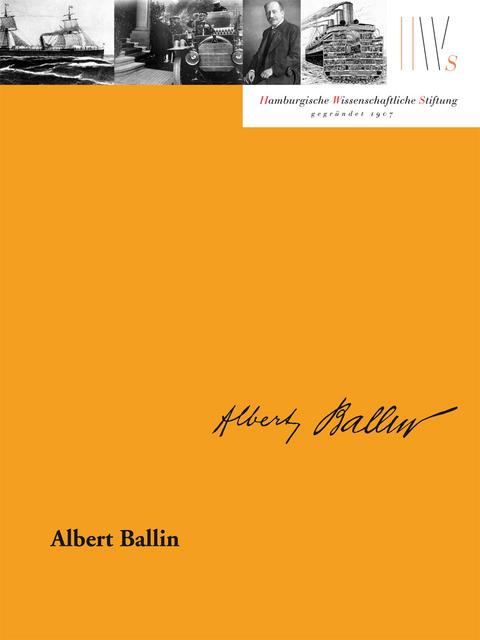
Albert Ballin
Hamburg University Press - Staats- und Universitätsbibliothek Hamburg Carl von Ossietzky (Verlag)
978-3-937816-80-7 (ISBN)
- Titel nicht im Sortiment
- Artikel merken
Contents
Publisher’s preface. p. 4
Foreword by the Chairman of the Executive Board of Hapag-Lloyd AG. p. 5
1. Prologue. p. 7
2. Early years. p. 10
Parents and childhood. p. 10
Starting into business on his own. p. 11
Marriage. p. 16
Personality. p. 18
3. Albert Ballin and the rise of Hapag. p.24
Hapag before Albert Ballin. p. 24
The first German top manager. p. 25
Shipbuilding policy. p. 31
Hapag as supplier of tourism services. p. 43
Emigrant halls. p. 47
Expansion of Hapag’s liner network. p. 56
Shipping diplomacy. p. 61
4. Albert Ballin and politics. p.72
“Little Potsdam” and Hamfelde. p. 72
Albert Ballin and the Kaiser. p. 74
Albert Ballin and his political influence. p. 80
Albert Ballin and the Admiral. p. 82
Albert Ballin and “big politics”. p. 84
5. Albert Ballin and the “great seminal Catastrophe of the 20th Century“. p.90
Economic expansion and military confrontation. p. 90
Albert Ballin in July 1914. p. 92
Hapag in the first world war. p. 94
Political influence in wartime Berlin. p. 97
Albert Ballin’s attitudes to the war aims of the German Empire. p. 100
Albert Ballin’s attitudes to submarine warfare. p.102
Peace via Wilson. p. 104
The end. p. 107
6. Epilogue. p. 117
7.Appendices. p. 121
Family tree (excerpt). p. 121
Albert Ballin and Hapag. p. 122
8. Sources, literature and photo credits. p. 124
9. Name index. p. 130
Foreword by the Chairman of the Executive Board of Hapag-Lloyd AG Albert Ballin’s name stands for an unprecedented success story in business: under his management, Hapag grew into the largest shipping company in the world, and Hamburg became the gateway to this world. Ballin’s generous and farsighted sponsoring activities, on the other hand, are less well known. The “top manager” who represented his company so impressively in public was very discrete with his sponsoring of worthy causes. Success counted for more than publicity for Ballin, who was particularly fond of linking financial support with practical assistance. His commitment on behalf of the Hamburg Scientific Foundation was typical in this respect: Ballin was not only a generous financial promoter, but also helped to organise the large ethnological Pacific Expedition. In this combination lay Ballin’s strength: he was a pragmatic visionary and could intuitively respond to trends of the time as well as turn them to profitable ends. While he developed new business areas with a visionary spirit, he also attended to every detail of his “overall work of art Hapag”. He thus made history. He invented the modern cruise in 1891 and then expanded Hapag also into the pioneering company in tourism and was even involved in civil aviation. Hapag achieved its global success thanks above all to the service it offered, in all classes: even poor emigrants were always taken seriously as customers and attracted with offers of passages. Millions of Europeans set off from Hapag’s internationally acclaimed emigrant town in the Port of Hamburg to start a new life overseas. The director general, one of the first German managers, devoted himself so wholeheartedly to his life’s work that it was stated: “He was Hapag, and Hapag was him.” For Ballin, that meant above all a sense of responsibil- ity: the visionary was never a gambler. The Hapag balance sheets of his era impressively confirm the sound financial foundation of even the most am- bitious projects of the company at any time. 5 Ballin had a wide-ranging sense of responsibility. He regarded Hapag as an integral component of its home country as well as integrated in a world economy with interconnections that he understood far better than most politicians of his time. He was a successful shipping diplomat who for decades at the head of large international conferences and joint ventures managed to solve even the most controversial problems constructively. Ballin also tried finally to transfer this successful model to politics: he made great efforts to advocate German-British rapprochement from 1908, but failed tragically because of the military-political establishment. Vision just as much as pragmatism were also typical of the social involvement of the head of Hapag. For example, in 1911 with his discrete commitment he played a decisive part in ensuring the financing of Lüneburg Heath Nature Park. In 1909 he had already joined the Jordsand Association and supported the exemplary environmental protection project by helping fi- nance the purchase of Hallig Norderoog. Ballin was also a particularly gen- erous and forward-looking patron of science: he was, for example, one of the financial backers making possible the beginnings of the presentday Max Planck Society. Albert Ballin embodied what is regarded as typically “Hanseatic”: cos- mopolitanism, open-mindedness and dynamism, coupled with down-to- earth realism and business acumen. He left an enduring mark on our company as well as his home city Hamburg, and indeed his name has been regarded internationally as the embodiment and hallmark of excellence of German shipping. But Ballin’s far-sightedness, dedication and influence went well beyond the realm of business. The commitment of the great man from Hamburg also lives on in the Hamburg Scientific Foundation, in which he was a member of the board of trustees. Michael Behrendt
A few days after Albert Ballin’s death, Kurt Singer, editor-in-chief of the “Wirtschaftsdienst” and later lecturer in economics at Hamburg University, wrote on November 15th 1918: “Germany is losing its greatest shipowner, one of its most brilliant mediators and one of its most loyal advisors, but also the man who represented like none other the power and limits of the post-Bismarck empire as representative and as symbol. With him and in him an era goes to an end.” Ballin was one of those who achieved a swift rise in Wilhelmine society and made the most of the scope for advancement in the German Empire, founded in 1871. Under his management, Hamburg-Amerikanische Packetfahrt-Actien-Gesellschaft, which was established in 1847 and called Hapag, became the world’s largest shipping company. Ballin’s career is all the more impres- sive because as son of a Jew who had emigrated from Denmark to Hamburg he had anything but a favourable start in life. Ballin was an “honest admirer” of Wilhelm II. He shared this attitude with many members of the upper middle class, with bank directors, captains of industry and shipowners. They all sought proximity to the monarch, who did not basically restrict personal contact (unlike the Hohenzollern rulers before him) to members of the aristocracy. Ballin was able with his ships to generate a special aura of splendour around the monarch, which undoubtedly impressed him – the German Empire founded a few years before had, after all, scarcely a past with traditions capable of being magnificently presented on specific occasions. The Hapag luxury liners “Imperator”, “Vaterland” and “Bismarck”, launched between 1912 and 1914, have thus been regarded as typical examples of Wilhelminism, as “floating symbols” of an entire country and, by a certain analogy, Albert Ballin has been seen as a Wilhelminist. The prism through which the historic personality Albert Ballin is observed below has – as already indicated by the brief introductory comments – two focal points: one economic and one political.
| Erscheint lt. Verlag | 25.3.2011 |
|---|---|
| Reihe/Serie | Mäzene für Wissenschaft ; 6 (en) |
| Übersetzer | Christopher Watson |
| Verlagsort | Hamburg |
| Sprache | englisch |
| Maße | 158 x 220 mm |
| Einbandart | gebunden |
| Themenwelt | Literatur ► Biografien / Erfahrungsberichte |
| Sachbuch/Ratgeber ► Beruf / Finanzen / Recht / Wirtschaft ► Wirtschaft | |
| Geisteswissenschaften ► Geschichte ► Regional- / Ländergeschichte | |
| Schlagworte | Albert Ballin • Auswanderung • Hamburg • Hamburgische Wissenschaftliche Stiftung • Hamburg Scientific Fondation • Hapag • Hapag-Lloyd • Universität Hamburg • Wilhelmine Empire |
| ISBN-10 | 3-937816-80-1 / 3937816801 |
| ISBN-13 | 978-3-937816-80-7 / 9783937816807 |
| Zustand | Neuware |
| Informationen gemäß Produktsicherheitsverordnung (GPSR) | |
| Haben Sie eine Frage zum Produkt? |
aus dem Bereich