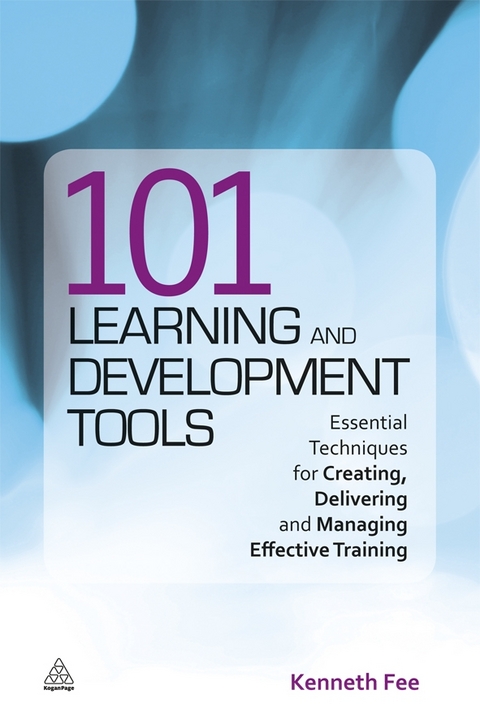
101 Learning and Development Tools
Kogan Page Ltd (Verlag)
978-0-7494-6108-9 (ISBN)
101 Learning and Development Tools is your practical guide to all the most up-to-date training techniques, organized around the classic learning and development cycle. Whether you need a quick, ready solution or some guidance on where to go for in-depth information, this is your essential reference guide. It picks up from where you are in the process of managing learning, and helps you place it in a broader context.
Each chapter is a mini guide to each tool with:
a description of the tool
analysis
resources needed
cost implications
cross-references to help you identify alternative or related tools for further study or investigation
101 Learning and Development Tools is the indispensable, all-in-one-volume reference book for both professionals in the field and students learning about the subject.
Kenneth Fee has worked in learning and development for 25 years, as a trainer, consultant, manager, and writer, among other roles. He has an MA degree in social science, an MBA, certificates in training and in assessment, a professional diploma in training management, and he is a Chartered Fellow of CIPD and a Fellow of CMI.
Chapter - 00: Introduction;
Chapter - 01: The learning and development cycle;
Section - ONE: Learning needs analysis;
Chapter - 02: Understanding learning, development, education and training;
Chapter - 03: L&DNA grids;
Chapter - 04: Identifying organizational learning needs: a step-by-step approach;
Chapter - 05: Performance analysis quadrant;
Chapter - 06: The learning curve;
Chapter - 07: Bloom’s taxonomy of learning domains;
Chapter - 08: Informal and non-formal learning;
Chapter - 09: Kolb’s experiential learning cycle;
Chapter - 10: Honey and Mumford’s learning styles;
Chapter - 11: Rose’s learning styles;
Chapter - 12: Overcoming barriers to learning;
Chapter - 13: Johari window;
Chapter - 14: How to develop a learning culture;
Chapter - 15: How to develop a learning organization;
Chapter - 16: The learning value chain;
Chapter - 17: Accelerated learning;
Chapter - 18: Emotional intelligence;
Chapter - 19: Gardner’s multiple intelligences;
Chapter - 20: Neuro-linguistic programming;
Chapter - 21: Knowledge management: distinguishing data, information and knowledge;
Chapter - 22: The five aspects of talent management;
Chapter - 23: The talent web;
Chapter - 24: The succession planning cycle;
Chapter - 25: Devising and using standards of competence;
Chapter - 26: Board-level development: a needs audit;
Chapter - 27: Learning methods and styles grid;
Chapter - 28: Learning methods choice matrix;
Section - TWO: Planning learning;
Chapter - 29: The six essential elements of a learning strategy;
Chapter - 30: Using the learning and development cycle to plan learning interventions;
Chapter - 31: A step-by-step guide to planning a learning event;
Chapter - 32: Personal development planning;
Chapter - 33: Using different approaches to learning and development;
Chapter - 34: Criteria for choosing a learning approach;
Chapter - 35: A checklist for procuring learning services;
Chapter - 36: Outsourcing versus insourcing;
Chapter - 37: The four phases of knowledge management;
Chapter - 38: The three component parts of e-learning;
Chapter - 39: The five models of e-learning;
Chapter - 40: Learning design: the five dimensions;
Chapter - 41: The route map model for e-learning design;
Chapter - 42: A classification of e-learning technologies;
Chapter - 43: What to look for in a digital learning platform;
Chapter - 44: Checklist – 10 things to look out for when dealing with e-learning vendors;
Chapter - 45: What to look for in a learning and development consultant;
Chapter - 46: What to look for in learning materials;
Chapter - 47: Working with union learning representatives;
Chapter - 48: Using qualifications;
Chapter - 49: Reference list of learning and development methods;
Section - THREE: Implementing learning;
Chapter - 50: Icebreakers;
Chapter - 51: Coaching – tips and pitfalls;
Chapter - 52: Facilitation – tips and pitfalls;
Chapter - 53: Lecturing – tips and pitfalls;
Chapter - 54: How to mentor someone;
Chapter - 55: How to organize work-based learning;
Chapter - 56: Guided practice;
Chapter - 57: Putting together action learning sets;
Chapter - 58: Setting up a community of practice;
Chapter - 59: The seven pillars of a corporate university;
Chapter - 60: Preparing a lesson plan;
Chapter - 61: Preparing to deliver a course: a checklist;
Chapter - 62: Tips for team teaching;
Chapter - 63: 360-degree feedback;
Chapter - 64: Psychometric instruments for development rather than assessment;
Chapter - 65: Innovative approaches to learning;
Chapter - 66: Using storytelling in learning and development;
Chapter - 67: Games, and learning through play;
Chapter - 68: Simulation;
Chapter - 69: Volunteering-based learning;
Chapter - 70: Development centres;
Chapter - 71: Assessing and recording competence;
Chapter - 72: Learning logs and contracts;
Chapter - 73: Guided reading;
Chapter - 74: Appreciative inquiry;
Chapter - 75: Networking via professional bodies;
Chapter - 76: Outplacement services;
Chapter - 77: Blended learning models;
Chapter - 78: Social networking and collaborative tools;
Chapter - 79: Checklist for setting up a learning centre;
Section - FOUR: Evaluating learning;
Chapter - 80: Costing learning;
Chapter - 81: Assessing learning;
Chapter - 82: Talent management and development: the GE nine box model;
Chapter - 83: Quality management of learning: the diamond model;
Chapter - 84: Applying quality management tools to learning;
Chapter - 85: Making a business case for learning and development;
Chapter - 86: Internal marketing of learning and development;
Chapter - 87: How to get value from a corporate university;
Chapter - 88: How to get value from learning consultants;
Chapter - 89: Evaluation: how to recognize and when to use the main methods;
Chapter - 90: Kirkpatrick’s four levels of evaluation;
Chapter - 91: Producing an evaluation sheet;
Chapter - 92: Measures in evaluating learning;
Chapter - 93: CIPD partnership of learning model;
Chapter - 94: Evaluation metrics;
Chapter - 95: Calculating return on investment;
Chapter - 96: Evaluation: return on expectations;
Chapter - 97: Six Sigma for learning and development;
Chapter - 98: Balanced scorecard for learning and development;
Chapter - 99: E-learning: the impact matrix;
Chapter - 100: Evaluation: total value add;
Chapter - 101: You
| Verlagsort | London |
|---|---|
| Sprache | englisch |
| Maße | 157 x 234 mm |
| Gewicht | 421 g |
| Themenwelt | Sachbuch/Ratgeber ► Beruf / Finanzen / Recht / Wirtschaft ► Wirtschaft |
| Sozialwissenschaften ► Pädagogik ► Berufspädagogik | |
| Wirtschaft ► Betriebswirtschaft / Management ► Personalwesen | |
| ISBN-10 | 0-7494-6108-X / 074946108X |
| ISBN-13 | 978-0-7494-6108-9 / 9780749461089 |
| Zustand | Neuware |
| Informationen gemäß Produktsicherheitsverordnung (GPSR) | |
| Haben Sie eine Frage zum Produkt? |
aus dem Bereich