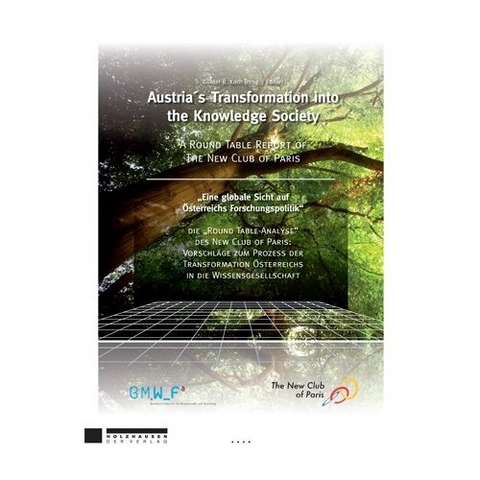
Austria's Transformation into the Knowledge Society
Holzhausen Verlag
978-3-85493-183-6 (ISBN)
- Titel ist leider vergriffen;
keine Neuauflage - Artikel merken
ENGLISH: The New Club of Paris, an association of knowledge economists,sociologists and entrepreneurs comparable to the Club of Rome,was founded in 2005/2006 as a continuation of a high level expertgroup constituted by the European Commission. Based on analysesperformed jointly by international and national experts, the Clubhas been issuing a series of Round Table Reports on the statusof the transformation of a country towards the Knowledge Society.The report on Austria is the third in the series after Finlandand Morocco, to be followed next by a report on Malaysia. Itsummarizes its results in a set of six recommendations. Additionalcontributions of the individual experts provide detailed insightsand comprehensive facts on the state of research and knowledgepolicies in Austria, such as extracts from the so-called systemevaluation report published in 2009 and analyses of political powerstructures. The report also includes constructive recommendationson how to compensate for well-known deficiencies, such asa lack of entrepreneurial dynamism, inadequate developmentof human capital, and slow take-up of new areas of research.The special value of this report lies in the way that it contraststhe “internal” perspectives of Austrian experts with the “external”perspectives of international experts. The resulting momentumleads to mutual learning in the area of integrated knowledgepolicies, thus paving the way to the future knowledge society.This report is a valuable resource for governments, parliaments,science and research administrations, professionalsand decision makers working in science and research,opinion leaders in education and in research policy, aswell as members of universities and research institutes.
DEUTSCH: Günter R. Koch versteht sich als Wissen(schaft)smanager – ein internationalanerkannter Forscher, erfolgreicher Entrepreneur und „Navigator“ diverserForschungseinrichtungen. Im Rahmen analysierter Forschungs- undWissenspolitiken in der EU und speziell in Österreich ist er gefragter undhäufiger Kommentator von Entwicklungen in Forschungseinrichtungen undUniversitäten. Wahrnehmung diverser Gastprofessuren in Systemforschungund Forschungsmanagement; heute Adj. Professor an der TU Graz. Mitgliedsog. High Level Expert Groups der Europäischen Kommission. Er ist Gründerund Sprecher des österreichischen Partnerschaftsunternehmens „execupery“(www.execupery.com), wie auch Partner der Knowledge Management Austria(KM-A) mit Arbeitsschwerpunkten in Wissensökonomie, Wissensmanagementund Wissensbilanzierung. In seiner letzten Managementfunktion war erLeiter des Central European Institute of Technology (CEIT) nahe Wien,Vorsitzender des Aufsichtsrates eines börsennotierten IT-Unternehmens,von 1998 bis 2003 CEO der Austrian Research Centers (ARC, vormals„Seibersdorf“, heute AIT), davor kurzzeitig in einer Spitzenfunktion beimComputerkonzern SUN Microsystems in Genf, nachdem er in den 90erJahren das von der Europäischen Kommission initiierte European SoftwareInstitute (ESI) in Spanien aufgebaut hatte. Von 1980 bis 1993 agierte erals Geschäftsführer eines deutsch-schweizerischen Softwareunternehmens.Z.Zt. amtierender Generalsekretär des „New Club of Paris“ (www.new-clubof-paris.org), Vorstand beim Verband der Österreichischen Softwareindustrie(VÖSI), Gründungs- und Vizepräsident der Austrian Association of Researchin IT (AARIT) und Kurator eines in Berlin ansässigen Fraunhofer-Instituts.Träger des Ehrenkreuzes für Wissenschaft und Kunst erster Klasse undder Kaplan-Erfindermedaille. Nach jahrzehntelangem Management vonForschungseinrichtungen, Think Tanks und IT-Unternehmen gilt er als einerder profundesten Kenner der europäischen und nationalen Forschungs- undTechnologieszene. ENGLISH: Professor Günter Koch from time to time is guest professor at TechnicalUniversities in specific Austria and the “Danube University”, permanentAdjunct Professor in Informatics at the IICM-Institute of the TechnicalUniversity of Graz, as well as a consultant to governments, banks, industries,in specific software dependant industries. He is also active as a memberof the board of the Association of the Austrian Software Industry (VÖSI).Professor Koch unites several and even divergent qualifications in his person:entrepreneur, manager and scientist. His last appointment as a manager of abig organisation was in1998 as the CEO of the Austrian Research Centres(ARC), Seibersdorf, today Austrian Institute of Technology (AIT) , Austria’slargest applied research organisation, employing some 1200 people in manydifferent disciplines, including material sciences, life sciences, informationtechnologies, system research, medical technology, energy and environmentetc. His first appointment in Austria was in the early 90ies, when he wasinvited to become a guest professor at the computer science faculty atGraz Technical University. During this persiod he was also a member ofthe university board of the Sévenan branch of the French University ofCompiègne. From 1993 to1997 he was the General Director of the EuropeanSoftware Institute (ESI) in Bilbao, Spain, at its time a prominent foundation bythe Europaen industry and the European Commission, which today serves asthe model for the European Institute of Technology (EIT) with its head officein Budapest. In 1997 he joined SUN Microsystems in their Geneva officesas a chief consultant in Software Engineering. After having been assistantprofessor at Karlsruhe University’s computer science faculty from on 1975,he became the founder managing director of a systems company specialisingfirst in medical informatics in 1981 and later in automation and in softwaretechnology. Günter Koch lives in Vienna and acts as the Vice President ofthe Austrian Association for Research in IT, works (part time) as GeneralSecretary of ‘The New Club of Paris’. He is a member of the Board of theFraunhofer Institute FIRST in Berlin, and he is affiliated with the Vienna-basedKnowledge Management Associates/ Academy / Association (KM-A ) andits cooperation partner www.execupery.com.
DEUTSCH
0. Management Summary1. Projektkonzept und Ablauf2. Einleitendes zum Thema der Transformation in dieWissensgesellschaft3. Einleitungspräsentation durch den Berichterstatter (Handout-Version, engl.)4. Der Round Table-Workshop im Österreichischen Nationalrat:Ansprache der Präsidentin des Nationalrats, Frau Mag. BarbaraPrammer5. Die globale Sicht durch internationale Mitglieder des „New Clubof Paris“• 5.1 L. Edvinsson : Some Quizzics for the Future of Austria as aKnowledge Economy and for its Knowledge Politics• 5.2 J.E. Aubert: Austria - The Road towards a Knowledge andInnovation Society• 5.3 P. Stahle: Austria towards the Top League of Innovation DrivenEconomies• 5.4 A. Bounfour: Dynamic Capabilities of Austria Under theCommunity Regime• 5.5 M. Azzman: Developing a Values-based Knowledge Society andKnowledge Economy- A Malaysian Experiment for Reference6. Die nationale Perspektive• 6.1 K. Aiginger: Evaluation of Government Funding in RTDI from aSystems Perspective in Austria – Towards a New Policy for Innovation,Science and Technology in Austria• 6.2 R. Sommer: Austrian Industry – A Unique Success Story (Reportby the Austrian Association of Industrialists)• 6.3 J. Fröhlich: Austria‘s transformation towards the KnowledgeSociety (PPT presentation in handout version)• 6.4 M. Gerzabek: Universities as key enablers for the transition intothe Knowledge Society (1) – the University of Natural Resources andApplied Life Sciences Vienna” as a model case• 6.5 H. Sünkel: Universities as Key Enablers for the Transition into theKnowledge Society (2) (PPT presentation in handout version)• 6.6 A. v. Gabain: A Triple View: A scientist, an Entrepreneur andMember of the European Institute of Technology (EIT) governanceboard gives his conclusive prospects on Austria as a science businesslocation. Text + presentation (PPT in handout version)AnhangA1 Ablauf / Programm• A1.1 „Vorspann“: Treffen der Wiener „Foresight Clubs“- die Teilnehmer• A1.2 Round-Table Seminar: Programm• A1.3 Der Round-Table-Workshop im Nationalrat – Programm deszentralen Ereignisses• A1.4 Die öffentliche Follow-Up Konferenz am Tag nach dem RoundTable: Agenda Knowledge – the 1st Austrian Conference onKnowledge PoliticsA2 Assoziierte Vorträge im Rahmen des Round-Table-Tags• A2.1 S.R. Selby: Establishing ‘Intellectual Capital Management’in Hong Kong (HK) – an implementation of “Knowledge Policy”• A2.2 S. Thurner: Complex Systems – science of the 21stcentury• A2.3 M. Hudec: Quantitative Indikatoren zur universitärenForschung in Österreich (Handout-Version)• A2.4 H. Katzmair : Network Analysis Applied - Robust DecisionMaking in a World that is in Transition (Handout-Version)A3 CVs aller am Workshop MitwirkendenA4 Information zum „New Club of Paris“• A4.1 Kurze Vorstellung (engl.)• A4.2 Manifest des “New Club of Paris” (engl.)
ENGLISH
0. Management Summary1. Project concept and schedule2. Introduction to the topic of becoming a knowledge society3. Introductory presentation by the author (handout version, Engl.)4. The Round Table Workshop of the National Council of Austria:address of the President of the National Council of Austria,Barbara Prammer5. A global perspective by international members of the „New Clubof Paris“• 5.1 L. Edvinsson : Some Quizzics for the Future of Austria as aKnowledge Economy and for its Knowledge Politics• 5.2 J.E. Aubert: Austria - The Road towards a Knowledge andInnovation Society• 5.3 P. Stahle: Austria towards the Top League of Innovation DrivenEconomies• 5.4 A. Bounfour: Dynamic Capabilities of Austria Under theCommunity Regime• 5.5 M. Azzman: Developing a Values-based Knowledge Society andKnowledge• Economy - A Malaysian Experiment for Reference6. National perspectives• 6.1 K. Aiginger: Evaluation of Government Funding in RTDI from aSystems Perspective in Austria – Towards a New Policy for Innovation,Science and Technology in Austria• 6.2 R. Sommer: Austrian Industry – A Unique Success Story (Reportby the Austrian Association of Industrialists)• 6.3 J. Fröhlich: Austria‘s transformation towards the KnowledgeSociety (PPT presentation in handout version)• 6.4 M. Gerzabek: Universities as key enablers for the transition intothe Knowledge Society (1) – the University of Natural Resources andApplied Life Sciences Vienna as a model case• 6.5 H. Sünkel: Universities as key enablers for the transition into theknowledge society (2) (PPT presentation in handout version)• 6.6 A. v. Gabain: A Triple View: A scientist, an Entrepreneur andMember of the European Institute of Technology (EIT) governanceboard gives his conclusive prospects on Austria as a science businesslocation Text + presentation (PPT in handout version)AppendixA1 Schedule / programme• A1.1 „Prelude“: Meeting of the Vienna „Foresight Club“ - participants• A1.2 Round Table Seminar: programme• A1.3 Round Table Workshop of National Council – programme ofcentral event• A1.4 Public follow-up conference on the day after the Round Table:AgendaA2 Associated lectures in the context of the Round Table day• A2.1 S.R. Selby: Establishing ‘Intellectual Capital Management’ inHong Kong (HK) – an implementation of “Knowledge Policy”• A2.2 S. Thurner: Complex Systems – science of the 21st century• A2.3 M. Hudec: Quantitative indicators for university research inAustria (handout version)• A2.4 H. Katzmair: Network Analysis Applied - Robust DecisionMaking in a World that is in Transition (handout version)A3 CVs of all workshop contributorsA4 Information about the „New Club of Paris“• A4.1 Brief introduction (Engl.)• A4.2 Manifesto of the „New Club of Paris“ (Engl.)
| Sprache | englisch; deutsch |
|---|---|
| Maße | 210 x 297 mm |
| Gewicht | 1000 g |
| Einbandart | gebunden |
| Themenwelt | Sachbuch/Ratgeber ► Beruf / Finanzen / Recht / Wirtschaft ► Wirtschaft |
| Sozialwissenschaften ► Politik / Verwaltung | |
| ISBN-10 | 3-85493-183-2 / 3854931832 |
| ISBN-13 | 978-3-85493-183-6 / 9783854931836 |
| Zustand | Neuware |
| Informationen gemäß Produktsicherheitsverordnung (GPSR) | |
| Haben Sie eine Frage zum Produkt? |
aus dem Bereich