


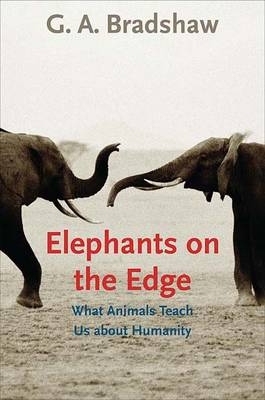
Elephants on the Edge
What Animals Teach Us about Humanity
Seiten
2010
Yale University Press (Verlag)
978-0-300-16783-2 (ISBN)
Yale University Press (Verlag)
978-0-300-16783-2 (ISBN)
- Titel z.Zt. nicht lieferbar
- Portofrei ab CHF 40
- Auch auf Rechnung
- Artikel merken
Drawing on accounts from India to Africa and California to Tennessee, and on research in neuroscience, psychology, and animal behaviour, the author explores the minds, emotions, and lives of elephants. By exploring the elephant mind and experience in the wild and in captivity, he bears witness to the breakdown of ancient elephant cultures.
In the tradition of Jane Goodall and Dian Fossey, a renowned animal trauma specialist offers an unusual glimpse into the elephant mind and makes an appeal for new notions of human uniqueness and treatment of animals
Drawing on accounts from India to Africa and California to Tennessee, and on research in neuroscience, psychology, and animal behavior, G. A. Bradshaw explores the minds, emotions, and lives of elephants. Wars, starvation, mass culls, poaching, and habitat loss have reduced elephant numbers from more than ten million to a few hundred thousand, leaving orphans bereft of the elders who would normally mentor them. As a consequence, traumatized elephants have become aggressive against people, other animals, and even one another; their behavior is comparable to that of humans who have experienced genocide, other types of violence, and social collapse. By exploring the elephant mind and experience in the wild and in captivity, Bradshaw bears witness to the breakdown of ancient elephant cultures.
All is not lost. People are working to save elephants by rescuing orphaned infants and rehabilitating adult zoo and circus elephants, using the same principles psychologists apply in treating humans who have survived trauma. Bradshaw urges us to support these and other models of elephant recovery and to solve pressing social and environmental crises affecting all animals, human or not.
In the tradition of Jane Goodall and Dian Fossey, a renowned animal trauma specialist offers an unusual glimpse into the elephant mind and makes an appeal for new notions of human uniqueness and treatment of animals
Drawing on accounts from India to Africa and California to Tennessee, and on research in neuroscience, psychology, and animal behavior, G. A. Bradshaw explores the minds, emotions, and lives of elephants. Wars, starvation, mass culls, poaching, and habitat loss have reduced elephant numbers from more than ten million to a few hundred thousand, leaving orphans bereft of the elders who would normally mentor them. As a consequence, traumatized elephants have become aggressive against people, other animals, and even one another; their behavior is comparable to that of humans who have experienced genocide, other types of violence, and social collapse. By exploring the elephant mind and experience in the wild and in captivity, Bradshaw bears witness to the breakdown of ancient elephant cultures.
All is not lost. People are working to save elephants by rescuing orphaned infants and rehabilitating adult zoo and circus elephants, using the same principles psychologists apply in treating humans who have survived trauma. Bradshaw urges us to support these and other models of elephant recovery and to solve pressing social and environmental crises affecting all animals, human or not.
G. A. Bradshaw, who holds doctorates in ecology and psychology, is director of the Kerulos Center. Her work on elephants, chimpanzees, parrots, and other animals is frequently featured in the national media, including the New York Times, NPR, 20/20, Time magazine, the London Times, National Geographic television, and National Geographic magazine. She lives in Jacksonville, OR.
| Erscheint lt. Verlag | 5.11.2010 |
|---|---|
| Zusatzinfo | 32 b-w illus. |
| Sprache | englisch |
| Maße | 156 x 235 mm |
| Gewicht | 376 g |
| Themenwelt | Sachbuch/Ratgeber ► Natur / Technik ► Naturführer |
| Naturwissenschaften ► Biologie ► Zoologie | |
| ISBN-10 | 0-300-16783-0 / 0300167830 |
| ISBN-13 | 978-0-300-16783-2 / 9780300167832 |
| Zustand | Neuware |
| Informationen gemäß Produktsicherheitsverordnung (GPSR) | |
| Haben Sie eine Frage zum Produkt? |
Mehr entdecken
aus dem Bereich



aus dem Bereich
Buch | Hardcover (2019)
Quelle & Meyer (Verlag)
CHF 55,90
Die Tagfalter und Widderchen Deutschlands
Buch | Softcover (2025)
Verlag Eugen Ulmer
CHF 33,90


