


Byrne. Six Books of Euclid
Seiten
2011
|
1., Auflage
Taschen (Verlag)
978-3-8365-1775-1 (ISBN)
Taschen (Verlag)
978-3-8365-1775-1 (ISBN)
- Titel ist leider vergriffen;
keine Neuauflage - Artikel merken
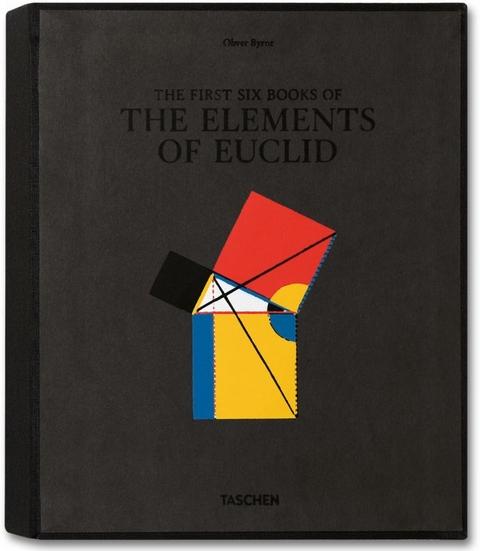
The Elements of Euclid In Living Color - a rare and beautiful geometry primer from the 19th century
Red, yellow, blue - and of course black - are the colours that Oliver Byrne employs for the figures and diagrams in his most unusual 1847 edition of Euclid, published by William Pickering and printed by Chiswick Press, and which prompt the surprised reader to think of Mondrian. The author makes it clear in his subtitle that this is a didactic measure intended to distinguish his edition from all others: "The Elements of Euclid in which coloured diagrams and symbols are used instead of letters for the greater ease of learners." Byrne is not content to trust solely in the supposed intuitive "logical" structure of Euclid's axioms and theorems - who doesn't know the first famous sentences of Euclid's Elements: "I. A point is that which has no parts. II. A line is length without breadth"? -, but translates them into colourful diagrams and symbols. He thereby thinks in terms of the school classroom: he compares his colours to the dyed chalks in which figures are drawn on the blackboard.
Farben für Euklid. Ein Prachtwerk viktorianischer Buchdruckkunst
Red, yellow, blue - and of course black - are the colours that Oliver Byrne employs for the figures and diagrams in his most unusual 1847 edition of Euclid, published by William Pickering and printed by Chiswick Press, and which prompt the surprised reader to think of Mondrian. The author makes it clear in his subtitle that this is a didactic measure intended to distinguish his edition from all others: "The Elements of Euclid in which coloured diagrams and symbols are used instead of letters for the greater ease of learners." Byrne is not content to trust solely in the supposed intuitive "logical" structure of Euclid's axioms and theorems - who doesn't know the first famous sentences of Euclid's Elements: "I. A point is that which has no parts. II. A line is length without breadth"? -, but translates them into colourful diagrams and symbols. He thereby thinks in terms of the school classroom: he compares his colours to the dyed chalks in which figures are drawn on the blackboard.
Farben für Euklid. Ein Prachtwerk viktorianischer Buchdruckkunst
Oliver Byrne (um 1810 um 1880) war ein irischer Autor und Bauingenieur. Über sein Leben ist kaum etwas bekannt, obwohl er eine erkleckliche Zahl von Büchern verfasste. Als Feldmesser der Königlichen Siedlungen auf den Falkland-Inseln hatte Byrne bereits mathematische und technische Schriften veröffentlicht.
Werner Oechslin, geb. 1944, studierte Kunstgeschichte, Archäologie, Philosophie und Mathematik in Zürich und Rom, lehrte in den USA, in Deutschland und in der Schweiz. Er war von 1985-2010 Professor für Kunst- und Architekturgeschichte an der ETH Zürich, 1986-2006 Vorsteher des Instituts gta, Departement Architektur der ETH Zürich, und ist der Gründer der Stiftung Bibliothek Werner Oechslin in Einsiedeln.
| Sprache | englisch; französisch; deutsch |
|---|---|
| Maße | 187 x 233 mm |
| Gewicht | 1660 g |
| Einbandart | gebunden |
| Themenwelt | Sachbuch/Ratgeber ► Natur / Technik ► Naturwissenschaft |
| Schlagworte | Byrne, Oliver • classics • Druckgrafik • euklidische Geometrie • Faksimile-Ausgaben • Hardcover, Softcover / Mathematik/Arithmetik, Algebra |
| ISBN-10 | 3-8365-1775-2 / 3836517752 |
| ISBN-13 | 978-3-8365-1775-1 / 9783836517751 |
| Zustand | Neuware |
| Informationen gemäß Produktsicherheitsverordnung (GPSR) | |
| Haben Sie eine Frage zum Produkt? |
Mehr entdecken
aus dem Bereich


aus dem Bereich
Wie wir die bisher unentdeckte Kraft der Wechseljahre für uns nutzen …
Buch | Softcover (2025)
dtv Verlagsgesellschaft
CHF 28,90


