


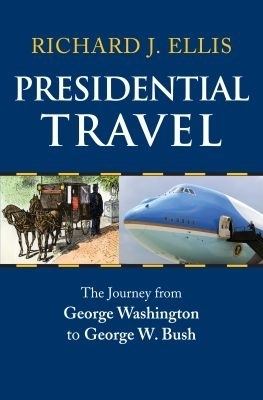
Presidential Travel
The Journey from George Washington to George W. Bush
Seiten
2008
University Press of Kansas (Verlag)
978-0-7006-1580-3 (ISBN)
University Press of Kansas (Verlag)
978-0-7006-1580-3 (ISBN)
Presenting the study of the history of presidential travel, this title explores how travel has reflected and shaped the changing relationship between American presidents and the American people. It traces the evolution of the president from First Citizen to First Celebrity.
In office less than half a year, President George Washington undertook an arduous month-long tour of New England to promote his new government and to dispel fears of monarchy. More than two hundred years later, American presidents still regularly traverse the country to advance their political goals and demonstrate their connection to the people.In this first book-length study of the history of presidential travel, Richard Ellis explores how travel has reflected and shaped the changing relationship between American presidents and the American people. Tracing the evolution of the president from First Citizen to First Celebrity, he spins a lively narrative that details what happens when our leaders hit the road to meet the people.Presidents, Ellis shows, have long placed travel at the service of politics: Rutherford ""the Rover"" Hayes visited thirty states and six territories and was the first president to reach the Pacific, while William Howard Taft logged an average of 30,000 rail miles a year. Unearthing previously untold stories of our peripatetic presidents, Ellis also reveals when the public started paying for presidential travel, why nineteenth-century presidents never left the country, and why earlier presidents - such as Andrew Jackson, once punched in the nose on a riverboat - journeyed without protection.Ellis marks the fine line between accessibility and safety, from John Quincy Adams skinny-dipping in the Potomac to George W. clearing brush in Crawford. Particularly important, Ellis notes, is the advent of air travel. While presidents now travel more widely, they have paradoxically become more remote from the people, as Air Force One flies over towns through which presidential trains once rumbled to rousing cheers. Designed to close the gap between president and people, travel now dramatizes the distance that separates the president from the people and reinforces the image of a regal presidency.As entertaining as it is informative, Ellis' book is a sprightly account that takes readers along on presidential jaunts through the years as our leaders press flesh and kiss babies, ride carriages and trains, plot strategies on board ships and planes, and try to connect with the citizens they represent.
In office less than half a year, President George Washington undertook an arduous month-long tour of New England to promote his new government and to dispel fears of monarchy. More than two hundred years later, American presidents still regularly traverse the country to advance their political goals and demonstrate their connection to the people.In this first book-length study of the history of presidential travel, Richard Ellis explores how travel has reflected and shaped the changing relationship between American presidents and the American people. Tracing the evolution of the president from First Citizen to First Celebrity, he spins a lively narrative that details what happens when our leaders hit the road to meet the people.Presidents, Ellis shows, have long placed travel at the service of politics: Rutherford ""the Rover"" Hayes visited thirty states and six territories and was the first president to reach the Pacific, while William Howard Taft logged an average of 30,000 rail miles a year. Unearthing previously untold stories of our peripatetic presidents, Ellis also reveals when the public started paying for presidential travel, why nineteenth-century presidents never left the country, and why earlier presidents - such as Andrew Jackson, once punched in the nose on a riverboat - journeyed without protection.Ellis marks the fine line between accessibility and safety, from John Quincy Adams skinny-dipping in the Potomac to George W. clearing brush in Crawford. Particularly important, Ellis notes, is the advent of air travel. While presidents now travel more widely, they have paradoxically become more remote from the people, as Air Force One flies over towns through which presidential trains once rumbled to rousing cheers. Designed to close the gap between president and people, travel now dramatizes the distance that separates the president from the people and reinforces the image of a regal presidency.As entertaining as it is informative, Ellis' book is a sprightly account that takes readers along on presidential jaunts through the years as our leaders press flesh and kiss babies, ride carriages and trains, plot strategies on board ships and planes, and try to connect with the citizens they represent.
Richard J. Ellis is the Mark O. Hatfield Professor of Politics at Willamette University. His previous books include To the Flag: The Unlikely History of the Pledge of Allegiance, Democratic Delusions: The Initiative Process in America, The Dark Side of the Left: Illiberal Egalitarianism in America, and Presidential Lightning Rods: The Politics of Blame Avoidance.
| Zusatzinfo | 25 photographs |
|---|---|
| Verlagsort | Kansas |
| Sprache | englisch |
| Maße | 159 x 239 mm |
| Gewicht | 656 g |
| Themenwelt | Reiseführer ► Nord- / Mittelamerika ► USA |
| Sozialwissenschaften ► Politik / Verwaltung | |
| ISBN-10 | 0-7006-1580-6 / 0700615806 |
| ISBN-13 | 978-0-7006-1580-3 / 9780700615803 |
| Zustand | Neuware |
| Informationen gemäß Produktsicherheitsverordnung (GPSR) | |
| Haben Sie eine Frage zum Produkt? |
Mehr entdecken
aus dem Bereich


aus dem Bereich
eigene Wege gehen und Einzigartiges erleben
Buch | Softcover (2024)
MAIRDUMONT (Verlag)
CHF 34,90


