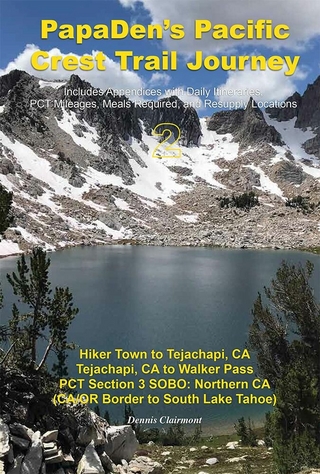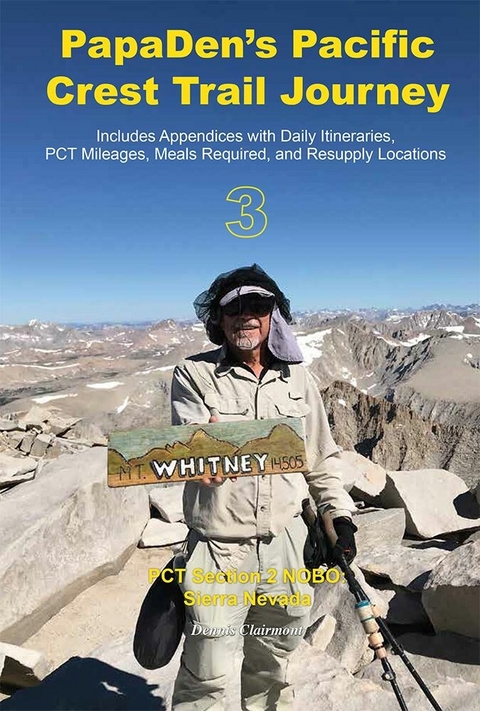
PapaDen's Pacific Crest Trail Journey Book 3 (eBook)
392 Seiten
Bookbaby (Verlag)
979-8-3178-2904-9 (ISBN)
DENNIS ARMAND CLAIRMONT was raised in the small New England town of Gilford Village, New Hampshire, at the base of Gunstock Mountain, where he developed a lifelong love for the outdoors. Fall meant playing football, winter brought skiing, and spring was for baseball. But summer was always his favorite season-building treehouses, digging underground forts, fishing for trout in nearby streams, raking blueberries, and hiking and camping with the Boy Scouts. In 1968, his family relocated from New England to California, leaving behind the landscape that had shaped his early passions. More than five decades later, after raising four children, Dennis found himself returning to those childhood roots. At 66 years old-despite arthritic knees and armed only with a backpack-he set out to undertake the most physically demanding challenge of his life: hiking the Pacific Crest Trail from Campo, California, to the Canadian border. Dennis has chronicled that adventure in PapaDen's Pacific Crest Trail Journey, a trilogy of three books that tells the full story-one of perseverance, adventure, and personal rediscovery along one of America's great long-distance trails. Dennis now lives in Portland, Oregon, with his wife Shelley-his college sweetheart-after 52 years of marriage. They remain close to their four children and fifteen grandchildren.
The Sierra – PCT Section 2 Chapter 1 Walker Pass, CA to Kennedy Meadows (South), CA PCT Mile 653.2 – 703.4, 50.2 miles July 24, 2019 – July 27, 2019
Introduction
Walker Pass: A New Beginning
Having left the granite halls of Desolation Wilderness behind, our journey now led into the heart of the High Sierra—where towering peaks, roaring rivers, and the mythic John Muir Trail waited ahead. We were beginning where I had left off in April: Walker Pass. Now, in late July, we were stepping into a blast furnace once again, dreading the final miles through the Mojave Desert.
Few transitions on the Pacific Crest Trail are as profound as the one between Walker Pass and Kennedy Meadows (South)—the final stretch of the desert before entering the legendary Sierra Nevada.
The Final Desert Miles
The Mojave would test me one last time with its searing heat, relentless winds, and scarce water. From scorching valley floors to sunbaked ridgelines, this section would push our endurance to the edge. Only three days of marching through these high desert foothills remained—the final taste of arid terrain before the granite walls of the Sierra took over.
Though technically still desert, the trail from Walker Pass to Kennedy Meadows is also a slow introduction to the mountains ahead. Subtle changes reveal themselves with each mile. Pinyon pines and junipers replace Joshua trees. The open, barren basins give way to rolling ridgelines, rocky outcrops, and distant glimpses of the towering Sierra skyline. The air, once heavy with desert heat, carries a faint crispness now—a hint of the alpine world waiting just beyond.
The Significance of Kennedy Meadows
For PCT hikers, Kennedy Meadows (South) is far more than a dot on the map. It’s a milestone, a rite of passage, a threshold. This is where desert-weary hikers finally breathe in the mountains. Here, the real Sierra section begins.
At Kennedy Meadows, the trail changes—and so do the hikers. Bear canisters, microspikes, and ice axes are added to packs. Food carries get heavier, snowfields loom ahead, and preparation for the coming high passes becomes real. After hundreds of miles of water rationing and scorching exposure, Kennedy Meadows feels like an oasis—a place where hikers gather, swap stories, and take stock of how far they’ve come and what still lies ahead.
The next three days would bring more hot climbs, long water carries, and the emotional weight of nearing the end of the desert. But with every step forward, the promise of the Sierra grew closer—the mountains we had dreamed of since this journey first began.
Day One: Walker Pass (Mile 653.2) to Spanish Needle Creek (Mile 669.9) – 16.7 Miles
The Journey Begins—A Pre-Dawn Departure
The alarm shattered the stillness of the motel room at 4:00 a.m., jolting us awake before the desert sun had a chance to take its toll. The reality of the day ahead hit hard—triple-digit temperatures, relentless climbs, and the final stretch of the Mojave desert miles before reaching the Sierra.
By 4:30 a.m., our gear was packed, and we made our way down the quiet streets toward the bus stop, headlamps flickering against the dark pavement. The life of a thru-hiker is anything but glamorous—early starts, constant movement, and hitching rides from one remote trailhead to the next.
At 5:20 a.m., the Kern County Transit bus pulled up, its headlights slicing through the darkness. We boarded for the 17-mile ride back to Walker Pass, where my journey had paused back in April. A different season, a different challenge. Spring’s cool embrace had made the desert bearable; now, in late July, the heat would be relentless—a force to endure for the next three days.
Walker Pass Monument—A Tribute to the Trailblazers
Stepping off the bus at Walker Pass Summit (Mile 653.2, elevation 5,275 feet), the morning air was already warm, the heat of the previous day still radiating from sand and rock. Before shouldering our packs, Mike and I paused at the Walker Pass Monument, honoring Joseph Rutherford Walker, who discovered this passage through the Sierra Nevada in 1834.
Walker Pass isn’t just another trail crossing. It marks the true threshold between desert and mountain—the end of the Mojave and the slow, punishing climb into the Sierra Nevada. But the Sierra wouldn’t come easy. The miles ahead would test us one final time before yielding the cool forests and high lakes we had long anticipated.
We snapped a few photos, took a deep breath, and stepped forward into the Owens Peak Wilderness.
Walker Pass Monument
The Climb into the Owens Peak Wilderness—Heat, Switchbacks, and Wildflowers
The trail wasted no time asserting its dominance. Within minutes, we were switchbacking up a sunbaked ridge, sand slipping underfoot, the heat already radiating from the earth. There was no shade—just an unrelenting ascent into the golden morning.
I had read somewhere that hiking is the slowest way to move, yet the fastest way to feel free. In that moment, I wasn’t sure I believed it. Every step felt like Sisyphus’s eternal punishment, rolling the boulder of my body up an endless incline.
But even here, the desert offered its strange beauty. Golden fields of rubber rabbitbrush, purple-pink rose sage, and deep blue desert larkspur burst defiantly against the barren rock. The sharp fragrance of sage mixed with wildflowers—a gift from the desert amid the hardship.
The sun clawed higher into the sky as we pushed forward, sweat soaking our shirts, packs pressing like anchors into our shoulders.
Owens Peak Saddle—A Sweeping Desert Panorama
After 2,047 feet of climbing and 7.3 grueling miles, we reached Owens Peak Saddle (Mile 660.6, elevation 7,050 feet) just before midday.
From this vantage point, the Mojave stretched out in an endless expanse—a sea of scorched earth, deep canyons, and scattered Joshua trees fading into the horizon. The granite formations ahead hinted at the Sierra, but the desert still clung stubbornly to the lower elevations.
Looming above it all was Owens Peak (8,445 feet), standing like a jagged sentinel over the transition from desert to mountain.
We paused, catching our breath, letting the wind cool our faces. The desert had tested us for hundreds of miles—and though we had survived, it wasn’t finished with us yet.
The Descent to Joshua Tree Spring Junction
From Owens Peak Saddle, the trail plunged downward, dropping 4.5 miles in a descent that burned our knees as much as the climb had burned our lungs. Sandy switchbacks gave way to rocky footing, yuccas and cacti dotting the slopes like scattered sentries.
At Mile 665.0 (elevation 5,475 feet), we reached Joshua Tree Spring Junction, where a spur trail led a quarter-mile to a spring-fed trough. Water in the desert is always a negotiation—necessary but never guaranteed. Guthook comments warned of recent mountain lion and bear sightings. We opted to ration what we carried rather than risk a nighttime encounter.
Walkers Pass to Spanish Creek Views
The Final Stretch to Spanish Needle Creek
The last miles of the day brought another 752-foot climb under the full heat of the afternoon sun, now pressing down like a heavy hand on our backs. Every step was a negotiation with exhaustion. But at the crest, the reward came fast—a gentle 743-foot descent into the shaded embrace of Spanish Needle Creek (Mile 669.9, elevation 5,109 feet).
At 3:11 p.m., we stumbled into camp with 16.7 miles behind us. The sight of running water was pure comfort. Spanish Needle Creek, shaded by pinyon pines and willows, offered several flat tent sites, two makeshift log benches, and a rock firepit.
Guthook again warned of bear activity. We hung our food securely in the trees, unwilling to gamble.
As the sun sank, the sky shifted from deep blue to soft ribbons of pink and orange. The desert, brutal and unrelenting by day, now felt peaceful, its edges softened by twilight.
After dinner, exhausted but satisfied, I stretched out in my tent, staring through the mesh at the first stars flickering into existence. Tomorrow, we would push closer to Kennedy Meadows—the gateway to the Sierra.
For now, I let the desert hold me one last time.
Day Two: Spanish Needle Creek (Mile 669.9) to Fox Mill Spring (Mile 684.3) – 14.4 Miles
A Grey Dawn in the Wilderness
I woke to the sound of silence—no birdsong, no rustling leaves, just the quiet weight of the overcast sky pressing down on the land. The usual golden light of dawn was absent, replaced by a dull, granite-grey expanse that stretched endlessly above us. It looked as though the sky might crack open and pour at any moment.
Chewey stirred in his tent. "Looks like we might finally get some rain," he muttered, rubbing the sleep from his eyes.
We wasted no time breaking camp. The air was heavy with the scent of damp earth and distant moisture, the promise of a storm lingering on the wind. By 6:10 a.m., our gear was packed, and we were stepping back onto the Pacific Crest Trail, bound for Fox Mill Spring—our last reliable water source before the long, dry push into Kennedy Meadows.
The Climb Through the Owens Peak Wilderness
Leaving...
| Erscheint lt. Verlag | 5.1.2026 |
|---|---|
| Sprache | englisch |
| Themenwelt | Reisen ► Sport- / Aktivreisen |
| ISBN-13 | 979-8-3178-2904-9 / 9798317829049 |
| Informationen gemäß Produktsicherheitsverordnung (GPSR) | |
| Haben Sie eine Frage zum Produkt? |
 EPUB (Ohne DRM)
Größe: 30,7 MB
Digital Rights Management: ohne DRM
Dieses eBook enthält kein DRM oder Kopierschutz. Eine Weitergabe an Dritte ist jedoch rechtlich nicht zulässig, weil Sie beim Kauf nur die Rechte an der persönlichen Nutzung erwerben.
Dateiformat: EPUB (Electronic Publication)
EPUB ist ein offener Standard für eBooks und eignet sich besonders zur Darstellung von Belletristik und Sachbüchern. Der Fließtext wird dynamisch an die Display- und Schriftgröße angepasst. Auch für mobile Lesegeräte ist EPUB daher gut geeignet.
Systemvoraussetzungen:
PC/Mac: Mit einem PC oder Mac können Sie dieses eBook lesen. Sie benötigen dafür die kostenlose Software Adobe Digital Editions.
eReader: Dieses eBook kann mit (fast) allen eBook-Readern gelesen werden. Mit dem amazon-Kindle ist es aber nicht kompatibel.
Smartphone/Tablet: Egal ob Apple oder Android, dieses eBook können Sie lesen. Sie benötigen dafür eine kostenlose App.
Geräteliste und zusätzliche Hinweise
Buying eBooks from abroad
For tax law reasons we can sell eBooks just within Germany and Switzerland. Regrettably we cannot fulfill eBook-orders from other countries.
aus dem Bereich