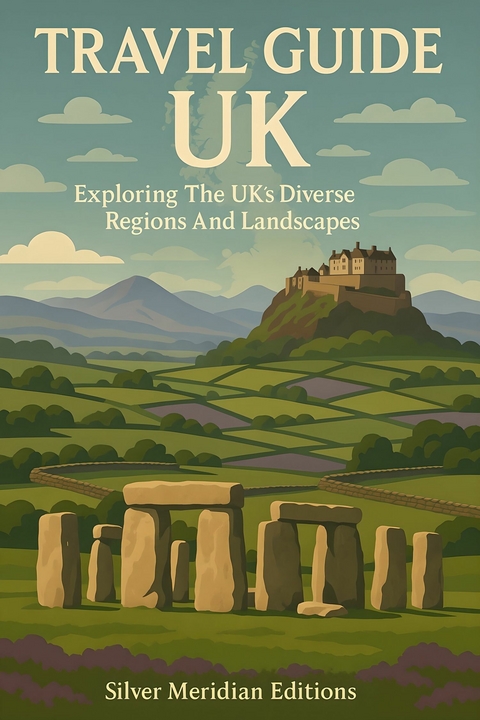
Travel Guide UK (eBook)
118 Seiten
Publishdrive (Verlag)
978-0-00-109484-0 (ISBN)
Do you feel overwhelmed trying to plan the perfect UK trip-unsure what to see, how long to stay, or how to get around?
Are you looking for a simple, step-by-step guide that covers every region without missing the must-see highlights (or the quiet gems locals love)?
Do you want to travel smarter-avoiding tourist traps, stretching your budget, and experiencing the real Britain and Northern Ireland?
If you answered YES to at least one of these questions, you MUST KEEP READING...
Unlock the Secrets to Effortless UK Travel-and See More with Less Stress
Trip planning can feel like a maze: countless blogs, conflicting advice, confusing rail passes, left-side driving, unpredictable weather, and itineraries that cram in too much-or too little. It's no surprise many travelers end up overspending, over-scheduling, and overlooking the very places they came to see.
But don't worry-you're not alone on this journey.
Presenting: Travel Guide UK: Exploring The UK's Diverse Regions And Landscapes
Chapter 1 — The Chalk South East: White Cliffs, Chalk Streams & Ridgeways
“Walk today’s hills on yesterday’s seabeds—chalk is the compressed skeletons of ancient plankton.”
1.1 Chalk Rivers & Downs
The story of the South East begins underfoot, in a substance so unassuming that it once filled school blackboards. Chalk is, in truth, a kind of time machine—a record of oceans that vanished long before there were maps, kings, or even Britain itself. Some ninety million years ago, when the world was warmer and the continents adrift, these lands lay beneath a shallow tropical sea teeming with plankton. As generations of these tiny organisms died, their calcium shells drifted down to the seabed and accumulated in drifts so immense that, when the sea retreated, it left behind hundreds of meters of soft white rock. Over eons, rain, frost, and tectonic rumpling sculpted this chalk into sweeping ridges, cliffs, and valleys—the distinctive landscape of the South Downs, North Downs, Chiltern Hills, and the White Cliffs of Dover.
Today, walking across these downs is to step across the memory of that ancient sea. The ground beneath your boots, porous and pale, swallows rainfall like a sponge. Because of this, rivers in chalk country behave unlike any others. They don’t gather brown torrents from mountain slopes; they rise instead from springs, filtered and clarified through the chalk’s natural limestone. This gives them their almost supernatural clarity—rivers so transparent that trout hover as if suspended in air.
Two of these rivers, the Itchen and the Test, are the purest expressions of this geology and have become quiet shrines for anglers, naturalists, and poets alike. They begin as modest trickles bubbling up from hidden aquifers, joining and meandering through meadows bright with buttercups and sedge. Their waters run cold year-round, nourishing a miniature jungle of aquatic plants—water crowfoot, starwort, and waving green ranunculus. Along their margins grow neat rows of watercress, one of Britain’s oldest cultivated greens, its peppery leaves thriving in the steady temperature of chalk-fed springs.
Follow these rivers on foot and you’ll notice how they shape the human rhythm as much as the natural one. The mills that once harnessed their flow for grinding grain now serve as inns or private homes. Old railway lines shadow their courses, repurposed into cycleways. Each village, from Alresford to Stockbridge, owes its very existence to the water’s dependable flow. Even the local architecture carries the memory of the chalk below: cottages of flint and lime mortar, pale and glinting in sunlight, echo the geology in their walls.
The soundscape here is intimate—running water, blackbird song, the click of bicycle gears. Yet look closer and the place hums with hidden life. The Test’s shallows flash with darting grayling and brown trout; kingfishers streak past like cobalt sparks. Otters, long absent, have returned in recent decades, silent proof of cleaner waters. Above, the air dances with damselflies, their glassy wings trembling in the filtered light. To linger beside one of these streams is to understand why anglers once wrote hymns to them—though today’s traveler might come not to fish, but to watch, to think, to breathe.
From the low-lying valleys, the landscape rises gently to the rolling South Downs, the long chalk ridge that arcs across Hampshire and Sussex before dropping into the sea at Beachy Head. On a clear day, the Downs feel infinite: broad grassy ridges under an open sky, wind-cooled and bare of trees except for the occasional clump of hawthorn or a stand of beech. Paths like the South Downs Way thread across the high ground, following lines that were already ancient when the Romans arrived. They are not mere trails—they are living corridors of memory, worn smooth by shepherds, soldiers, pilgrims, and now hikers with GPS watches and dogs off leash.
One of the charms of the Downs is how they alternate between exposure and intimacy. On the ridge, light floods everything—the kind of light that seems to bleach thought itself, pure and merciless. But drop just a few hundred meters into the folds, and you find yourself in quiet coombes: chalk hollows where dew gathers and the air is still. Villages huddle in these dips, sheltered from wind, their churches often marked by Norman towers of flint. From above, the pattern is organic, like veins or tributaries—each valley an arm reaching toward the Weald, the darker, older landscape that lies beyond.
Walkers on the South Downs Way often pause at Iron Age hillforts like Chanctonbury Ring or Cissbury Ring. These rings of earth, softened by time and sheep, still command views across the Channel and the Sussex plain. It’s humbling to think that these ramparts were raised nearly three thousand years ago with tools of antler and wood. Each hillfort was once a hub of trade and ritual, a place where communities gathered to mark the rhythm of the seasons. Today, they offer a different kind of gathering—a quiet communion between past and present, where a lone hiker might share the ridge with circling buzzards and the ghosts of forgotten tribes.
At first glance, the downs seem simple—just grass, sky, and wind. But look closer at your feet and a miniature world unfolds. The chalk grassland here is one of Europe’s richest habitats, home to a kaleidoscope of orchids, gentians, and thyme. It’s a place of scarcity and abundance at once: thin soils, poor in nutrients, yet bursting with life precisely because of that poverty. Each plant must adapt to dryness and exposure, and in doing so, it creates a delicate web that supports butterflies, bees, and birds. Skylarks nest among the short turf, their song spiraling upward like a thread of joy. Adonis blues flutter low, wings flashing electric against the pale ground.
The fragility of this ecosystem is easy to overlook. Centuries of grazing by sheep and rabbits kept the grass cropped short, maintaining the balance that wildflowers need. But remove the grazers—or add fertilizer—and the balance collapses. Tall grasses smother the orchids; diversity withers. That’s why conservationists today often use traditional grazing to keep the downs alive. When you pass a small flock nibbling at a slope under the watchful eye of a farmer, know that they are not mere scenery—they are the caretakers of an ancient harmony between soil, plant, and hoof.
The same fragility applies to the chalk itself. Its softness makes it porous but also vulnerable. Each bootprint on a steep path, each bike skid after rain, can accelerate erosion. To tread lightly here is not a metaphor—it’s a necessity. Stick to the paths where possible, and where the trail narrows, walk in single file. The reward for such care is subtle but profound: you become part of a lineage of respectful travelers stretching back centuries, those who read the land not as a playground but as a manuscript of deep time.
The Downs also reveal how geology shapes temperament. Towns born of granite or slate tend to feel enclosed, weathered, pragmatic. Chalk country, by contrast, carries an airiness, a reflective calm. The light is diffuse, the palette soft—cream, green, silver-blue. Even the place names echo gentleness: Alfriston, Amberley, Meon, Tisbury. It’s as if the land itself speaks in vowels. Yet beneath that softness lies resilience: the chalk endures wind and water, yields crops, and gives rise to pure springs. Its strength lies not in hardness but in permeability—the same quality that allows rain to pass through and rivers to be born clear.
Standing on the ridge near Firle Beacon or Ditchling, you can look north to the patchwork of fields and hedgerows, or south to the glimmer of the Channel. Ships crawl across the horizon, their wakes invisible but implied. On evenings when the air is still, the distant murmur of traffic from the A27 drifts upward—a faint reminder of modernity below. Yet up here, the sense of continuity overwhelms the noise. You are walking on seabed turned to stone, turned again to hill. Every footstep compresses a few million years of history into a heartbeat.
If there is a single image that captures the soul of the chalk country, it might be the dew pond. These small, round ponds dot the ridgeways, often reflecting the sky like a fragment of mirror. They were dug by shepherds centuries ago to collect rain and dew for their flocks, ingenious solutions to a landscape that absorbs water too well. Even today, they appear like eyes of the Downs—watchful, quiet, sustaining life in an arid world. In the summer, dragonflies hover over them; in winter, they freeze into delicate disks of glass.
The South East may be the most densely populated region of Britain, but on the downs and beside the chalk rivers, time stretches and softens. Here, human and natural histories are braided so tightly that they cannot be separated. The chalk remembers the sea. The rivers remember the rain. The paths remember every traveler who has ever crossed them. To walk these ridges and follow these streams is to move through the strata of both geology and memory—to walk, quite literally, on yesterday’s seabeds toward tomorrow’s understanding of place.
1.2 Cliffs, Estuaries & Sea Margins
Few landscapes in Britain are as immediately recognizable—or as emotionally charged—as the chalk cliffs of the South East. They are both a boundary and a beacon, the last or first sight of England for travelers across the centuries. To stand on their edge is to feel the full intersection of geology, weather, and memory. The Seven Sisters, their backs to the downs and their faces to the sea, rise in a rhythmic...
| Erscheint lt. Verlag | 31.10.2025 |
|---|---|
| Sprache | englisch |
| Themenwelt | Reisen ► Reiseführer ► Europa |
| ISBN-10 | 0-00-109484-X / 000109484X |
| ISBN-13 | 978-0-00-109484-0 / 9780001094840 |
| Informationen gemäß Produktsicherheitsverordnung (GPSR) | |
| Haben Sie eine Frage zum Produkt? |
 EPUB (Adobe DRM)
Größe: 1,3 MB
Kopierschutz: Adobe-DRM
Adobe-DRM ist ein Kopierschutz, der das eBook vor Mißbrauch schützen soll. Dabei wird das eBook bereits beim Download auf Ihre persönliche Adobe-ID autorisiert. Lesen können Sie das eBook dann nur auf den Geräten, welche ebenfalls auf Ihre Adobe-ID registriert sind.
Details zum Adobe-DRM
Dateiformat: EPUB (Electronic Publication)
EPUB ist ein offener Standard für eBooks und eignet sich besonders zur Darstellung von Belletristik und Sachbüchern. Der Fließtext wird dynamisch an die Display- und Schriftgröße angepasst. Auch für mobile Lesegeräte ist EPUB daher gut geeignet.
Systemvoraussetzungen:
PC/Mac: Mit einem PC oder Mac können Sie dieses eBook lesen. Sie benötigen eine
eReader: Dieses eBook kann mit (fast) allen eBook-Readern gelesen werden. Mit dem amazon-Kindle ist es aber nicht kompatibel.
Smartphone/Tablet: Egal ob Apple oder Android, dieses eBook können Sie lesen. Sie benötigen eine
Geräteliste und zusätzliche Hinweise
Buying eBooks from abroad
For tax law reasons we can sell eBooks just within Germany and Switzerland. Regrettably we cannot fulfill eBook-orders from other countries.
aus dem Bereich