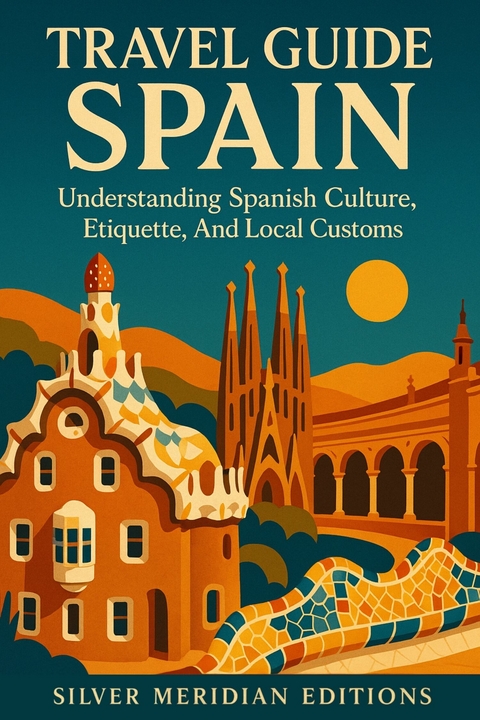
Travel Guide Spain (eBook)
134 Seiten
Publishdrive (Verlag)
978-0-00-109482-6 (ISBN)
Do you worry about making a faux pas in Spain-when to kiss, when to shake hands, or how late dinner really starts?
Are you looking for a simple, step-by-step guide to Spanish customs so you can blend in at tapas bars, family tables, and business meetings?
Do you want to connect with locals, not just check off landmarks?
If you answered YES to at least one of these questions, you MUST KEEP READING...
Unlock the Secrets to Navigating Spain Like a Local
Culture shock can turn a dream trip into awkward moments: showing up to eat at 6:30 p.m. and finding closed kitchens, over-tipping when it isn't expected, ordering the wrong size of tapas, or misreading the rhythm of 'Spanish time.' Add regional languages, festival etiquette, and midday shop closures, and it's easy to feel out of step.
But don't worry-you're not alone on this journey...
Presenting: Travel Guide Spain: Understanding Spanish Culture, Etiquette, and Local Customs
Chapter 1: The Spanish Concept of Time — Why “Mañana” Is Not Tomorrow
"In Spain, the clock serves life, not the other way around. A missed appointment might mean a perfect sunset was witnessed instead." — Carlos Ruiz Zafón
1.1 The Art of Spanish Punctuality
For the uninitiated, the Spanish relationship with time can feel like a paradox—disorganized on the surface, yet deeply human once you understand its rhythm. Visitors often arrive expecting Europe’s trademark efficiency: trains that leave on the second, meetings that start at the dot of the hour, and dinner served before sunset. Instead, they encounter a world where “five more minutes” stretches into twenty, where conversations spill long past their scheduled end, and where the word mañana—tomorrow—often means “not today, but someday soon, when it feels right.”
At first, this may seem like chaos. But behind the flexible pace of Spanish life lies a cultural philosophy that treats time not as a tyrant but as a companion. Spaniards do not ignore the clock; they simply refuse to be ruled by it. Time, in the Spanish sense, is measured less by precision than by presence. It is about being in the moment rather than on the minute.
The 15-Minute Grace Period
Nowhere is this philosophy more evident than in what might be called Spain’s “15-minute grace period.” In social contexts, arriving precisely on time can actually be considered impolite. If you show up at a dinner party at 9:00 p.m. sharp, you might find the hosts still setting the table, the wine uncorked but not yet poured, the air lacking the relaxed hum of conversation that defines a proper evening. Ten or fifteen minutes late is, in fact, the perfect moment—fashionably delayed, signaling that you are not rushing, that you come to share time rather than to watch it.
This approach contrasts starkly with northern European cultures, where punctuality is a moral virtue and lateness a personal failing. In Spain, however, the logic is social, not mechanical. The point of gathering is convivencia—the art of living together, of sharing moments without hurry. If someone is late, it is rarely taken as disrespect; it simply means they were caught in life’s flow—perhaps a chat with a friend ran long, or the afternoon traffic by the beach moved slower than usual. The assumption is that people are worth waiting for.
In practice, this creates a rhythm that can initially frustrate outsiders but soon reveals its charm. Business meetings may begin five or ten minutes past their scheduled time; family lunches may last three hours without apology. It is not inefficiency—it is a cultural rhythm that values depth over speed. The Spanish are masters at turning moments of waiting into opportunities for conversation, reflection, or simply another sip of coffee. Time stretches, but it rarely feels wasted.
Business vs. Social Time
Of course, Spain is no stranger to the demands of globalization. In cities like Madrid and Barcelona—cosmopolitan hubs that compete on international stages—business punctuality has grown sharper in recent decades. Many multinational offices and startups operate with Anglo-European precision, meetings begin on time, and schedules are tightly managed. Yet even in these environments, the Spanish nuance remains: relationships still take precedence over the clock.
A Spanish business meeting, for instance, often begins not with an agenda but with personal conversation—a brief chat about family, a comment on the weather, a shared anecdote about a football match. These few minutes are not digressions; they are rituals of trust. Rushing straight to business would feel cold, mechanical, even disrespectful. Spaniards believe that effective collaboration grows from mutual familiarity, not strict timetables.
It’s also common for meetings to end later than expected. Once the conversation flows, it is allowed to unfold naturally. A topic may lead to a tangent, a tangent to a story, and the story to a moment of laughter. That laughter, in turn, strengthens the bond between people, often more valuable than the punctual end of a meeting. Spanish business etiquette, even in its modernized form, recognizes that human connection is the invisible engine behind every productive exchange.
In traditional Spanish companies—especially those outside major cities—the tempo remains more fluid. Workdays can start late, pause for a leisurely midday meal, and resume into the evening. In smaller towns and family-owned enterprises, time is not so much scheduled as negotiated. A client may drop by without notice and be welcomed warmly. An afternoon meeting may be postponed if a local festival passes through town. The unspoken understanding is that life’s richness takes precedence over its rigidity.
This distinction between business time and social time can be disorienting for newcomers who expect uniformity. In Spain, context is king. A 10:00 a.m. business meeting in Madrid means 10:00 a.m. sharp; a 10:00 a.m. coffee invitation in Seville means you might meet anywhere between 10:15 and 10:45, depending on the pace of the morning. The Spanish are acutely aware of these nuances, even if they rarely articulate them—they sense the social contract behind every occasion.
Regional Variations
Like most aspects of Spanish culture, attitudes toward time vary widely across the country. Geography, climate, and history shape local rhythms as much as personal temperament. In the north—in regions such as the Basque Country, Navarra, or Catalonia—punctuality tends to be stricter, reflecting cultural influences from France and other nearby European nations. Barcelona, in particular, has embraced a time-conscious professionalism. Appointments start promptly, public transport runs efficiently, and deadlines are respected with near-Swiss regularity. The city’s fast-paced business sector and international ties have cultivated a modern rhythm where the clock ticks audibly.
But travel south, and the tempo shifts. In Andalusia, time flows like honey—thick, golden, and unhurried. The afternoon sun dictates more than the wristwatch. The streets empty for siesta, shops reopen when the heat eases, and life resumes at twilight with renewed energy. Conversations linger in the cool night air, stretching past midnight, with no one counting the hours. In Granada or Seville, a 9:00 p.m. dinner might not begin until 9:45, and no one would think twice about it.
In the rural heartlands—Castilla-La Mancha, Extremadura, Aragón—time is a companion of routine. Daily rhythms are tied to agriculture and tradition. Markets open when the produce arrives, not when the clock strikes a certain hour. Farmers, artisans, and villagers live by the natural pulse of the seasons rather than by timetables. Here, punctuality means being present when needed, not necessarily being early or exact.
The islands, too, have their own tempo. In the Balearics and the Canaries, the Mediterranean and Atlantic breezes seem to slow time itself. There is an island saying—“No pasa nada,” meaning “It’s okay, no problem”—that encapsulates the islander’s approach to life. Flights may be delayed, ferries may leave late, but tempers rarely flare. Island time, as locals call it, is a shared understanding that everything will happen when it should.
Across all these regions, however, a common thread persists: time is human, elastic, and deeply social. The Spanish day is not an industrial schedule divided into uniform blocks but a living landscape—mornings for productivity, afternoons for rest, evenings for life. It is a rhythm that reflects centuries of adaptation to climate, community, and culture.
Time as a Reflection of Values
Ultimately, Spanish punctuality—or its flexible counterpart—is not about timekeeping at all. It is about values. It reveals what a culture prioritizes: connection over calculation, quality over quantity, warmth over precision. To understand it is to grasp a key aspect of the Spanish soul.
The 15-minute grace period is not laziness; it is empathy for life’s unpredictability. The blurred line between business and social time is not inefficiency; it is trust-building. And the regional differences in time perception are not disorganization; they are expressions of identity—ways in which each community has chosen to balance life’s demands with its pleasures.
To the traveler, adjusting to this rhythm can be transformative. It invites a slower, more intentional experience. You learn to release the anxious need for control, to accept that a train might leave late but arrive on time for your story, that a conversation might last longer than expected but reveal something essential. In Spain, time is not lost—it is lived.
Understanding the art of Spanish punctuality is not about mastering a schedule but about shifting perspective. Once you do, you begin to see that mañana does not mean procrastination—it means patience. It is the freedom to live by the sun and not the stopwatch, to measure life not by minutes but by moments. And that, perhaps, is the truest form of punctuality there is.
1.2 Understanding Horario Español (The Spanish Schedule)
To understand Spanish timekeeping, one must first understand the horario español—a rhythm of daily life that defies the conventions of most Western societies. To outsiders, it can seem almost eccentric: lunches that begin when others are finishing work, dinners that start when the rest of Europe is already asleep, and children still laughing in public squares at midnight. But this distinctive rhythm is neither disorganization nor...
| Erscheint lt. Verlag | 31.10.2025 |
|---|---|
| Sprache | englisch |
| Themenwelt | Reisen ► Reiseführer ► Europa |
| ISBN-10 | 0-00-109482-3 / 0001094823 |
| ISBN-13 | 978-0-00-109482-6 / 9780001094826 |
| Informationen gemäß Produktsicherheitsverordnung (GPSR) | |
| Haben Sie eine Frage zum Produkt? |
 EPUB (Adobe DRM)
Größe: 3,8 MB
Kopierschutz: Adobe-DRM
Adobe-DRM ist ein Kopierschutz, der das eBook vor Mißbrauch schützen soll. Dabei wird das eBook bereits beim Download auf Ihre persönliche Adobe-ID autorisiert. Lesen können Sie das eBook dann nur auf den Geräten, welche ebenfalls auf Ihre Adobe-ID registriert sind.
Details zum Adobe-DRM
Dateiformat: EPUB (Electronic Publication)
EPUB ist ein offener Standard für eBooks und eignet sich besonders zur Darstellung von Belletristik und Sachbüchern. Der Fließtext wird dynamisch an die Display- und Schriftgröße angepasst. Auch für mobile Lesegeräte ist EPUB daher gut geeignet.
Systemvoraussetzungen:
PC/Mac: Mit einem PC oder Mac können Sie dieses eBook lesen. Sie benötigen eine
eReader: Dieses eBook kann mit (fast) allen eBook-Readern gelesen werden. Mit dem amazon-Kindle ist es aber nicht kompatibel.
Smartphone/Tablet: Egal ob Apple oder Android, dieses eBook können Sie lesen. Sie benötigen eine
Geräteliste und zusätzliche Hinweise
Buying eBooks from abroad
For tax law reasons we can sell eBooks just within Germany and Switzerland. Regrettably we cannot fulfill eBook-orders from other countries.
aus dem Bereich