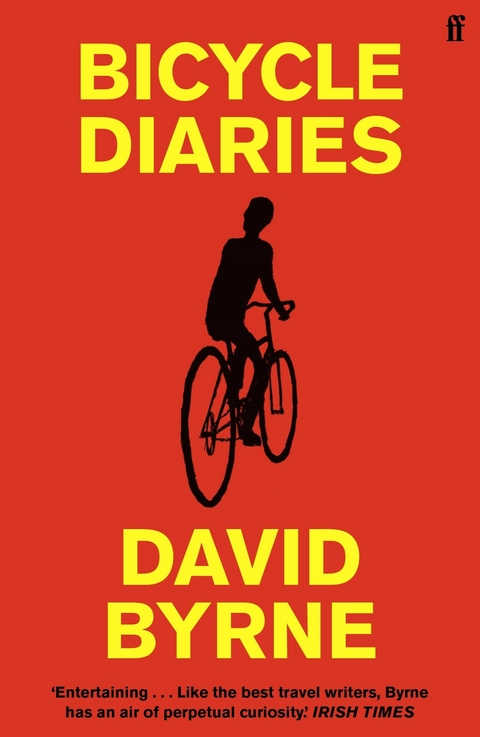
Bicycle Diaries (eBook)
348 Seiten
Faber & Faber (Verlag)
978-0-571-25806-2 (ISBN)
A co-founder of the musical group Talking Heads, David Byrne has also released many solo albums in addition to collaborating with such noted artists as Twyla Tharp, Robert Wilson, and Brian Eno. His art includes photography and installation works and has been published in five books. He lives in New York and he recently added some new bike racks of his own design around town. His web site is www.davidbyrne.com.
Most U.S. cities are not very bike-friendly. They’re not very pedestrian-friendly either. They’re car-friendly—or at least they try very hard to be. In most of these cities one could say that the machines have won. Lives, city planning, budgets, and time are all focused around the automobile. It’s long-term unsustainable and short-term lousy living. How did it get this way? Maybe we can blame Le Corbusier for his “visionary” Radiant City proposals in the early part of the last century:
Le Corbusier, “Radiant City” (plans). Banque d’Images/Art Resource, NY. © 2009 Artists Rights Society (ARS), New York / ADAGP, Paris / FLC
His utopian proposals—cities (just towers really) enmeshed in a net of multilane roads—were perfectly in synch with what the car and oil companies wanted. Given that four of the five biggest corporations in the world still are oil and gas companies, it’s not surprising how those weird and car-friendly visions have lingered. In the postwar period General Motors was the largest company in the whole world. Its president, Charlie Wilson said, “What’s good for GM is good for the country.” Does anyone still believe that GM ever had the country’s best interests at heart?
Maybe we can also blame Robert Moses, who was so successful at slicing up New York City with elevated expressways and concrete canyons. His force of will and proselytizing had wide-ranging effects. Other cities copied his example. Or maybe we can blame Hitler, who built the autobahns in order to allow German troops and supplies fast, efficient, and reliable access to all points along the fronts during World War II.
I try to explore some of these towns—Dallas, Detroit, Phoenix, Atlanta—by bike, and it’s frustrating. The various parts of town are often “connected”—if one can call it that—mainly by freeways, massive awe-inspiring concrete ribbons that usually kill the neighborhoods they pass through, and often the ones they are supposed to connect as well. The areas bordering expressways inevitably become dead zones. There may be, near the edges of town, an exit ramp leading to a KFC or a Red Lobster, but that’s not a neighborhood. What remains of these severed communities is eventually replaced by shopping malls and big-box stores isolated in vast deserts of parking. These are strung along the highways that have killed the towns that the highways were meant to connect. The roads, housing developments with no focus, and shopping centers eventually sprawl as far as the eye can see as the highways inch farther and farther out. Monotonous, tedious, exhausting … and soon to be gone, I suspect.
I grew up in the suburbs of Baltimore. One of the houses we lived in there had a housing development to the right and some older houses behind it—with woods and a working farm in front. We lived right where suburban development had (temporarily) stopped—at the point where it met the farmland. Like a lot of people, I grew to disdain the suburbs, their artificialness and sterility. But I could never shake them entirely. There was some kind of weird fascination and attraction that I (and I think many others) can’t quite get out of my system.
I must have gotten hooked on cycling early on: in high school I used to pedal over to my girlfriend’s house in the evenings, which was at least four miles away, so I could hang out and smooch after I’d finished my homework. We almost did it right by the adjoining city dump once—no intruders there.
My generation makes fun of the suburbs and the shopping malls, the TV commercials and the sitcoms that we grew up with—but they’re part of us too. So our ironic view is leavened with something like love. Though we couldn’t wait to get out of these places they are something like comfort food for us. Having come from those completely uncool places we are not and can never be the urban sophisticates we read about, and neither are we rural specimens—stoic, self-sufficient, and relaxed—at ease and comfortable in the wild. These suburbs, where so many of us spent our formative years, still push emotional buttons for us; they’re both attractive and deeply disturbing.
In Baltimore when I was in high school I used to go downtown by bus and wander around the shopping districts. It was exciting. Malls didn’t exist yet! There were lots of people, hustle and bustle. Riding an escalator at Hutzler’s or Hecht’s (downtown department stores) was a thrill! Bad girls went there to shoplift cool clothes. But white flight was already in progress and soon, amazingly quickly, the center of Baltimore was abandoned except to those who couldn’t afford to leave it. Many streets soon featured boarded-up row houses. And in the late 1960s there were race riots in the aftermath of which more whites left and the corner bars adopted what was called riot architecture. They don’t teach this kind of architecture at Yale. It consists of filling in the windows of your establishment with painted cinder blocks and leaving a couple of glass bricks in the center. On the other side of the tracks from the downtown shopping zone whole blocks were simply razed. Like the legendary South Bronx it looked like a war zone—and in a way it is. An undeclared civil war in which the car is winning. The losers are our cities and in most cases African Americans and Latinos.
There once existed natural geographical reasons for most towns to come into being: a meeting of rivers, as in Pittsburgh; a river meeting a lake, as in Cleveland or Chicago; a canal meeting a lake, as in Buffalo; a secure and sheltered harbor, as in Baltimore, Houston, and Galveston. Eventually, what was originally a geographical justification for choosing one place over another to settle got cemented down as rail lines reached across the open spaces and connected these cities. As more and more people were attracted to these towns, the density of habitation and attendant business opportunities became additional reasons for even more people to make their homes there. They were drawn to live in proximity to other people, as social animals will tend to do. In many cases the rivers or lakes eventually became irrelevant, and shipping moved elsewhere or shipping by water was replaced by rail and eventually by trucks. As a result the rivers and waterfronts soon became derelict and the industry built alongside them became ugly inconveniences. Nice people shunned those neighborhoods. I sound a bit didactic in this recapitulation of history—bear with me, it’s a way of trying to figure out for myself how we got here.
There is often a highway along the waterfront in many towns. Before these highways were built, the waterfronts, already dead zones, were seen as the most logical places from which to usurp land for conversion into a concrete artery. Inevitably, little by little, the citizens of these towns become walled off from their own waterfronts, and the waterfronts became dead zones of yet a different kind—concrete dead zones of clean, swooping flyovers and access ramps that soon were filled with whizzing cars. Under these were abandoned shopping carts, homeless people, and piles of toxic waste. Often you couldn’t even access the water as a pedestrian unless you climbed a few fences.
Most of the time it turns out the cars are merely using these highways not to have easier access to businesses and residences in the nearby city, as might have been originally proposed, but to bypass that city entirely. The highways allowed people to flee the cities and to isolate themselves in bedroom communities, which must have seemed to many like a good thing—one’s own domain, a yard for the kids, safe schools, backyard barbeques, ample parking.
Years ago it was thought that our cities were not sufficiently car-friendly. People who wanted to move about in a car quickly found the streets frustratingly congested and crowded. So planners suggested that massive freeways and concrete arteries would solve the congestion problem. They didn’t. They quickly filled up with even more cars—maybe because more people thought they could get to and fro faster on an expressway. So even more highways were built.
In some cases ring roads were added, encircling cities, to enable the motorist to get from one side of town to the other, or from one suburb to another, without even entering the city. When I bike around these places I discover that sometimes the only way to get from point A to point B is via a highway. The smaller roads have atrophied or sometimes they just aren’t there anymore. Often they’ve been cut in two or sliced and diced by the larger arteries so you can’t get from one place to another on surface streets even if you want to. As a cyclist or a pedestrian it makes one feel unwanted, like an interloper, and you end up sort of pissed off. Needless to say, riding a bike along the shoulder of an expressway is no fun. There’s nothing romantic about it either—you’re not a cool outlaw, you’re simply somewhere you don’t belong.
Niagara Falls
I wake up in America. The sun is blasting and I am in a tour bus in a huge parking lot in Buffalo—somewhere near the Canadian border. A highway passes alongside the parking lot and...
| Erscheint lt. Verlag | 3.6.2010 |
|---|---|
| Sprache | englisch |
| Themenwelt | Sachbuch/Ratgeber ► Sport ► Motor- / Rad- / Flugsport |
| Reisen ► Reiseberichte | |
| ISBN-10 | 0-571-25806-9 / 0571258069 |
| ISBN-13 | 978-0-571-25806-2 / 9780571258062 |
| Informationen gemäß Produktsicherheitsverordnung (GPSR) | |
| Haben Sie eine Frage zum Produkt? |
 EPUB (Adobe DRM)
Kopierschutz: Adobe-DRM
Adobe-DRM ist ein Kopierschutz, der das eBook vor Mißbrauch schützen soll. Dabei wird das eBook bereits beim Download auf Ihre persönliche Adobe-ID autorisiert. Lesen können Sie das eBook dann nur auf den Geräten, welche ebenfalls auf Ihre Adobe-ID registriert sind.
Details zum Adobe-DRM
Dateiformat: EPUB (Electronic Publication)
EPUB ist ein offener Standard für eBooks und eignet sich besonders zur Darstellung von Belletristik und Sachbüchern. Der Fließtext wird dynamisch an die Display- und Schriftgröße angepasst. Auch für mobile Lesegeräte ist EPUB daher gut geeignet.
Systemvoraussetzungen:
PC/Mac: Mit einem PC oder Mac können Sie dieses eBook lesen. Sie benötigen eine
eReader: Dieses eBook kann mit (fast) allen eBook-Readern gelesen werden. Mit dem amazon-Kindle ist es aber nicht kompatibel.
Smartphone/Tablet: Egal ob Apple oder Android, dieses eBook können Sie lesen. Sie benötigen eine
Geräteliste und zusätzliche Hinweise
Buying eBooks from abroad
For tax law reasons we can sell eBooks just within Germany and Switzerland. Regrettably we cannot fulfill eBook-orders from other countries.
aus dem Bereich