


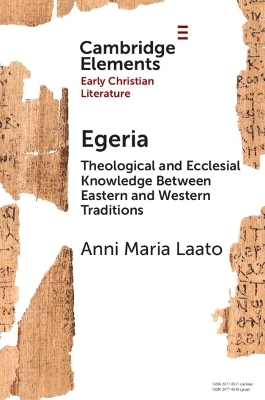
Egeria
Theological and Ecclesial Knowledge Between Eastern and Western Traditions
Seiten
2025
Cambridge University Press (Verlag)
978-1-009-61623-2 (ISBN)
Cambridge University Press (Verlag)
978-1-009-61623-2 (ISBN)
As a travel writer, Egeria had an eye for the ordinary and for the new Christian practices in the east. This Element is a great resource for those interested in the roles and possibilities of women in antiquity, beginnings of pilgrimage to the holy land, vernacular Latin, and origins of Christian liturgy.
Egeria's Itinerarium is a unique document. It is one of the few surviving works from antiquity written by a woman and is one of the first Christian travelogues depicting a pilgrimage to and in the Holy Land. In her Itinerarium, Egeria describes not only her travels but also the practices of pilgrimage and the liturgical life in Jerusalem at a time when both of these were developing rapidly. As Egeria's explicit goal is to communicate her observations and thoughts to her friends, a community of women in the west, this study focusses on Egeria's role as a communicator. Both the contents of her text – what she wanted to communicate and the techniques she used to mediate her experiences and learning to her friends, that is, how she chose to communicate, are scrutinized. Special attention is given to how Egeria describes lived religion in antiquity.
Egeria's Itinerarium is a unique document. It is one of the few surviving works from antiquity written by a woman and is one of the first Christian travelogues depicting a pilgrimage to and in the Holy Land. In her Itinerarium, Egeria describes not only her travels but also the practices of pilgrimage and the liturgical life in Jerusalem at a time when both of these were developing rapidly. As Egeria's explicit goal is to communicate her observations and thoughts to her friends, a community of women in the west, this study focusses on Egeria's role as a communicator. Both the contents of her text – what she wanted to communicate and the techniques she used to mediate her experiences and learning to her friends, that is, how she chose to communicate, are scrutinized. Special attention is given to how Egeria describes lived religion in antiquity.
1. Introduction; 2. Egeria the Travel Writer in Context; 3. Egeria's Routes, Places she Visited and People she Encountered; 4. Communicating Sense-perception and Emotions; 5. Egeria as a Mediator of Theological and Biblical Traditions; 6. Conclusions: Egeria, a Travel Writer with an Eye for Ordinary Things; Bibliography.
| Erscheinungsdatum | 24.05.2025 |
|---|---|
| Reihe/Serie | Elements in Early Christian Literature |
| Zusatzinfo | Worked examples or Exercises |
| Verlagsort | Cambridge |
| Sprache | englisch |
| Themenwelt | Reisen ► Reiseberichte |
| Religion / Theologie ► Christentum ► Kirchengeschichte | |
| Religion / Theologie ► Christentum ► Liturgik / Homiletik | |
| ISBN-10 | 1-009-61623-4 / 1009616234 |
| ISBN-13 | 978-1-009-61623-2 / 9781009616232 |
| Zustand | Neuware |
| Informationen gemäß Produktsicherheitsverordnung (GPSR) | |
| Haben Sie eine Frage zum Produkt? |
Mehr entdecken
aus dem Bereich

aus dem Bereich
eine andere Geschichte der Papststadt
Buch | Softcover (2024)
C.H.Beck (Verlag)
CHF 25,20


