


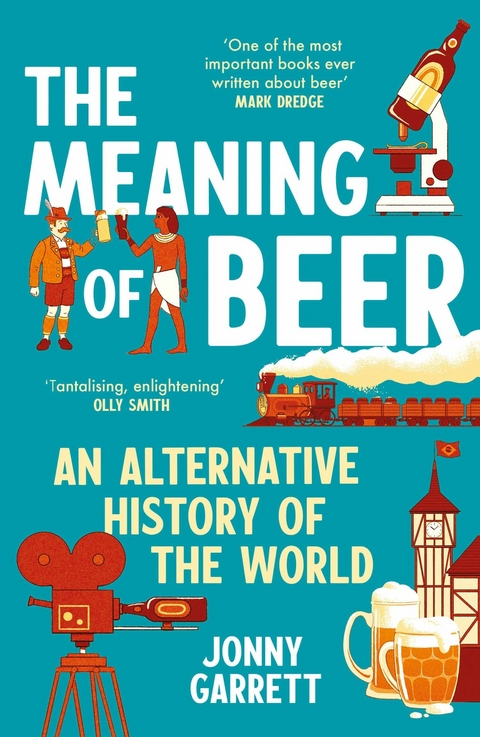
Meaning of Beer (eBook)
368 Seiten
Atlantic Books (Verlag)
978-1-83895-995-1 (ISBN)
Jonny Garrett is a multi-award-winning journalist, author and filmmaker. He's best known as the founder of Youtube's Craft Beer Channel, which has over 160,000 subscribers and 13 million views. He has written four books and his most recent one, A Year in Beer (CAMRA Books, 2021), won the Fortnum & Mason Drinks Book of the Year, British Guild of Food Writers Drinks Book of the Year and British Guild of Beer Writers Book of the Year. He was also voted British Beer Writer of the Year in 2019 and 2022.
THE PRIZE-WINNING BOOK EVERY BEER-LOVER MUST READ'Tantalising, enlightening and the best reason to raise another glass of beer' Olly Smith'This is one of the most important books ever written about beer' Mark DredgeWINNER, BEST DRINK BOOK AT THE FORTNUM & MASON FOOD AND DRINK AWARDS 2025What's the oldest and most consumed alcoholic beverage on earth? BEER, of course. And it might just be our most important invention. Since its creation 13,000 years ago, our love of beer has shaped everything from religious ceremonies to advertising, and architecture to bioengineering. The people who built the pyramids were paid in ale, the first fridge was built for beer not food, bacteria was discovered while investigating sour beer, Germany's beer halls hosted Hitler's rise to power, and brewer's yeast may yet be the answer to climate change. In The Meaning of Beer, award-winning beer writer Jonny Garrett tells the stories of these incredible human moments and inventions, taking readers to some of the best-known beer destinations in the world - Munich and Oktoberfest, Carlsberg Brewery's historic laboratory, St Louis and the home of Budweiser - as well as those lesser-known, from a 5,000 year old brewery in the Egyptian desert to Arctic Svalbard, home to the world's most northerly pub. Ultimately, this is not a book about how we made beer, but how beer made us.
Jonny Garrett is a multi-award-winning journalist, author and filmmaker. He's best known as the founder of Youtube's Craft Beer Channel, which has over 160,000 subscribers and 13 million views. He has written four books and his most recent one, A Year in Beer (CAMRA Books, 2021), won the Fortnum & Mason Drinks Book of the Year, British Guild of Food Writers Drinks Book of the Year and British Guild of Beer Writers Book of the Year. He was also voted British Beer Writer of the Year in 2019 and 2022.
INTRODUCTION
Not how we made beer,
but how beer made us
Every night when my dad got home from work, he’d kiss my mum, ask what my brother and I were watching on TV (usually to little or no response), and head straight upstairs.
There he’d change out of his work uniform of branded polo and chinos, and into his home uniform of unbranded polo and chinos. He’d then thud back downstairs and hit start on the microwave to reheat whatever we’d eaten a few hours before. Finally, he’d go to the fridge, pull out a stubby bottle of lager and settle at the kitchen table. He’d only ever have one beer, but in my misty-eyed recollections he never skips it. It was the routine; his signal that the work day had ended – as vital as the meal he had it with, as the kiss for my mum, as the begrudging communication from his heirs.
For such an important moment – maybe the best moment of the day – he didn’t invest much in it. My dad is hardly a gourmand, but he knows his wine in an ‘oooh Gavi di Gavi!’ kind of way. He’s certainly never served red with fish, and likes to discuss that fact. But the opposite is true of his beer drinking. Despite having a bottle every darn day, he stuck to the bottom-shelf stubbies; lagers our family fondly came to call ‘French Piss’. I don’t know if Biere D’Or was his favourite, or if my mum simply shopped at Tesco more than any other supermarket, but the gold label, chunky bottles and flimsy cardboard crate shaped like a Robot Wars entry destined to go out in the first round are burned into my memory.
When I was young I’d sometimes be charged with loading the basket at the bottom of the fridge with more, and when I was a little older I was allowed to crack open the bottles for him, sniffing suspiciously at its strange, grainy aroma. I took my first tentative sip in my early teens. One evening my older brother had – to his and my surprise – been left in charge of the house along with some friends. Naturally, being in charge at the age of sixteen meant drinking beer and watching films with an eighteen certificate. The fact that I was only thirteen didn’t seem relevant as he handed me a bottle and said, ‘Don’t get drunk.’ That wasn’t a problem – the beer was awful, and I struggled to get through one 250ml bottle. Biere D’Or is barely introduced to hops when it’s brewed, but it was bitter enough to claw like fingernails at my Ribenaweaned palate. I sipped half-heartedly at it, feeling the bottle go warm in my clammy hands and wondering why my dad would put himself through this every weeknight.
Of course, that mystery revealed itself pretty quickly, as it does with most teenagers. My dad’s green stubbies became the lubricant for many drunken barbecues and illicit house parties as I pinballed my way through my teens, and Biere D’Or now holds a very special place in my heart. When I visit my parents these days, I insist that there’s a stack of French Piss in the fridge ready for my arrival.
I’m telling you this admittedly indulgent story for a very important reason. Civilization certainly didn’t start, or even really continue, at my kitchen table – not the way the Garretts eat. There were no great inventions or cultural moments inspired by Biere D’Or there, either. But my dad’s ritual is the bedrock upon which my love of beer was founded, and I bet you have a similar story. To me, beer has always retained the key purpose it had for my dad. It’s not just a quick drink or a way to wash down a microwave meal: it’s a full stop on the day – a moment that may seem small if you’re sitting opposite my dad, but takes on a global significance when you think that on our suburban road, tens of people were doing exactly the same thing at the same time. In pubs throughout my home town there were hundreds more sharing that moment. Around the world, as 5 p.m. hit each time zone, millions would pop caps and lean back, sharing in the collective sip and sigh of a day done that stretches back millennia.
My point is that since civilization began, beer has played a vital role in how we experience and process the world, even during childhood. My dad’s routine sparked synapses in my brain that connect beer and relaxation, beer and food, beer and work, beer and home, beer and family. My pubescent misadventures bonded beer irrevocably to adventure, to friends and to love. Most of my best memories involve it in some way – from leaving school to celebrating my Master’s, from starting my first job to painting the walls of my first house, from my first date with my wife to our wedding. And that personal significance needs to be multiplied by the billion: by everyone who has ever lived and everyone who ever will, because beer (which is to say an alcoholic drink made from fermented cereals) has been with us for at least 13,000 years – and will outlast everyone alive today.
It’s not just the personal stories that are timeless, either. Something of such cultural significance requires huge means of production. An inconceivable amount of human ingenuity and endeavour, of adventure and trade, of experimentation and research went into making the French Piss my dad unwound with every night. Some anthropologists believe that the nomadic tribes that roamed the earth 13,000 years ago only settled to grow cereals for beer and bread. There’s archaeological evidence that refining the brewing process was humanity’s first great engineering project, with epic breweries found in the ruins of ancient societies. We built the first commercial compressed-gas refrigerator exclusively to keep our beer cold, and laid railways to take it to new places as quickly as possible. The process of pasteurization was perfected to ensure beer didn’t spoil and led to the discovery of bacteria’s role in infections. The isolation of yeast, key to all bread baking and even biofuel production, was done in the name of brewing. Beer was the keystone of early civilization, then spurred humanity on its endless scientific advances. We’ll fully explore all this throughout this book, but clearly beer is one of the most important discoveries we have made as a species. In fact, there are academics who believe – like I do – that the control of fermentation is as important to human development as the discovery of fire.
Not a Real Job
You wouldn’t know that to look at how we treat it or talk about it, however. As my dad’s blasé approach shows, while the traditions of fine wine are held in the highest regard, beer’s central place in the world seems to be its undoing. Far from being an artisan endeavour, to most people it’s a daily inevitability that sits on shopping lists next to the washing-up liquid. This delicious drink, through which the entire history of humanity can be traced, has become a homogeneous corporate product, the significance of which few give a second’s thought to. It’s this fact that has spurred me on the journey I’ve taken for this book, and indeed inspired my career as a broadcaster and writer.
My job has taken me across the globe in search of exciting flavours, but like everyone else my love of good beer started in my local. I was fresh out of university and flush with my first pay cheque as a journalist. A sunny Saturday stretched out in front of me, and I wanted to try something different; something bold and exciting. Standing at the bar, I looked past the standard lager taps of my teens and saw a giant hammer at the end. It loomed out of the beer fonts in lieu of a normal tap handle. Along its shaft were written the words ‘Long Hammer IPA’. I couldn’t not order it.
The barman pulled the foot-long hammer down in a great arc. Clear amber beer and creamy white foam cascaded out of the tap, and as he passed the glass over to me the head spilled luxuriously over the side. That first sip changed my world. Citrus oils swam across my palate; pine needles pricked the back of my tongue; caramel stuck to my teeth. I was intoxicated in so many ways – by the alcohol, the heady aromas, the biting bitterness, the mystery of where it all came from. How was this beer so radically different from the faux lagers I’d grown up choking down?
That pint, as well as three more that followed it, sent me on the adventure I’ve been on for over a decade – travelling the world to discover all the flavours that malt, water, hops and yeast create when put together in the right order, at the right temperatures, and at the right time. On the surface it seems like a very simple process: warm water is mixed with malted grain to create a sugary liquid, which is then boiled with hop flowers to add flavour and bitterness, before yeast is added to eat the sugar and release alcohol. But as I’ve proven many times through my home-brewing exploits, making good beer is a lot more complicated than that. As I looked to unlock brewing’s secrets, I read every book I could afford and toured every brewery I came across. I tried every sample and asked every question I could think of. I learned of remarkable beer styles and drinking cultures – the lambics of Belgium, the farmhouse ales of Norway, the diverse lagers of Bavaria and Bohemia, the soft and bittersweet cask ales of the UK and hop-saturated IPAs of the West Coast. As I fell deeper down the rabbit hole I started blogging about it, then filming it, then finally writing my own books. The aim was to convince everyone to drink better beer – to help people...
| Erscheint lt. Verlag | 7.11.2024 |
|---|---|
| Verlagsort | London |
| Sprache | englisch |
| Themenwelt | Sachbuch/Ratgeber ► Essen / Trinken ► Getränke |
| Reisen ► Reiseberichte | |
| Schlagworte | best books about beer • best new non fiction 2024 • books about beer • books about beer history • Father's Day • funny history books • gift book for boyfriend • gift books for friends • gift books for husband • gifts for brother • gifts for dad • gifts for uncle • great books about beer • guide to good beers • history of beer • History of beer brewing • history of beer in england • history of beer in germany • Humour books • new non fiction books • new non fiction books 2024 uk • what book to buy as a gift • what book to get dad |
| ISBN-10 | 1-83895-995-5 / 1838959955 |
| ISBN-13 | 978-1-83895-995-1 / 9781838959951 |
| Informationen gemäß Produktsicherheitsverordnung (GPSR) | |
| Haben Sie eine Frage zum Produkt? |
 EPUB (Wasserzeichen)
DRM: Digitales Wasserzeichen
Dieses eBook enthält ein digitales Wasserzeichen und ist damit für Sie personalisiert. Bei einer missbräuchlichen Weitergabe des eBooks an Dritte ist eine Rückverfolgung an die Quelle möglich.
Dateiformat: EPUB (Electronic Publication)
EPUB ist ein offener Standard für eBooks und eignet sich besonders zur Darstellung von Belletristik und Sachbüchern. Der Fließtext wird dynamisch an die Display- und Schriftgröße angepasst. Auch für mobile Lesegeräte ist EPUB daher gut geeignet.
Systemvoraussetzungen:
PC/Mac: Mit einem PC oder Mac können Sie dieses eBook lesen. Sie benötigen dafür die kostenlose Software Adobe Digital Editions.
eReader: Dieses eBook kann mit (fast) allen eBook-Readern gelesen werden. Mit dem amazon-Kindle ist es aber nicht kompatibel.
Smartphone/Tablet: Egal ob Apple oder Android, dieses eBook können Sie lesen. Sie benötigen dafür eine kostenlose App.
Geräteliste und zusätzliche Hinweise
Buying eBooks from abroad
For tax law reasons we can sell eBooks just within Germany and Switzerland. Regrettably we cannot fulfill eBook-orders from other countries.
aus dem Bereich


