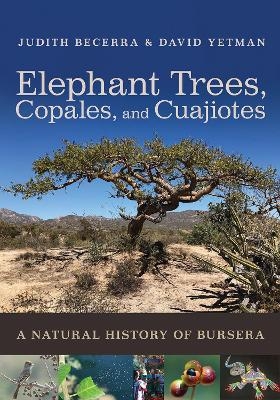
Elephant Trees, Copales, and Cuajiotes
University of Arizona Press (Verlag)
978-0-8165-5194-1 (ISBN)
Predominantly native to the U.S. Southwest, Mexico, and the Caribbean, the various species of Bursera have been prized throughout history for their distinctive aromas, medicinal properties, workable wood, and attractive appearance. Despite its extensive past and current use as incense in religious ceremonies, and its resourceful antiseptic ability to treat a range of maladies, no comprehensive book exists on this vital yet overlooked plant. Highlighting bursera’s importance and impact within the desert Southwest and Mexico, this volume will be the first book to describe the ecology, evolution, ethnobotany, and peculiar chemistry of the many species of Bursera.
In the United States, Bursera is represented by the short, contorted, and aromatic elephant tree of the hot Sonoran Desert and the stately and colorful gumbo limbo of southern Florida, while in the torrid lowlands of southern Mexico, the engines of evolution have produced forests dominated by dozens of species of Bursera, each with a peculiar ecological slot. This evolutionary tableau presents a complicated sex life that puzzles scientists. Recent research also reveals a gripping narrative of an epic struggle between trees and the insects that would subsist on their leaves: the insects seeking to exploit a food resource, the trees reacting with ever-changing, dramatic counter strategies. In addition to the fascinating and intricate workings of the genus’s ecological adaptations, burseras play a formative role in the lives of indigenous populations. Native peoples relish the plants’ aromatic resin, workable wood, and often colorful bark as a source for endless human applications.
Written in an engaging style, enhanced with two hundred color photographs, and complete with a compendium of species descriptions, this book will be an essential reference on a significant North American plant.
Judith Becerra is an associate professor at Biosphere 2, University of Arizona. A Fulbright, Beckman, and National Geographic award winner, Becerra’s research interests include the evolution and ecology of the genus Bursera and interaction with herbivores and the chemical and genomic links between stinkbugs and Alzheimer’s disease. David Yetman is a researcher at the Southwest Center of the University of Arizona whose specialties include the peoples and ecology of northwest Mexico and the southwestern United States. He is the author of numerous books, including Sonora: An Intimate Geography and The Saguaro Cactus: A Natural History. He has traveled extensively in the Bursera-rich regions of southern and western Mexico.
Foreword
Acknowledgments
Introduction
1. The Physical Setting: Mexico’s Mountain Ranges and Climate
2. American Tropical Deciduous Forests
3. Bursera Through Time: The Advantages of Being at the Right Place at the Right Time
4. Bursera’s Anatomical and Physiological Adaptations to the Land
To Exfoliate or Not to Exfoliate, That Is the Question
Succulence
Leaves, the Most Variable Trait of Bursera
5. Bursera Leaves and Their Interactions with Leaf Devourers
6. Bursera Reproductive Traits, or a Genus with Confused Sexuality
Reproductive Systems
Flowers
Fruits
7. Bursera and People
Resins
Essential Oil
Bursera Wooden Artifacts
8. Where Burseras Grow
9. How to Grow Burseras
10. Systematics and Taxonomy
Bursera Belongs to the Burseraceae
Evolutionary Relationships Within the Genus
11. Bursera: Genus and Species Descriptions
12. Index of Plants by Major Leaf Traits and Location
Glossary
References
Index
| Erscheinungsdatum | 17.01.2024 |
|---|---|
| Vorwort | Exequiel Ezcurra |
| Zusatzinfo | 190 color photographs, 3 maps, 1 table |
| Verlagsort | Tucson |
| Sprache | englisch |
| Maße | 178 x 254 mm |
| Gewicht | 272 g |
| Themenwelt | Sachbuch/Ratgeber ► Natur / Technik ► Natur / Ökologie |
| Reiseführer ► Nord- / Mittelamerika ► Mexiko | |
| Naturwissenschaften ► Biologie ► Ökologie / Naturschutz | |
| Naturwissenschaften ► Geowissenschaften ► Geografie / Kartografie | |
| ISBN-10 | 0-8165-5194-4 / 0816551944 |
| ISBN-13 | 978-0-8165-5194-1 / 9780816551941 |
| Zustand | Neuware |
| Informationen gemäß Produktsicherheitsverordnung (GPSR) | |
| Haben Sie eine Frage zum Produkt? |
aus dem Bereich