Zum Hauptinhalt springen
Nicht aus der Schweiz? Besuchen Sie lehmanns.de
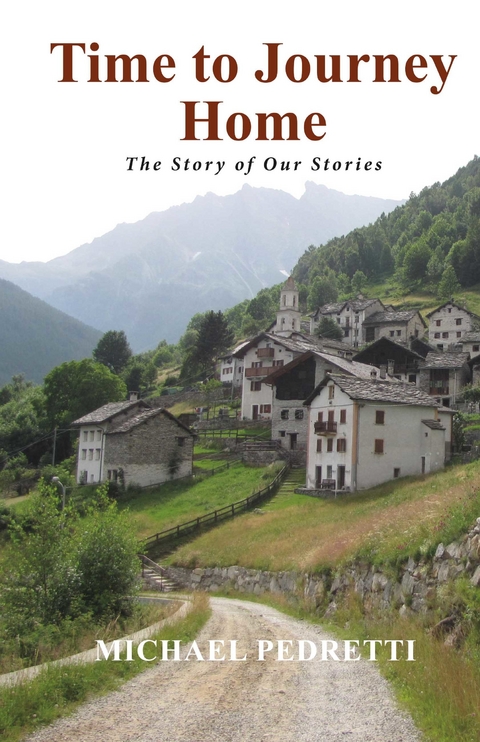
Time to Journey Home -  Michael Pedretti

Time to Journey Home (eBook)

eBook Download: EPUB
2020 | 1. Auflage
298 Seiten
Bookbaby (Verlag)
978-1-5439-9851-1 (ISBN)
Systemvoraussetzungen
3,56 inkl. MwSt
(CHF 3,45)
Der eBook-Verkauf erfolgt durch die Lehmanns Media GmbH (Berlin) zum Preis in Euro inkl. MwSt.
  • Download sofort lieferbar
  • Zahlungsarten anzeigen
Read about the author's journey home - travel with him as he encounters the small valley in Northern Italy that his ancestors called home for a thousand years before immigrating to a small Midwestern town in the mid-nineteenth century. There he discovered his ancestors were a kind, creative and empathetic people. As he learned more about them he became inspired to write a twelve book epic (Time to Journey Home is Book I) covering many generations in a family saga that highlights their contributions to and perspectives on life. In a separate section the author makes a plea for a new epic form - one that celebrates woman and kindness instead of man and war, the most common theme of epics of old. He asserts that epics have always defined who a people are while also providing a moral compass for how the people could and should live. Also, included is a detailed history of Genoa, Wisconsin, where his ancestors settled in the mid 1850s and where the author avows a spray drift of calmness flows through the coulee mingling with the spirit of kindness and empathy that their offspring inherited to create a way of life that inspired this book and the entire series of twelve books titled The Story of Our Stories that will follow. The appendix includes a genealogical history of the author tracing some lines of the family back to the 1500s.
Time to Journey Home is the story about the author's trip back to the small valley in Northern Italy that his ancestors called home for a thousand years before immigrating to a small Midwestern town in the mid-nineteenth century. While there Pedretti was inspired to write The Story of Our Stories, a twelve book epic designed to tell our story - of how our ancestors came to America, how America shaped them and how they shaped America. In this travelogue to discover his family history - his ancestry - the author explains how he prepared for the trip, whom he met on his journey and how he succeeded in adding nearly fifty ancestors to his family tree. Follow him in his genealogical search through the uncovering of church documents that identify the births, weddings and deaths of his family and how meeting others in search of their families often overlapped with his own research. Still his objective was not so much a genealogical search as it was a search to discover what shaped the way of life his ancestors had come to live. While visiting and meeting the people and the land, the author sees a kind and gentle people who seemed completely in synch with the beauty and majesty of the Alps. You will read about some very real imaginary conversations he had with a couple of his nineteenth century ancestors. Join the author as he visits the homes, churches, streets, and mountainsides where his ancestors had once lived. The first immigrants of our family saga settled in the small township of Bad Ax, Wisconsin. The book includes the story of rough-and-tough Bad Ax City evolving into Genoa, Wisconsin-the home of a spray drift of calm. This town will be center to much of the epic series. The author includes a manifesto calling for a new epic for the modern world. Historically epics helped to define who the culture was and provided the citizens a moral compass by which to live and make choices. The epics we know from the early ages celebrated man and war. The author believes the modern epic must celebrate woman and kindness. The new epic hero must be a planter rather than a warrior-destroyer. The new epic hero will be mother, the woman who shapes and defines the family and the world where kindness, creativity and empathy will rule. Each book will contain a piece that explores an idea that the people of this family saga might have written. In this book, the author reveals the great inequality perpetrated by the Social Security Act and offers a fail-safe solution to equalize and perpetuate a secure retirement for all ad infinitum. The appendix includes an ancestral history of the author at the start of his journey and the autobiographies of select persons, who researched the family's ancestry. The Story of Our Stories is the story of Marianna and Petronella, Peter and John, Adelaide and Stefano, and Agnes and her children and her grandchildren. It is about the individuals who peopled the Mount of San Bernardo and Valle Spluga who turned the roughness of Bad Ax City into the gentleness of Genoa, Wisconsin; but first and foremost it is our story, the story of you and me. Our story is written as an epic composed of twelve books, each with a supportive appendix. Each book covers a different story. Some cover the life of a typical family member of a specific generation; others reflect many people of a generation; another traces the entire story from beginning to now; and one looks into a future predicated by the behavior of our mothers. Each volume tells a critical part of the story, is an integral part of the whole, and plays into the unfolding of the epic. While part of a whole, each book can be read independent of the rest.

THE STORY OF OUR STORIES
BOOK I
Time to Journey Home
“The Journey is my home. . . . The universe is made of stories, not of atoms.”
—Muriel Rukeyser
“Your descendants shall gather your fruits.”
—Virgil
April 17, 2009
The time was now. The call was strong. It was time to journey home. Not home to Genoa, Wisconsin, where I was born and raised, but to that home on the mountain of San Bernardo and in the nearby valley town of Campodolcino where so many of my ancestors had lived for centuries, before circumstances uprooted them from their traditions and forced them west to the untested wilderness of western Wisconsin 150 years ago. It was a journey that led to finding out about long-lost ancestors and new facts about known ancestors. But that was not the call I heard. The need was simpler and more profound than collecting facts. I had to stand where my forebears stood, walk the streets they had walked, watch the same sunset over the same mountain with my girlfriend in my arms, stand on the very spot where a great-great-great-grandfather wooed the love of his life, worship where they worshipped, maybe even drink an espresso at the same bar. I invite you to come on that journey with me now to experience the connection and maybe even re-root yourself on firmer ground.
I grew up, like many other Americans, with little knowledge of anything before myself. Maybe I knew even less than most. As the twelfth child, I never heard the stories of my dad or mom’s youth, about how mean my grandparents were or how brave and generous my great-grandparents were. Maybe they had told those stories so many times to their older children they thought we were all sick of hearing about them, so they turned silent about the past.
Or possibly they knew very little themselves. Consider this: My mother’s mother, Mary Caroline Nicolatti, was born in Italy. She had nine children and more than fifty grandchildren. She was still alive to attend the weddings of some of her grandchildren. Yet not one of her children or grandchildren knew where she had been born in Italy, and at some point someone made up the story she had been born in Trieste. Not until 2011, some fifty-five years after her death, did we discover she had been born in Trento. The story was that her mother was born in Austria, and her father born in Italy. In fact, both were born in towns near Trento. All of Grandmother’s children and many of her grandchildren knew her parents. Still, I repeat, not one knew where they were born and raised.
How soon they forgot. It is hard to believe they did not make a conscious effort to forget, as if the world of their parents and grandparents would somehow contaminate the new world of lusciousness they found in the deep, rich, black soil (tended for millennia by natives) and turn the fertile dirt into the barren and overused and abused land they had left behind. Consider further, my parents not only did not know where their grandparents came from, but they had no idea that three of them, who came from the same narrow, ten-mile-long valley in Northern Italy called Valle San Giacomo (Saint James Valley, defined on the south by Chiavenna and on the other sides by mountains rising three thousand feet above sea level) almost certainly knew each other back in the old country.
I recall knowing only two things: one, that my dad’s grandfather, Stefano Pedretti, came from a place called Saint Bernard, Italy (but Dad had no idea where that might be), because that was what was carved on Stefano’s gravestone in the Saint Charles Cemetery in Genoa; the other was that I thought I had more Austrian blood in me than Italian, but that turned out not to be true.
There is a reason that families throughout history, and in every country, pass on their stories from generation to generation. These stories become part of who we are and assist us in finding a moral compass. Luckily, I had discovered the power of literature as a teenager, so I had a substitute for my own personal family’s stories. But a substitute is still a substitute. Little by little I became aware of an elemental need to know the real stories, to fill this void in my life.
In 1990 I was invited to be a guest at the International Festival of Mime in southern France, and I decided to take the opportunity to add on a honeymoon in Florence and Venice. It was considerably more economical to fly to Paris and rent a car than it was to fly to Milan. Nancy Hill, my bride, and I decided to drive through Switzerland, and I chose to route our trip to cross from Switzerland into Italy at the famous Great Saint Bernard Pass, best known for its dogs. Maybe that was the birthplace of my dad’s grandfather, Stephen Pedretti. It wasn’t. Still, during the night, sleeping in a loft room of a rustic hotel just past the Swiss-Italian border, I had a dream about the most ordinary woman of all times, who was, on second look, an extraordinary woman. Upon waking in the middle of the night, I realized the person I dreamt about was a blend of my mother, Agnes Venner, and her two sisters, who had also married sons of Peter Pedretti. I began to write furiously about the heroine of my dream. By the time Nancy awoke I had the first three chapters of a novel written, and I dashed off the fourth before we headed down the mountain. I completed the first draft of the book in two months and then put the draft aside.
A decade or so later I got my hands on three manuscripts that deeply inspired me because they included names, dates, events, and some fables about my family’s roots that I had no idea anybody knew or cared about. Jim Venner, my double first cousin and the son of Francis Venner and Mary Margaret Pedretti, had spent years building a manuscript, From Campodolcino to Genoa, the Descendants of Francesco Zaboglio, that identified fifty-nine of our ancestors, going back in one family to Antonio Buzzetti, who was born in 1569. It was a massive undertaking and had been researched with meticulous care. The edition I received was published in 1996. Shortly thereafter I was told that Jean Pedretti-Flottmeyer, also a double first cousin and the daughter of Albert Pedretti and Helen Venner, had made a manuscript simply called Malin, tracing the roots of Grandpa Peter’s wife and our grandmother Margaret “Maggie” Malin-Pedretti. Malin was another labor of love, filled with seventy-one pages of the descendants of my great-great-grandfather Josef Anton Malin (born August 16, 1847), covering 149 years right up to and past the birth of my daughter Victoria, who was born in March 1995. The book included wedding pictures of my parents, all my aunts and uncles and Grandpa Peter Pedretti, along with pictures of Grandma Maggie’s parents. At about the same time, I purchased a copy of Tracing Our Roots by Susanne Pedretti, the daughter of Joseph Pedretti, the son of Stephen, whose father was my great-grandfather Stefano Pedretti. Susanne had traveled via a circuitous route back to San Bernardo, a small village overlooking Chiavenna, Sondrio, Italy, on the mountain side of Valle San Giacomo. With the help of a couple of local citizens she found proof that this was indeed the Saint Bernard where Stefano Pedretti was born and spent the first twenty-seven years of his life before immigrating in 1854 to Bad Ax City, which a few years later became Genoa, Wisconsin.
These manuscripts motivated me to make a graphic representation of my genealogical past. As I developed that work for myself, I decided a modified version of the pictograph booklet would be of interest to my children and to my brothers and sisters, so I made seventeen versions and gave them as holiday presents in 2002. That was my project for that year. I have been studying a new topic or taking on a new project each year for the past couple of decades. In 2009 I decided it was time to discover my family’s story—to explore my own roots. I would make my annual study for 2009 the area of Italy where my ancestors once lived. A little research informed me that Italy was divided into twenty regions, and that Campodolcino, Vho, San Bernardo, San Giacomo Filippo, Como, Sondrio, and a few other places referenced as “towns of origins” of both the Pedretti and Venner families were in a northernmost region called Lombardy. Thus began my study.
I learned that the specific area the Pedretti and Venner families came from was called Valle San Giacomo. I looked up the area on Google Earth, found websites with photographs and detailed stories about the communities, devoured every book I could find on the region, reread the Venner, Flottmeyer, and Pedretti books, and referred time and again to my graphic representation to see which ancestor was alive during the period I was studying. Soon I felt a powerful need to return. I had to go! And I had to go now. I wanted to make the most of my trip “home,” so I immediately contacted the mayor of Campodolcino, who put me in touch with the director of tourism for the area. Then I called Jim Venner. Both suggested I contact two of the foremost experts on the area, Luigi Fanetti and Paulo Via, who were deeply invested in local history, genealogy, and the connection between Genoa, Wisconsin, and Campodolcino. As I spoke no Italian, I would need an interpreter if I was going to carry on conversations with the people I hoped to meet, so I called my friend Anne Guerrieri, who lives in Rome, to inquire if she would be available. She spoke perfect Italian, French, and English, and had told me in detail about her own voyage home, to Georgia, where her ancestors were of the ruling class before Stalin cut them...

Erscheint lt. Verlag 6.1.2020
Sprache englisch
Themenwelt Reisen Reiseführer Europa
ISBN-10 1-5439-9851-8 / 1543998518
ISBN-13 978-1-5439-9851-1 / 9781543998511
Informationen gemäß Produktsicherheitsverordnung (GPSR)
Haben Sie eine Frage zum Produkt?
EPUBEPUB (Ohne DRM)
Größe: 19,3 MB

Digital Rights Management: ohne DRM
Dieses eBook enthält kein DRM oder Kopier­schutz. Eine Weiter­gabe an Dritte ist jedoch rechtlich nicht zulässig, weil Sie beim Kauf nur die Rechte an der persön­lichen Nutzung erwerben.

Dateiformat: EPUB (Electronic Publication)
EPUB ist ein offener Standard für eBooks und eignet sich besonders zur Darstellung von Belle­tristik und Sach­büchern. Der Fließ­text wird dynamisch an die Display- und Schrift­größe ange­passt. Auch für mobile Lese­geräte ist EPUB daher gut geeignet.

Systemvoraussetzungen:
PC/Mac: Mit einem PC oder Mac können Sie dieses eBook lesen. Sie benötigen dafür die kostenlose Software Adobe Digital Editions.
eReader: Dieses eBook kann mit (fast) allen eBook-Readern gelesen werden. Mit dem amazon-Kindle ist es aber nicht kompatibel.
Smartphone/Tablet: Egal ob Apple oder Android, dieses eBook können Sie lesen. Sie benötigen dafür eine kostenlose App.
Geräteliste und zusätzliche Hinweise

Buying eBooks from abroad
For tax law reasons we can sell eBooks just within Germany and Switzerland. Regrettably we cannot fulfill eBook-orders from other countries.

Mehr entdecken
aus dem Bereich