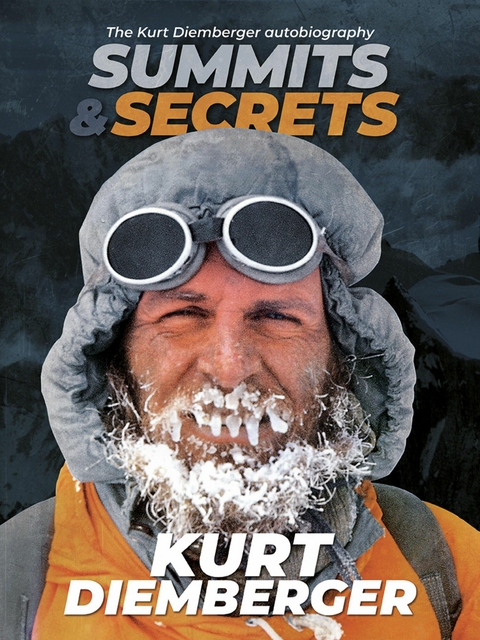
Summits and Secrets (eBook)
Vertebrate Publishing (Verlag)
978-1-912560-02-8 (ISBN)
Austrian mountaineer Kurt Diemberger is a member of an extremely select club - he is one of only two climbers to have made the first ascent of two of the world's 8,000-metre peaks: Broad Peak in 1957 and Dhaulagiri in 1960. Diemberger is also one of the top high-altitude filmmakers in the world and an accomplished writer, and his books - including The Endless Knot, about the 1986 K2 disaster - have enjoyed popularity around the globe. He is now recognised as one of the finest chroniclers of the contemporary mountain scene, with his writing guaranteed to enlighten, move and entertain. In 2013, Diemberger was awarded the Piolet d'Ors lifetime achievement award.
'A book grows rather like a snow crystal. One doesn't write it from start to finish but, in greater or less degree, all at the same time ... that is why my book is not in chronological order; for everything is of the present, held in the moment when thought captures it.'Kurt Diemberger's Summits and Secrets is a mountaineering autobiography like no other. Writing anecdotally, Diemberger provides an abstract look into his life and climbing career that is both fascinating and awe-inspiring to navigate. Known for surviving the 1986 K2 disaster an account described in harrowing detail in his award-winning book The Endless Knot Diemberger provides a captivating insight into his earlier climbs in Summits and Secrets. From climbing his first peak in the Tyrol mountains of Austria, to the epoch-making first ascent of Broad Peak with Hermann Buhl in 1957, and then summiting Dhaulagiri in 1960, where he became one of only two people to have made first ascents of two mountains over 8,000 metres, Diemberger recounts his experiences with wit, honesty and an infectious enthusiasm:'Every climber knows the thrill the unique inexplicable tension, which the regular shapes of the mountain world awake in him: huge pyramids, enormous rectangular slabs, piled-up triangles of rock, white circles, immense squares the thrill of simplicity of shape and outline and the excitement of mastering them, to an unbelievable extent, by his own efforts, his own power 'Summits and Secrets is a must-read for those wanting an insight into the life and achievements of one of the toughest high-altitude climbers the world has ever known.
My grandfather gave me his bicycle, a 1909 ‘museum-piece’. ‘Ride to school on it,’ he said; and I can still see the stern but kindly face with its white moustache. He was a headmaster, and headmasters always have to be a little stern …
He had covered the whole of the hilly country around the little village in Lower Austria, where he had worked all his life, year in, year out, either on his bicycle or on foot; for he was a keen hunter.
When he was fifty, he thought he had perhaps done enough pedalling, and acquired a motorcycle; but when the war ended, he had to dispose of it, and started pedalling again. He was still pedalling when he was eighty; and, had not the sight of one eye deteriorated, he would no doubt be pedalling today, when he is over ninety and still facing the world with great confidence.
That bicycle certainly opened up undreamed of possibilities for me. What matter that this 1909 showpiece was one of the first to be made after the famous ‘penny-farthings’? Or that it was still rather taller than normal machines, and a little peculiar to ride? That was just its hallmark; and there were definitely three people who knew how to ride it – my grandfather, my father and I. Everyone else – and I had a number of friends who wanted to try it out – dismounted in great haste.
‘Either you can or you can’t,’ thought I, and launched out on great adventures. My bike and I crossed the highest passes in the Alps together, journeyed far and wide through Austria, Switzerland and Italy.
I have it no longer. One day I left it outside the railway station, unpadlocked, as always. When I at last remembered it, two days later, it had disappeared, and it has never been seen again. Even now, I just can’t understand it. Certainly, nobody can possibly be riding it. Perhaps it graces the private collection of some connoisseur as a vintage exhibit; or maybe, one of these days, I shall recognise a part of it in an exhibition of pop art sculpture.
Nowadays I belong to the majority of the human race – those who either possess, want to possess or have possessed a car. Nowadays, I too take to the available motorway and think in terms of mileage, petrol, cash, and time. A spin in the car? Yes, of course – why not, on a Sunday afternoon?
Yet I wonder whether mountains, valleys and passes really exist anymore for the motorist? If anyone says they do, I hand him a bicycle and tell him to get cracking. I am sure he will very soon turn back – and will have understood the message. Poor devils! – he will be thinking – meaning the cyclists. Never again will he attempt a pass on a bicycle; but that will only be because he has sat in a car for too long a time.
Rrrums-treng … foot up, look up to see if the hairpin is clear … it is … foot down … trrreng … then the next hairpin … rums-treng … through it … left, treng … right, treng … left, right, left, right, left … ah, here we are at the top of the pass. The motorist is king of the world. He has done it again …!
Let’s hop out for a couple of minutes and stretch our legs a bit, and look at the view. Noticeably colder up here, but the view is fine, really remarkably fine, the view; a cigarette, eh? Or a quick one at the bar? Yes, the car did very well; the engine still pulls splendidly, well enough, that is – but, of course, such a lot depends on the driver …
Then down again on the other side, rums-treng, the first hairpin, rums-trrreng the second … left, right, left, right, left … with a new sticker on the windscreen.
What’s that I see – a cyclist? And – two more? Dear God, there must still be idealists about the place! The proud motorist at the helm maybe falls silent for a while – or he starts talking about the treadmill of our era, of the shortage of leisure time, of the treadmill from which there is no escape … the treadmill …
But perhaps, as I have suggested, he falls silent for a while and does some quiet thinking …
My grandfather’s bicycle was a magnificent treadmill. When you trod on the pedal you took a giant’s leap forwards, because the chainwheel was outsize. Later on I changed it for a smaller, more modern one. That produced an additional advantage: for I then had some spare links for my chain again, whereas I had been forced many a time to call in a blacksmith’s skill on the old one.
At the outset, I rode to my fossil beds – what an improvement that was! I was there in next to no time. How mechanical transport can alter one’s life … a quarter of an hour’s pedalling and I had covered ground which used to take me a long hour on foot, and reached my Glasenbachklamm, the gorge with the ammonites. Farther north, it only took an hour to the sandstone cliffs of the Haunsberg, where long ago the sea used to break against the nearby coast, and where you could find sea urchins as big as your head, mussels and a hundred other creatures. And, just before the end of my fossil-hunting days, fate granted me an unusual and highly impressive find. There, on a boulder below a sandstone cliff, in the middle of the woods, sat a crab, which chance had allowed, almost as if intentionally, to fall from high up in the cliff. I couldn’t believe my eyes. There it sat, bolt upright, with half-closed claws, between the ferns and the shrubs, as if waiting for something … for seventy million years.
That sort of thing had, however, become a Sunday afternoon pastime by now. As soon as I found a little more time, I rode farther afield into the Hohen Tauern, whose realm of peaks now lay open to me, without an upper limit; but I still kept on disappearing into its remotest corners, to look for crystals, minerals, or even gold – for the Romans had discovered the precious metal in the rocks of the Tauern and had mined it high up among them on the steep shores of the Bockart See. I found the gold-galleries, though they were barely recognisable. I must admit at once that I did not make my fortune, for what I lugged down to the valley was pyrites. Of course, I knew that, but I hoped there might be some gold in it. There wasn’t. So, in the end, I dragged half a rucksack-full – and all I could carry – of silver ore out of a gallery which, for a change, had been worked as recently as the Third Reich. I now felt that I had a great deal of silver at home. True, it had not been minted, but that did not seem to me to be important.
Then I climbed up again towards my summits, traversing the Geiselspitze in fog, armed only with a sketch I had made beforehand; for, having no camera, I had started making sketches of my summits. I had already sketched the Gross Venediger and the Gross Geiger, the first, two really white peaks I had ever seen. I was also doing things quite near Salzburg. At Easter, I took a hammer and a chisel, and climbed the north face of the Schafberg, high above the Attersee. There were Christmas roses still blooming down in the woods, snow and ice above that, and finally rock. I felt dreadful, but I could not turn back, and got to the top in the dark. Today I would not dream of tackling it without crampons, and I shudder when I think of it – but young climbers in their early years have all the more need for an outsize guardian angel.
At that moment I discovered for myself a guiding spirit, though a wingless one: it was a book on my father’s shelf. He had climbed a little himself in his younger days and later again during his military service. Over and again I had heard the story of his solo climb in army socks – he had left his forage-cap down below – on the Red Tower in the Lienz Dolomites; a story which grew more gripping every time it was repeated. Sometimes, too, when some of his old friends came to see us, I also heard about a certain chimney, up which they had hauled girls from Lienz – by preference fat ones – and how entertainingly Mina had got jammed in it.
The book was called The Dangers of the Alps – and it was a fat book at that. There was nothing about Mina in it – but it provided information about absolutely everything else: cornices and avalanches, bad weather, belaying with or without an axe, chimneys and overhangs, snow slopes and glaciers. ‘The Dangers of the Alps’ said the jacket, ‘by Zsigmondy and Paulcke.’ Clearly, at that moment, nothing more interesting could have fallen into my hands … It is a certainty that there could be no book of greater interest, and it happened, not infrequently, at school that the margin of some history book suddenly acquired the picture of a rescue from a crevasse or a snow contour or the stratification of some mountain – for it was clearly of decisive importance whether one climbed on the top of the strata or toiled painfully up the outward-sloping pitched roof on the reverse side …
My history teacher did not approve at all; but what he naturally could not understand was that it is no use being angry with such people, for they cannot be other than they are. And so I got my usual gamma minus for history again. On the credit side, I owed my life to the three-point rule of climbing when, on an easy but exposed pitch, a foothold came away. And it still seemed to me much more interesting to know why a glacier breaks up into crevasses, why in its ice those extraordinary interleavings of blue lie...
| Erscheint lt. Verlag | 8.3.2019 |
|---|---|
| Verlagsort | London |
| Sprache | englisch |
| Themenwelt | Literatur ► Biografien / Erfahrungsberichte |
| Literatur ► Romane / Erzählungen | |
| Sachbuch/Ratgeber ► Natur / Technik ► Natur / Ökologie | |
| Sachbuch/Ratgeber ► Sport | |
| Reisen ► Reiseberichte | |
| Naturwissenschaften ► Geowissenschaften ► Geografie / Kartografie | |
| Schlagworte | Adventure book • ALPINE • alpinism • Alps • austria • Brenva • Broad Peak • Climb • climbing book • Everest • Filmmaker • Greenland • Hermann Buhl • Himalaya • hindu kush • K2 • Matterhorn • Mont Blanc • Mountains • Travel |
| ISBN-10 | 1-912560-02-X / 191256002X |
| ISBN-13 | 978-1-912560-02-8 / 9781912560028 |
| Informationen gemäß Produktsicherheitsverordnung (GPSR) | |
| Haben Sie eine Frage zum Produkt? |
 EPUB (Adobe DRM)
Kopierschutz: Adobe-DRM
Adobe-DRM ist ein Kopierschutz, der das eBook vor Mißbrauch schützen soll. Dabei wird das eBook bereits beim Download auf Ihre persönliche Adobe-ID autorisiert. Lesen können Sie das eBook dann nur auf den Geräten, welche ebenfalls auf Ihre Adobe-ID registriert sind.
Details zum Adobe-DRM
Dateiformat: EPUB (Electronic Publication)
EPUB ist ein offener Standard für eBooks und eignet sich besonders zur Darstellung von Belletristik und Sachbüchern. Der Fließtext wird dynamisch an die Display- und Schriftgröße angepasst. Auch für mobile Lesegeräte ist EPUB daher gut geeignet.
Systemvoraussetzungen:
PC/Mac: Mit einem PC oder Mac können Sie dieses eBook lesen. Sie benötigen eine
eReader: Dieses eBook kann mit (fast) allen eBook-Readern gelesen werden. Mit dem amazon-Kindle ist es aber nicht kompatibel.
Smartphone/Tablet: Egal ob Apple oder Android, dieses eBook können Sie lesen. Sie benötigen eine
Geräteliste und zusätzliche Hinweise
Buying eBooks from abroad
For tax law reasons we can sell eBooks just within Germany and Switzerland. Regrettably we cannot fulfill eBook-orders from other countries.
aus dem Bereich