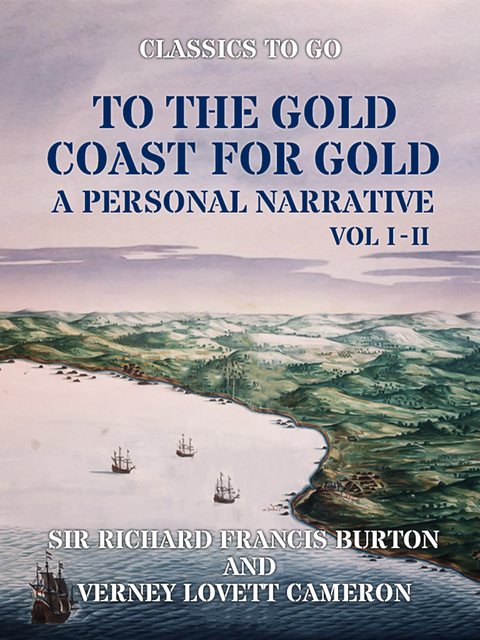
To The Gold Coast for Gold A Personal Narrative Vol I & Vol II (eBook)
489 Seiten
OTB eBook publishing (Verlag)
978-3-96272-844-1 (ISBN)
CHAPTER II.
FROM LISBON TO MADEIRA.
My allotted week in Lisbon came to an end only too soon: in the society of friends, and in the Camonian room (Bibliotheca Nacional), which contains nearly 300 volumes, I should greatly have enjoyed a month. The s.s. Luso (Captain Silva), of the 'Empresa Insulana,' one of the very few Portuguese steamers, announced her departure for December 20; and I found myself on board early in the morning, with a small but highly select escort to give me God-speed.
Unfortunately the 'May weather' had made way for the cacimbas (mists) of a rainy sou'-wester. The bar broke and roared at us; Cintra, the apex of Lisbon's extinct volcano and the Mountain of the (Sun and) Moon, hid her beautiful head, and even the Rock of Lisbon disdained the normal display of sturdy flank. Then set in a brise carabinée, which lasted during our voyage of 525 miles, and the Luso, rolling like a moribund whale, proved so lively that most of the fourteen passengers took refuge in their berths. A few who resisted the sea-fiend's assaults found no cause of complaint: the captain and officers were exceedingly civil and obliging, and food and wines were good and not costly.
From Madeira the Luso makes, once a month, the tour of the Azores, touching at each island—a great convenience—and returning in ten days.
Early on Thursday, the 22nd, the lumpy, churning sea began to subside, and the invisible balm seduced all the sufferers to the quarter-deck. They were wild to sight Madeira as children to see the rising of the pantomime-curtain. There was not much to gaze at; but what will not attract man's stare at sea?—a gull, a turtle, a flying fish! By the by, Captain Tuckey, of the Congo Expedition, remarked the 'extraordinary absence of sea-birds in the vicinity of Madeira and the Canaries:' they have since learned the way thither. Porto Santo appeared as a purple lump of three knobs, a manner of 'gizzard island,' backed by a deeper gloom of clouds—Madeira. Then it lit up with a pale glimmer as of snow, the effect of the sun glancing upon the thin greens of the northern flank; and, lastly, it broke into two masses—northern and southern—of peaks and precipices connected by a strip of lowland.
It is generally held that the discovery of the Madeiran group (1418-19) was the first marking feature of the century which circumnavigated Africa, and that Porto Santo was 'invented 'by the Portuguese before Madeira. The popular account, however, goes lame. For instance, the story that tried and sturdy soldiers and seamen were deterred from advancing a few miles, and were driven back to Portugal by the 'thick impenetrable darkness which was guarded by a strange noise,' and by anile fancies about the 'Mouth of Hell' and 'Cipango,' reads like mere stuff and nonsense. Again, great are the difficulties in determining the nationality of the explorers, and settling the conflicting claims of the French, Genoese, Portuguese, Spanish, English, and Arabs. History, and perhaps an aptitude for claiming, have assigned the honour exclusively to Lusitania: and every guide-book tells the same old tale. But I have lived long enough to have seen how history is written; and the discovery was, at best, a mere re-discovery, as we learn from Pliny (vi. 36), whose 'insulae purpurariae' cannot be confounded [Note: Mr. Major, however, would identify the Purple Islands with Oanarian Fuerteventura and Lanzarote, both possibly Continental.] with the Fortunate Islands, or Canaries. The 'Gaetulian dye' of King Juba in the Augustan age is not known. Its origin has been found in the orchilla still growing upon the Desertas; but this again appears unlikely enough. Ptolemy (iv. 1,16) also mentions 'Erythía,' the Red Isle—'red,' possibly, for the same reason; and Plutarch (in Suet.) may allude to the Madeiran group when he relates of the Fortunate Islands: 'They are two, separated only by a narrow channel, and at a distance of 400 leagues (read 320 miles) from the African coast.'
The Jesuit, Antonio Cordeyro, [Note: Historia insulana das Ilhas a Portugal sugoytas, pp. 61-96. Lisbon, 1717.] who borrows from the learned and trustworthy Dr. Gaspar Fructuoso, [Note: As Saudades da Terra, lib. i. ch. iii, Historia das Ilhas, &c. This lettered and conscientious chronicler, the first who wrote upon the Portuguese islands, was born (A.D. 1522) at Ponta Delgada (Thin Point) of St. Michael, Azores. He led a life of holiness and good works, composed his history in 1590, left many 'sons of his soul,' as he called his books, and died in his natal place, A.D. 1591. The Madeiran portion of the two huge folios (some 4,000 pages of MS.) has been printed at Funchal, with copious notes by Dr. A. Rodrigues de Azevedo, Professor of Literature, &c., at the National Lyceum; and a copy was kindly lent to me, during the author's absence in Lisbon, by Governor Viscount de Villa Mendo.] declares in 1590: 'The first discoverers of the Porto Santo Island, many say, were those Frenchmen and Castilians (Spaniards) who went forth from Castile to conquer the Canaries; these, when either outward or homeward bound, came upon the said island, and, for that they found it uninhabited and small, they abandoned it; but as they had weathered a storm and saved themselves there, they named it Port Holy.' Fructuoso (i. 5) expressly asserts that the Portuguese sailed from Lisbon in June 1419 for 'the Isle of Porto Sancto'(in 32° N. lat.), which two years before had been discovered by some Castilian ships making the Canaries, the latter having been occupied a short time previously by the French; wherefore the pilot took that route.' The Jesuit chronicler continues to relate that after the formally proclaimed annexation of the Canaries by the Normans and Castilians (A.D. 1402-18), Prince Henry, the Navigator, despatched from Lagos, in 1417, an expedition to explore Cape Bojador, the 'gorbellied.' The three ships were worked by the Italian master-seaman Bertholomeu Palestrello or Palestro, commonly called Perestrello. The soldiers, corresponding to our marines, were commanded by the 'sweet warman,' João Gonçales da Camara, nicknamed 'O Zargo,' the Cyclops, not the squint-eyed; [Note: Curious to say, Messieurs White and Johnson, the writers of the excellent guide-book, will translate the word 'squint-eyed:' they might have seen the portrait in Government House.] his companion was Tristão Vaz Teyxeyra, called in honour 'the Tristam.' Azurara, [Note: Chronica do Descobrimento de Guiné. By Gomes Eannes de Azurara, written between A.D. 1452-53, and quoted by Prof. Azevedo, Notes, p. 830.] a contemporary, sends the 'two noble squires,' Zarco and Tristam, 'who in bad weather were guided by God to the isle now called Porto Sancto' (June 1419). They returned home (marvellous to relate) without touching at Madeira, only twenty-three miles distant; and next year (1420) Prince Henry commissioned Palestrello also.
The Spaniards prefer to believe that after Jehan de Béthencourt's attack upon the Canaries (A.D. 1403), his soldier Lancelot, who named Lanzarote Island, touched at Porto Santo in 1417; and presently, sailing to the south-west, discovered Madeira. This appears reasonable enough.
Patriotic Barbot (1700), in company with the mariner Villault de Belfons, Père Labat, and Ernest de Fréville, [Note: Mémoire sur le Commerce Maritime de Rouen.] claims the honour for France. According to that 'chief factor for the African Company,' the merchants of Dieppe first traded to West Africa for cardamoms and ivory. This was during the reign of Charles V., and between 1364 and 1430, or half a century before the Portuguese. Their chief stations were Goree of Cape Verde, Sierra Leone, Cape Mount, the Kru or Liberian coast, then called 'of Grain,' from the 'Guinea grains' or Malaguetta pepper (Amomum granum Paradisi), and, lastly, the Gold Coast. Here they founded 'Petit Paris' upon the Baie de France, at 'Serrelionne;' 'Petit Dieppe,' at the mouth of the St. John's River, near Grand Bassá, south of Monrovia; and 'Cestro' [Note: Now generally called Grand Sestros, and popularly derived from the Portuguese cestos—pepper.] or 'Sestro Paris,' where, three centuries afterwards, the natives retained a few words of French. Hence Admiral Bouet-Willaumez explains the Great and Little 'Boutoo' of our charts by butteau, from butte, the old Norman word still preserved in the great western prairies.
Barbot resumes that in 1383 the Rouen traders, combining with the Dieppe men, sent upon an exploring voyage three ships, one of which, La Vierge, ran down coast as far as where Commenda (Komenda or Komání) and Elmina now stand. At the latter place they built a fort and factory just one century before it was occupied by the Portuguese. The Frenchman declares that one of the Elmina castles was called Bastion de France, and 'on it are still to be seen some old arithmetical numbers, which are anno 13' (i.e. 1383); 'the rest being defaced by weather.' This first factory was afterwards incorporated with the modern building; and in 1387 it was enlarged with the addition of a chapel to lodge more than ten or twelve men, the original garrison.
In 1670 Ogilvy [Note: London: Printed by Tho. Johnson for the author, and to be had at his house in White Fryers, MDCLXX.] notes: 'The castle (Elmina) was judged to be an Antient Building from several marks of Antiquity about it; as first by a decay'd Battery, which the Dutch repaired some years ago, retaining the name of the French Battery, because it seems to have been built by the French; who, as the Inhabitants say, before the coming of the Portugals harbour'd there. The Dutch when they won it, found the numerical Figures...
| Erscheint lt. Verlag | 10.1.2019 |
|---|---|
| Sprache | englisch |
| Themenwelt | Sachbuch/Ratgeber |
| Reisen ► Reiseführer | |
| ISBN-10 | 3-96272-844-9 / 3962728449 |
| ISBN-13 | 978-3-96272-844-1 / 9783962728441 |
| Informationen gemäß Produktsicherheitsverordnung (GPSR) | |
| Haben Sie eine Frage zum Produkt? |
 EPUB (Ohne DRM)
Größe: 1,0 MB
Digital Rights Management: ohne DRM
Dieses eBook enthält kein DRM oder Kopierschutz. Eine Weitergabe an Dritte ist jedoch rechtlich nicht zulässig, weil Sie beim Kauf nur die Rechte an der persönlichen Nutzung erwerben.
Dateiformat: EPUB (Electronic Publication)
EPUB ist ein offener Standard für eBooks und eignet sich besonders zur Darstellung von Belletristik und Sachbüchern. Der Fließtext wird dynamisch an die Display- und Schriftgröße angepasst. Auch für mobile Lesegeräte ist EPUB daher gut geeignet.
Systemvoraussetzungen:
PC/Mac: Mit einem PC oder Mac können Sie dieses eBook lesen. Sie benötigen dafür die kostenlose Software Adobe Digital Editions.
eReader: Dieses eBook kann mit (fast) allen eBook-Readern gelesen werden. Mit dem amazon-Kindle ist es aber nicht kompatibel.
Smartphone/Tablet: Egal ob Apple oder Android, dieses eBook können Sie lesen. Sie benötigen dafür eine kostenlose App.
Geräteliste und zusätzliche Hinweise
Buying eBooks from abroad
For tax law reasons we can sell eBooks just within Germany and Switzerland. Regrettably we cannot fulfill eBook-orders from other countries.
aus dem Bereich