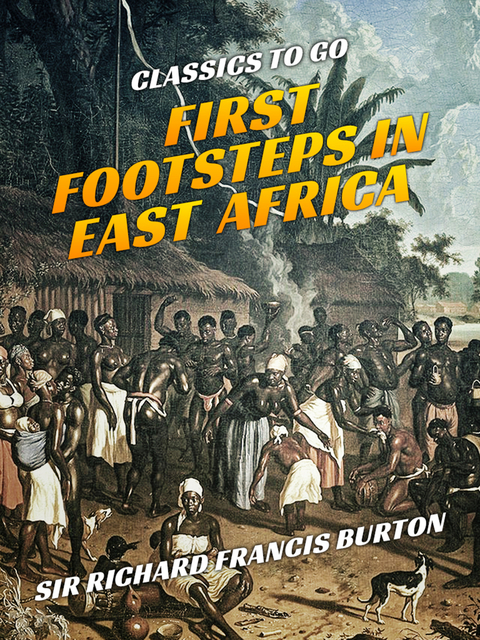
First Footsteps in East Africa (eBook)
333 Seiten
OTB eBook publishing (Verlag)
978-3-96272-842-7 (ISBN)
PREFACE.
Averse to writing, as well as to reading, diffuse Prolegomena, the author finds himself compelled to relate, at some length, the circumstances which led to the subject of these pages.
In May 1849, the late Vice-Admiral Sir Charles Malcolm, formerly Superintendent of the Indian Navy, in conjunction with Mr. William John Hamilton, then President of the Royal Geographical Society of Great Britain, solicited the permission of the Court of Directors of the Honorable East India Company to ascertain the productive resources of the unknown Somali Country in East Africa. The answer returned, was to the following effect:—
"If a fit and proper person volunteer to travel in the Somali Country, he goes as a private traveller, the Government giving no more protection to him than they would to an individual totally unconnected with the service. They will allow the officer who obtains permission to go, during his absence on the expedition to retain all the pay and allowances he may be enjoying when leave was granted: they will supply him with all the instruments required, afford him a passage going and returning, and pay the actual expenses of the journey."
The project lay dormant until March 1850, when Sir Charles Malcolm and Captain Smyth, President of the Royal Geographical Society of Great Britain, waited upon the chairman of the Court of Directors of the Honorable East India Company. He informed them that if they would draw up a statement of what was required, and specify how it could be carried into effect, the document should be forwarded to the Governor-General of India, with a recommendation that, should no objection arise, either from expense or other causes, a fit person should be permitted to explore the Somali Country.
Sir Charles Malcolm then offered the charge of the expedition to Dr. Carter of Bombay, an officer favourably known to the Indian world by his services on board the "Palinurus" brig whilst employed upon the maritime survey of Eastern Arabia. Dr. Carter at once acceded to the terms proposed by those from whom the project emanated; but his principal object being to compare the geology and botany of the Somali Country with the results of his Arabian travels, he volunteered to traverse only that part of Eastern Africa which lies north of a line drawn from Berberah to Ras Hafun,—in fact, the maritime mountains of the Somal. His health not permitting him to be left on shore, he required a cruizer to convey him from place to place, and to preserve his store of presents and provisions. By this means he hoped to land at the most interesting points and to penetrate here and there from sixty to eighty miles inland, across the region which he undertook to explore.
On the 17th of August, 1850, Sir Charles Malcolm wrote to Dr. Carter in these terms:—"I have communicated with the President of the Royal Geographical Society and others: the feeling is, that though much valuable information could no doubt be gained by skirting the coast (as you propose) both in geology and botany, yet that it does not fulfil the primary and great object of the London Geographical Society, which was, and still is, to have the interior explored." The Vice-Admiral, however, proceeded to say that, under the circumstances of the case, Dr. Carter's plans were approved of, and asked him to confer immediately with Commodore Lushington; then Commander in Chief of the Indian Navy.
In May, 1851, Vice-Admiral Sir Charles Malcolm died: geographers and travellers lost in him an influential and an energetic friend. During the ten years of his superintendence over the Indian Navy that service rose, despite the incubus of profound peace, to the highest distinction. He freely permitted the officers under his command to undertake the task of geographical discovery, retaining their rank, pay, and batta, whilst the actual expenses of their journeys were defrayed by contingent bills. All papers and reports submitted to the local government were favourably received, and the successful traveller looked forward to distinction and advancement.
During the decade which elapsed between 1828 and 1838, "officers of the Indian Navy journeyed, as the phrase is, with their lives in their hands, through the wildest districts of the East. Of these we name the late Commander J. A. Young, Lieutenants Wellsted, Wyburd, Wood, and Christopher, retired Commander Ormsby, the present Capt. H. B. Lynch C.B., Commanders Felix Jones and W. C. Barker, Lieutenants Cruttenden and Whitelock. Their researches extended from the banks of the Bosphorus to the shores of India. Of the vast, the immeasurable value of such services," to quote the words of the Quarterly Review (No. cxxix. Dec. 1839), "which able officers thus employed, are in the mean time rendering to science, to commerce, to their country, and to the whole civilized world, we need say nothing:—nothing we could say would be too much."
"In five years, the admirable maps of that coral-bound gulf—the Red Sea— were complete: the terrors of the navigation had given place to the confidence inspired by excellent surveys. In 1829 the Thetis of ten guns, under Commander Robert Moresby, convoyed the first coal ship up the Red Sea, of the coasts of which this skilful and enterprising seaman made a cursory survey, from which emanated the subsequent trigonometrical operations which form our present maps. Two ships were employed, the 'Benares' and 'Palinurus,' the former under Commander Elwon, the latter under Commander Moresby. It remained, however, for the latter officer to complete the work. Some idea may be formed of the perils these officers and men went through, when we state the 'Benares' was forty-two times aground.
"Robert Moresby, the genius of the Red Sea, conducted also the survey of the Maldive Islands and groups known as the Chagos Archipelago. He narrowly escaped being a victim to the deleterious climate of his station, and only left it when no longer capable of working. A host of young and ardent officers,—Christopher, Young, Powell, Campbell, Jones, Barker, and others,—ably seconded him: death was busy amongst them for months and so paralyzed by disease were the living, that the anchors could scarcely be raised for a retreat to the coast of India. Renovated by a three months' stay, occasionally in port, where they were strengthened by additional numbers, the undaunted remnants from time to time returned to their task; and in 1837, gave to the world a knowledge of those singular groups which heretofore—though within 150 miles of our coasts—had been a mystery hidden within the dangers that environed them. The beautiful maps of the Red Sea, drafted by the late Commodore Carless, then a lieutenant, will ever remain permanent monuments of Indian Naval Science, and the daring of its officers and men. Those of the Maldive and Chagos groups, executed by Commander then Acting Lieutenant Felix Jones, were, we hear, of such a high order, that they were deemed worthy of special inspection by the Queen."
"While these enlightening operations were in progress, there were others of this profession, no less distinguished, employed on similar discoveries. The coast of Mekran westward from Scinde, was little known, but it soon found a place in the hydrographical offices of India, under Captain, then Lieutenant, Stafford Haines, and his staff, who were engaged on it. The journey to the Oxus, made by Lieut. Wood, Sir. A. Burnes's companion in his Lahore and Afghan missions, is a page of history which may not be opened to us again in our own times; while in Lieut. Carless's drafts of the channels of the Indus, we trace those designs, that the sword of Sir Charles Napier only was destined to reveal."
"The ten years prior to that of 1839 were those of fitful repose, such as generally precedes some great outbreak. The repose afforded ample leisure for research, and the shores of the island of Socotra, with the south coast of Arabia, were carefully delineated. Besides the excellent maps of these regions, we are indebted to the survey for that unique work on Oman, by the late Lieut. Wellsted of this service, and for valuable notices from the pen of Lieut. Cruttenden.
"Besides the works we have enumerated, there were others of the same nature, but on a smaller scale, in operation at the same period around our own coasts. The Gulf of Cambay, and the dangerous sands known as the Molucca Banks, were explored and faithfully mapped by Captain Richard Ethersey, assisted by Lieutenant (now Commander) Fell. Bombay Harbour was delineated again on a grand scale by Capt. R. Cogan, assisted by Lieut. Peters, now both dead; and the ink of the Maldive charts had scarcely dried, when the labours of those employed were demanded of the Indian Government by Her Majesty's authorities at Ceylon, to undertake trigonometrical surveys of that Island, and the dangerous and shallow gulfs on either side of the neck of sand connecting it with India. They were the present Captains F. F. Powell, and Richard Ethersey, in the Schooner 'Royal Tiger' and 'Shannon,' assisted by Lieut. (now Commander) Felix Jones, and the late Lieut. Wilmot Christopher, who fell in action before Mooltan. The first of these officers had charge of one of the tenders under Lieut. Powell, and the latter another under Lieut. Ethersey. The maps of the Pamban Pass and the Straits of Manaar were by the hand of Lieut. Felix Jones, who was the draftsman also on this survey: they speak for themselves."
In 1838 Sir Charles Malcolm was succeeded by Sir Robert Oliver, an "old officer of the old school"—a strict disciplinarian, a faithful and honest servant of Government, but a violent, limited, and prejudiced man. He wanted "sailors," individuals conversant with ropes and rigging, and steeped in knowledge of shot and...
| Erscheint lt. Verlag | 10.1.2019 |
|---|---|
| Sprache | englisch |
| Themenwelt | Sachbuch/Ratgeber |
| Reisen ► Reiseführer | |
| ISBN-10 | 3-96272-842-2 / 3962728422 |
| ISBN-13 | 978-3-96272-842-7 / 9783962728427 |
| Informationen gemäß Produktsicherheitsverordnung (GPSR) | |
| Haben Sie eine Frage zum Produkt? |
 EPUB (Ohne DRM)
Größe: 1,3 MB
Digital Rights Management: ohne DRM
Dieses eBook enthält kein DRM oder Kopierschutz. Eine Weitergabe an Dritte ist jedoch rechtlich nicht zulässig, weil Sie beim Kauf nur die Rechte an der persönlichen Nutzung erwerben.
Dateiformat: EPUB (Electronic Publication)
EPUB ist ein offener Standard für eBooks und eignet sich besonders zur Darstellung von Belletristik und Sachbüchern. Der Fließtext wird dynamisch an die Display- und Schriftgröße angepasst. Auch für mobile Lesegeräte ist EPUB daher gut geeignet.
Systemvoraussetzungen:
PC/Mac: Mit einem PC oder Mac können Sie dieses eBook lesen. Sie benötigen dafür die kostenlose Software Adobe Digital Editions.
eReader: Dieses eBook kann mit (fast) allen eBook-Readern gelesen werden. Mit dem amazon-Kindle ist es aber nicht kompatibel.
Smartphone/Tablet: Egal ob Apple oder Android, dieses eBook können Sie lesen. Sie benötigen dafür eine kostenlose App.
Geräteliste und zusätzliche Hinweise
Buying eBooks from abroad
For tax law reasons we can sell eBooks just within Germany and Switzerland. Regrettably we cannot fulfill eBook-orders from other countries.
aus dem Bereich