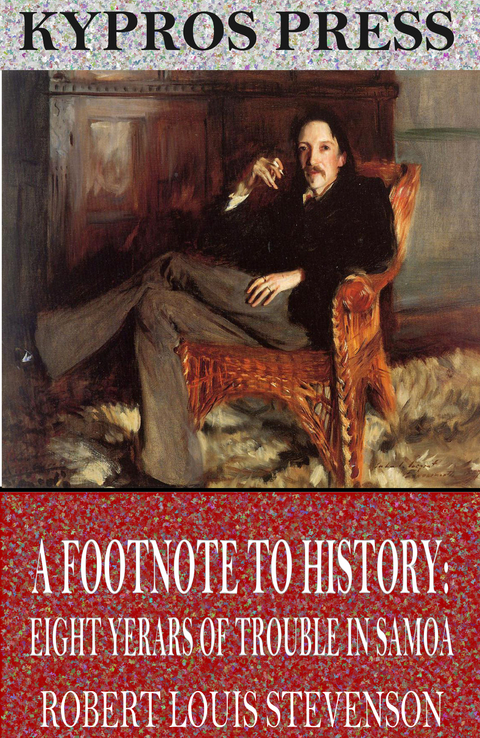
Footnote to History: Eight Years of Trouble in Samoa (eBook)
249 Seiten
Charles River Editors (Verlag)
978-1-5312-8835-8 (ISBN)
Robert Louis Stevenson was a Scottish author who is considered to be one of the greatest writers of the nineteenth century. With classics such as Treasure Island, Kidnapped, and The Strange Case of Dr. Jekyll and Mr. Hyde, Stevenson is still one of the most widely read authors today. This edition of A Footnote to History: Eight Years of Trouble in Samoa includes a table of contents.
CHAPTER 2. THE ELEMENTS OF DISCORD: FOREIGN
THE huge majority of Samoans, like other God-fearing folk in other countries, are perfectly content with their own manners. And upon one condition, it is plain they might enjoy themselves far beyond the average of man. Seated in islands very rich in food, the idleness of the many idle would scarce matter; and the provinces might continue to bestow their names among rival pretenders, and fall into war and enjoy that a while, and drop into peace and enjoy that, in a manner highly to be envied. But the condition — that they should be let alone — is now no longer possible. More than a hundred years ago, and following closely on the heels of Cook, an irregular invasion of adventurers began to swarm about the isles of the Pacific. The seven sleepers of Polynesia stand, still but half aroused, in the midst of the century of competition. And the island races, comparable to a shopful of crockery launched upon the stream of time, now fall to make their desperate voyage among pots of brass and adamant.
Apia, the port and mart, is the seat of the political sickness of Samoa. At the foot of a peaked, woody mountain, the coast makes a deep indent, roughly semicircular. In front the barrier reef is broken by the fresh water of the streams; if the swell be from the north, it enters almost without diminution; and the war-ships roll dizzily at their moorings, and along the fringing coral which follows the configuration of the beach, the surf breaks with a continuous uproar. In wild weather, as the world knows, the roads are untenable. Along the whole shore, which is everywhere green and level and overlooked by inland mountain-tops, the town lies drawn out in strings and clusters. The western horn is Mulinuu, the eastern, Matautu; and from one to the other of these extremes, I ask the reader to walk. He will find more of the history of Samoa spread before his eyes in that excursion, than has yet been collected in the blue-books or the white-books of the world. Mulinuu (where the walk is to begin) is a flat, wind-swept promontory, planted with palms, backed against a swamp of mangroves, and occupied by a rather miserable village. The reader is informed that this is the proper residence of the Samoan kings; he will be the more surprised to observe a board set up, and to read that this historic village is the property of the German firm. But these boards, which are among the commonest features of the landscape, may be rather taken to imply that the claim has been disputed. A little farther east he skirts the stores, offices, and barracks of the firm itself. Thence he will pass through Matafele, the one really town-like portion of this long string of villages, by German bars and stores and the German consulate; and reach the Catholic mission and cathedral standing by the mouth of a small river. The bridge which crosses here (bridge of Mulivai) is a frontier; behind is Matafele; beyond, Apia proper; behind, Germans are supreme; beyond, with but few exceptions, all is Anglo-Saxon. Here the reader will go forward past the stores of Mr. Moors (American) and Messrs. MacArthur (English); past the English mission, the office of the English newspaper, the English church, and the old American consulate, till he reaches the mouth of a larger river, the Vaisingano. Beyond, in Matautu, his way takes him in the shade of many trees and by scattered dwellings, and presently brings him beside a great range of offices, the place and the monument of a German who fought the German firm during his life. His house (now he is dead) remains pointed like a discharged cannon at the citadel of his old enemies. Fitly enough, it is at present leased and occupied by Englishmen. A little farther, and the reader gains the eastern flanking angle of the bay, where stands the pilot-house and signal-post, and whence he can see, on the line of the main coast of the island, the British and the new American consulates.
The course of his walk will have been enlivened by a considerable to and fro of pleasure and business. He will have encountered many varieties of whites, — sailors, merchants, clerks, priests, Protestant missionaries in their pith helmets, and the nondescript hangers-on of any island beach. And the sailors are sometimes in considerable force; but not the residents. He will think at times there are more signboards than men to own them. It may chance it is a full day in the harbour; he will then have seen all manner of ships, from men-of-war and deep-sea packets to the labour vessels of the German firm and the cockboat island schooner; and if he be of an arithmetical turn, he may calculate that there are more whites afloat in Apia bay than whites ashore in the whole Archipelago. On the other hand, he will have encountered all ranks of natives, chiefs and pastors in their scrupulous white clothes; perhaps the king himself, attended by guards in uniform; smiling policemen with their pewter stars; girls, women, crowds of cheerful children. And he will have asked himself with some surprise where these reside. Here and there, in the back yards of European establishments, he may have had a glimpse of a native house elbowed in a corner; but since he left Mulinuu, none on the beach where islanders prefer to live, scarce one on the line of street. The handful of whites have everything; the natives walk in a foreign town. A year ago, on a knoll behind a bar-room, he might have observed a native house guarded by sentries and flown over by the standard of Samoa. He would then have been told it was the seat of government, driven (as I have to relate) over the Mulivai and from beyond the German town into the Anglo-Saxon. To-day, he will learn it has been carted back again to its old quarters. And he will think it significant that the king of the islands should be thus shuttled to and fro in his chief city at the nod of aliens. And then he will observe a feature more significant still: a house with some concourse of affairs, policemen and idlers hanging by, a man at a bank-counter overhauling manifests, perhaps a trial proceeding in the front verandah, or perhaps the council breaking up in knots after a stormy sitting. And he will remember that he is in the ELEELE SA, the “Forbidden Soil,” or Neutral Territory of the treaties; that the magistrate whom he has just seen trying native criminals is no officer of the native king’s; and that this, the only port and place of business in the kingdom, collects and administers its own revenue for its own behoof by the hands of white councillors and under the supervision of white consuls. Let him go further afield. He will find the roads almost everywhere to cease or to be made impassable by native pig-fences, bridges to be quite unknown, and houses of the whites to become at once a rare exception. Set aside the German plantations, and the frontier is sharp. At the boundary of the ELEELE SA, Europe ends, Samoa begins. Here, then, is a singular state of affairs: all the money, luxury, and business of the kingdom centred in one place; that place excepted from the native government and administered by whites for whites; and the whites themselves holding it not in common but in hostile camps, so that it lies between them like a bone between two dogs, each growling, each clutching his own end.
Should Apia ever choose a coat of arms, I have a motto ready: “Enter Rumour painted full of tongues.” The majority of the natives do extremely little; the majority of the whites are merchants with some four mails in the month, shopkeepers with some ten or twenty customers a day, and gossip is the common resource of all. The town hums to the day’s news, and the bars are crowded with amateur politicians. Some are office-seekers, and earwig king and consul, and compass the fall of officials, with an eye to salary. Some are humorists, delighted with the pleasure of faction for itself. “I never saw so good a place as this Apia,” said one of these; “you can be in a new conspiracy every day!” Many, on the other hand, are sincerely concerned for the future of the country. The quarters are so close and the scale is so small, that perhaps not any one can be trusted always to preserve his temper. Every one tells everything he knows; that is our country sickness. Nearly every one has been betrayed at times, and told a trifle more; the way our sickness takes the predisposed. And the news flies, and the tongues wag, and fists are shaken. Pot boil and caldron bubble!
Within the memory of man, the white people of Apia lay in the worst squalor of degradation. They are now unspeakably improved, both men and women. To-day they must be called a more than fairly respectable population, and a much more than fairly intelligent. The whole would probably not fill the ranks of even an English half-battalion, yet there are a surprising number above the average in sense, knowledge, and manners. The trouble (for Samoa) is that they are all here after a livelihood. Some are sharp practitioners, some are famous (justly or not) for foul play in business. Tales fly. One merchant warns you against his neighbour; the neighbour on the first occasion is found to return the compliment: each with a good circumstantial story to the proof. There is so much copra in the islands, and no more; a man’s share of it is his share of bread; and commerce, like politics, is here narrowed to a focus, shows its ugly side, and becomes as personal as fisticuffs. Close at their elbows, in all this contention, stands the native looking on. Like a child, his true analogue, he observes, apprehends, misapprehends, and is usually silent. As in a child, a considerable intemperance of speech is accompanied by some power of secrecy. News he publishes; his thoughts have often to be dug for. He looks...
| Erscheint lt. Verlag | 22.3.2018 |
|---|---|
| Sprache | englisch |
| Themenwelt | Reisen ► Reiseberichte |
| Reisen ► Reiseführer | |
| Schlagworte | Adventure • Catriona • Classic • Historical • Kidnapped • Romantic • Scottish • Travel • Treasure Island |
| ISBN-10 | 1-5312-8835-9 / 1531288359 |
| ISBN-13 | 978-1-5312-8835-8 / 9781531288358 |
| Informationen gemäß Produktsicherheitsverordnung (GPSR) | |
| Haben Sie eine Frage zum Produkt? |
 EPUB (Adobe DRM)
Größe: 1,3 MB
Kopierschutz: Adobe-DRM
Adobe-DRM ist ein Kopierschutz, der das eBook vor Mißbrauch schützen soll. Dabei wird das eBook bereits beim Download auf Ihre persönliche Adobe-ID autorisiert. Lesen können Sie das eBook dann nur auf den Geräten, welche ebenfalls auf Ihre Adobe-ID registriert sind.
Details zum Adobe-DRM
Dateiformat: EPUB (Electronic Publication)
EPUB ist ein offener Standard für eBooks und eignet sich besonders zur Darstellung von Belletristik und Sachbüchern. Der Fließtext wird dynamisch an die Display- und Schriftgröße angepasst. Auch für mobile Lesegeräte ist EPUB daher gut geeignet.
Systemvoraussetzungen:
PC/Mac: Mit einem PC oder Mac können Sie dieses eBook lesen. Sie benötigen eine
eReader: Dieses eBook kann mit (fast) allen eBook-Readern gelesen werden. Mit dem amazon-Kindle ist es aber nicht kompatibel.
Smartphone/Tablet: Egal ob Apple oder Android, dieses eBook können Sie lesen. Sie benötigen eine
Geräteliste und zusätzliche Hinweise
Buying eBooks from abroad
For tax law reasons we can sell eBooks just within Germany and Switzerland. Regrettably we cannot fulfill eBook-orders from other countries.
EPUB (Ohne DRM)Digital Rights Management: ohne DRM
Dieses eBook enthält kein DRM oder Kopierschutz. Eine Weitergabe an Dritte ist jedoch rechtlich nicht zulässig, weil Sie beim Kauf nur die Rechte an der persönlichen Nutzung erwerben.
Dateiformat: EPUB (Electronic Publication)
EPUB ist ein offener Standard für eBooks und eignet sich besonders zur Darstellung von Belletristik und Sachbüchern. Der Fließtext wird dynamisch an die Display- und Schriftgröße angepasst. Auch für mobile Lesegeräte ist EPUB daher gut geeignet.
Systemvoraussetzungen:
PC/Mac: Mit einem PC oder Mac können Sie dieses eBook lesen. Sie benötigen dafür die kostenlose Software Adobe Digital Editions.
eReader: Dieses eBook kann mit (fast) allen eBook-Readern gelesen werden. Mit dem amazon-Kindle ist es aber nicht kompatibel.
Smartphone/Tablet: Egal ob Apple oder Android, dieses eBook können Sie lesen. Sie benötigen dafür eine kostenlose App.
Geräteliste und zusätzliche Hinweise
Buying eBooks from abroad
For tax law reasons we can sell eBooks just within Germany and Switzerland. Regrettably we cannot fulfill eBook-orders from other countries.
aus dem Bereich