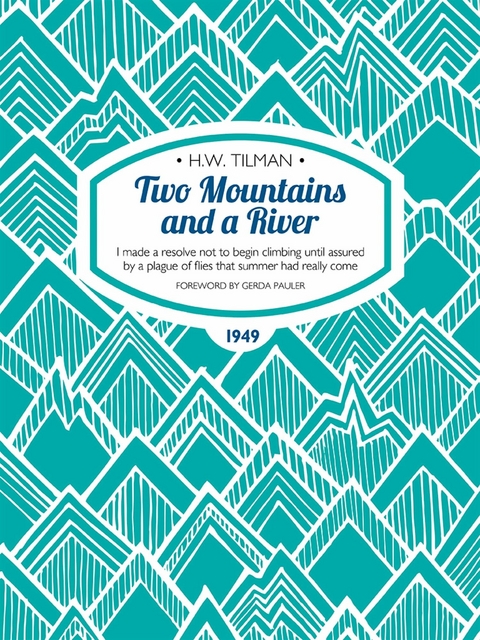
Two Mountains and a River (eBook)
Vertebrate Publishing (Verlag)
978-1-909461-31-4 (ISBN)
Harold William Bill Tilman (1898 1977) was among the greatest adventurers of his time, a pioneering mountaineer and sailor who held exploration above all else. Tilman joined the army at seventeen and was twice awarded the Military Cross for bravery during WWI. After the war Tilman left for Africa, establishing himself as a coffee grower. He met Eric Shipton and began their famed mountaineering partnership, traversing Mount Kenya and climbing Kilimanjaro. Turning to the Himalaya, Tilman went on two Mount Everest expeditions, reaching 27,000 feet without oxygen in 1938. In 1936 he made the first ascent of Nanda Devi the highest mountain climbed until 1950. He was the first European to climb in the remote Assam Himalaya, he delved into Afghanistan's Wakhan Corridor and he explored extensively in Nepal, all the while developing a mountaineering style characterised by its simplicity and emphasis on exploration. It was perhaps logical then that Tilman would eventually buy the pilot cutter Mischief, not with the intention of retiring from travelling, but to access remote mountains. For twenty-two years Tilman sailed Mischief and her successors to Patagonia, where he crossed the vast ice cap, and to Baffin Island to make the first ascent of Mount Raleigh. He made trips to Greenland, Spitsbergen and the South Shetlands, before disappearing in the South Atlantic Ocean in 1977.
H.W. Tilman's Two Mountains and a River picks up where Mount Everest 1938 left off. In this instalment of adventures, Tilman and two Swiss mountaineers set off for the Gilgit region of the Himalaya with the formidable objective of an attempt on the giant Rakaposhi (25,550 feet). However, this project was not to be fulfilled. Not one to be dispirited, Tilman and his various accomplices including pioneering mountaineer and regular partner Eric Shipton continue to trek and climb in locations across China, Pakistan, Afghanistan and other areas of Asia, including the Kukuay Glacier, Muztagh Ata, the source of the Oxus river, and Ishkashim, where the author was arrested on suspicion of being a spy Two Mountains and a River brims with the definitive Tilman qualities detailed observations and ever-present humour that convey a strong appreciation of the adventures and mishaps he experiences along the way. With a new foreword from prominent trekker, climber and lecturer, Gerda Pauler, this classic mountaineering text maintains Tilman's name as a unique and inquisitive explorer and raconteur.
– Chapter 2 –
Karachi to Abbottabad
At Karachi I found that the Swiss consignment of stores had already arrived. Under a guard provided by the ‘Stiftung’ to prevent pilfering en route, it had been taken by road to Genoa and there shipped. ‘Every writer of travels’, I have read, ‘should consider that, like all other authors, he undertakes, either to instruct or please, or to mingle pleasure with instruction’; for the benefit therefore of readers as ignorant as myself, I pass on what I learnt while we were discussing this question of shipment, namely that during the late war Switzerland maintained a merchant fleet and a port. The port was a quay and warehouse at Genoa from which coastal vessels plied to other Mediterranean ports. My share of our stores came in two ships, one of which arrived a day later than myself while the other was delayed at Bombay. This hitch was to cause us some trouble. Already the breeze of anxiety was playing around the brow of expectation, as it was to do frequently during the next three weeks.
Rakaposhi lies in the extreme north-west corner of India (now Pakistan) in what was until recently the Gilgit Agency. This comprised the petty states of Hunza, Nagar, Ishkuman, Yasin, Gilgit, Ghizar, Darel, and the Chilas republic, all of which were administered by a British Political Agent with headquarters at Gilgit. Gilgit itself was actually a ‘wazirat’ of Kashmir from whom the Indian Government leased it in 1935, although the Agency itself was established in 1889. These small states acknowledged the suzerainty of Kashmir but were never part of its territory. In August 1947 when the Gilgit Agency was hurriedly handed over to Kashmir, the Kashmir Durbar sent its own representative to Gilgit. This unfortunate, being a Hindu, was persona non grata and by the end of October was accordingly put in prison for his own safety. The states refused to be subject to Kashmir and declared their adhesion to Pakistan.
The usual route to Gilgit goes from Srinagar in Kashmir over the Burzil pass (13,99 ft.); another, about the same distance, avoids Kashmir and goes from Abbottabad by the Kagan valley and the Babusar pass (13,000 ft.). Both these passes are closed in winter for ordinary traffic but open about the same time in the spring in late May or early June. (The Gilgit mail-runners continue to cross the Burzil throughout the winter.) Col. R. N. Bacon, then Political Agent, Gilgit, had advised us to come by the Kagan valley route so that Abbottabad, which is railhead, was to be our starting-point. Coming out in the plane I had met as fellow-passenger Col. R. C. F. Schomberg, an old and very experienced Central Asian traveller, who having time after time begun his expeditions from Srinagar was concerned to find we were proposing to start from Abbottabad. There was no place like Srinagar for assembling and starting an expedition, for there, as he put it, ‘you could buy anything from a set of false teeth to an ice-axe’.
However, having announced our route to the authorities we could not now change, so to Abbottabad I went on 8 May by train, along with twenty-four packages. To get this disgusting amount of stuff on a passenger train requires much local knowledge, and the Swiss firm Messrs Volkart Bros, readily put their ample stock of this commodity at my disposal. Arrangements had already been made for our four Sherpas, who were at Darjeeling at the other extremity of India, to meet me in Abbottabad on the 9th. As I had waited a few days in vain for my missing shipment I was already late, and the breeze of anxiety which had begun to play about me at Karachi, increased in strength and was presently to rise to gale force on account of these Sherpas.
Before I attempt to unravel and explain another complication in which we had landed ourselves, I must introduce the fourth member of our party, Mr Campbell H. Secord, who was, I think, in some ways responsible for it. As we shall see later he had been on Rakaposhi, or at least a ridge of it, in 1938, and as a pioneer, so to speak, had strong claims for inclusion in any attempt upon the mountain. Although he was working in a Government office his time was not his own, so that it was not until Gilgit was reached that we knew for sure that he would be coming. This important piece of news was brought by Secord himself.
To get to Abbottabad from Karachi one changes at Rawalpindi whence one goes on either by train or bus. Col. Schomberg had given me the name of a friend of his at Rawalpindi, a Maj. C. W. M. Young who is a keen traveller and an expert user of a cine-camera. Quite by chance, for I am not usually so longheaded, I had wired him of my arrival and given his name to Volkart. On Rawalpindi station at about 9 o’clock at night, as I alighted to look after my twenty-four packages, Maj. Young met me and handed me a telegram from the Government of India offering to fly[1] us and our kit to Gilgit for a consideration. So considerable was this consideration that I decided to stop the night, if not longer, at Rawalpindi to think it over.
Very early in our acquaintanceship the Swiss had been canvassing the idea of having ourselves and our kit flown to Gilgit. Our kit, by the way, would have to have been ‘dropped’ since the Gilgit airfield can receive only small planes with a load of about seven passengers. It was thought, however, that the R.A.F. in India might welcome such an opportunuty for an exercise, so negotiations, were opened by the ‘Stiftung’ with the Government of India through the usual channels. Secord, who at that time was toying with the idea of joining us, took up the flying project with enthusiasm, and since he had been in the R.A.F. during the war, where he had made some valuable acquaintances, he hoped he could pull wires to some purpose. After receiving an official reply to our application in rather discouraging terms we heard no more about it, and I mistakenly thought that the project had happily been consigned to limbo. But as the Chinese proverb says: ‘Beware what you ask lest it be granted.’
The chief reason for this air-mindedness, of which I heartily disapproved, was the sound one that communal trouble at Abbottabad and in the Hazara district—then a very disturbed area—through which we had to travel, might prevent us starting at all. In addition the Swiss were anxious to save time, in particular Kappeler who regarded every day not spent in climbing as a day wasted. Perhaps such an uncouth method of approaching a mountain can be justified in a place like Alaska where the mountains are more inaccessible, the season shorter, and where the party itself has to hump or sledge the gear. In the Himalaya I think the approach by air is a mistake. In the first place no one who wants to do a lot of climbing should go to the Himalaya where he will do very little. Secondly, the time spent on the approach march, be it only a week or as much as three weeks, is in my opinion time well spent. It may well be the only enjoyable part of the trip. One’s body gets a chance to accustom itself to strange conditions and to acquire a little fitness: one gets to know one’s companions and porters under conditions where the worst can be faced with manly resignation, whereas if some maddening habit or peculiarity was suddenly sprung on one when lying cheek-by-jowl in a tent with snow falling outside, the result might be manslaughter; and the porters in their turn have time to become familiar with tents and gear generally so that the place of everything is known and pitching and striking camp has become mere routine long before the mountain is reached.
And last, though I believe it should be put first, there is our old friend the ‘thin end of the wedge’. I have quoted elsewhere the Bengali proverb that ‘the sight of a horse makes the traveller lame’, and I have some fear that the sight of an aeroplane might make the mountaineer think. To see an aeroplane accomplishing in four hours a journey which will take him nearly three weeks of toil and sweat is bound to give rise to thought—some of it subversive; whether the time so spent can be justified in the face of heaven and, perhaps, his family or employer; whether (unless he is a Fascist reactionary) it is not his duty to spare the oppressed coolies staggering along behind him their tribute of toil and sweat which his longer purse commands; or, still more to the point, whether it is not his duty to spare himself a little toil and sweat—a proposition which, of course, strikes at the very root of a mountaineer’s religion. Such a picture is not entirely fanciful, and I have urged at length elsewhere[2] the case against the use of the aeroplane by Himalayan expeditions. ‘Resist the beginnings’ is a well-tried maxim. The farther away from mountains we can keep aeroplanes the better; a sentiment with which even pilots will not quarrel, and which, I hope, even those mountaineers whose pleasure it is to keep abreast or well ahead of the times will echo.
It did not take me as long to make up my mind as I had expected. By the time Young and I had dealt with a large rump steak and a beer—in India even in the hot weather one must be uncompromisingly British—I had decided to refuse the offer without waiting to consult the Swiss. Perhaps I feared that Kappeler’s eagerness to reach the mountains might overcome any desire for economy. Another beer encouraged a new train of thought—why not combine speed and economy by doing away with the ‘Anson’ which was to take our party of seven, and drop the bodies as well as the kit from the ‘Dakota’? Any recalcitrance on the part of the Sherpas or the Swiss could be easily overcome if I had a good ‘dispatcher’ in the plane with me. On the other hand, what would my friends think of this volte-face...
| Erscheint lt. Verlag | 1.9.2016 |
|---|---|
| Reihe/Serie | H.W. Tilman: The Collected Edition |
| H.W. Tilman: The Collected Edition | H.W. Tilman: The Collected Edition |
| Vorwort | Gerda Pauler |
| Verlagsort | London |
| Sprache | englisch |
| Themenwelt | Literatur ► Biografien / Erfahrungsberichte |
| Literatur ► Romane / Erzählungen | |
| Sachbuch/Ratgeber ► Sport ► Segeln / Tauchen / Wassersport | |
| Reisen ► Reiseberichte | |
| Reisen ► Reiseführer | |
| Schlagworte | Abbottabad • Afghanistan • Arrest • Asia • bill tillman • Bill Tilman • Bob Comlay • Chalt • Chalt to Misgar • China • Classic travel writing • Climbing • Dainyor Nallah • Eric Shipton • Everest • Faizabad • Gerda Pauler • Gilgit • Gilgit Himalaya • Hiking • Himalaya • H.W. 'Bill' Tilman • H W Tilman • H.W. Tilman • Ishkashim • Jaglot approaches • Kagan Valley • Karachi • Kukuay Glacier • Matun Das • Misgar • Monk's Head • mountaineer • Muztagh Ata • Oxus river • Pakistan • Rakaposhi • Sarhad • Spy • Tashkurghan • Tilman • Travel writing • Trekking • Two Mountains and a River • Walking • Yak • yort |
| ISBN-10 | 1-909461-31-8 / 1909461318 |
| ISBN-13 | 978-1-909461-31-4 / 9781909461314 |
| Informationen gemäß Produktsicherheitsverordnung (GPSR) | |
| Haben Sie eine Frage zum Produkt? |
 EPUB (Adobe DRM)
Kopierschutz: Adobe-DRM
Adobe-DRM ist ein Kopierschutz, der das eBook vor Mißbrauch schützen soll. Dabei wird das eBook bereits beim Download auf Ihre persönliche Adobe-ID autorisiert. Lesen können Sie das eBook dann nur auf den Geräten, welche ebenfalls auf Ihre Adobe-ID registriert sind.
Details zum Adobe-DRM
Dateiformat: EPUB (Electronic Publication)
EPUB ist ein offener Standard für eBooks und eignet sich besonders zur Darstellung von Belletristik und Sachbüchern. Der Fließtext wird dynamisch an die Display- und Schriftgröße angepasst. Auch für mobile Lesegeräte ist EPUB daher gut geeignet.
Systemvoraussetzungen:
PC/Mac: Mit einem PC oder Mac können Sie dieses eBook lesen. Sie benötigen eine
eReader: Dieses eBook kann mit (fast) allen eBook-Readern gelesen werden. Mit dem amazon-Kindle ist es aber nicht kompatibel.
Smartphone/Tablet: Egal ob Apple oder Android, dieses eBook können Sie lesen. Sie benötigen eine
Geräteliste und zusätzliche Hinweise
Buying eBooks from abroad
For tax law reasons we can sell eBooks just within Germany and Switzerland. Regrettably we cannot fulfill eBook-orders from other countries.
aus dem Bereich