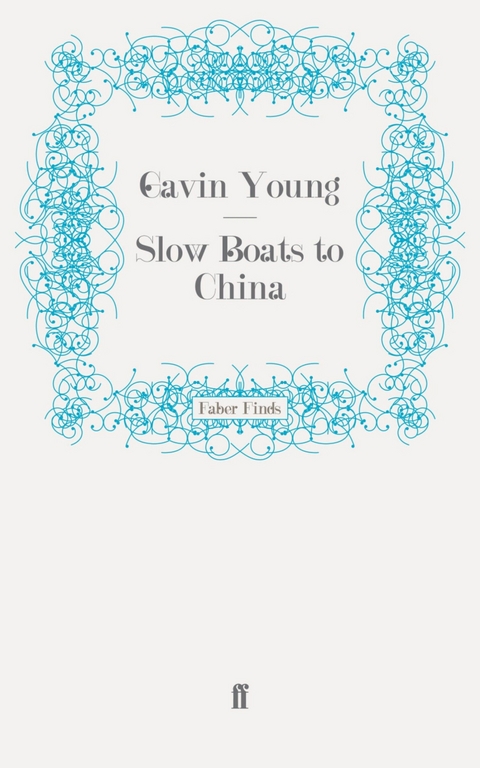
Slow Boats to China (eBook)
504 Seiten
Faber & Faber (Verlag)
978-0-571-32446-0 (ISBN)

Gavin Young (1929-2001) was a journalist, writer, and briefly a member of MI6. As a journalist, he was most associated with the Observer, being in the words of Mark Frankland's obituary 'a star foreign correspondent'. When disenchantment with journalism set in he turned to the writing of books. The two most famous ones are Slow Boats to China and its sequel Slow Boats Home. He himself had a particular affection for two later books In Search of Conrad (winner of the Thomas Cook Book Award) and A Wavering Grace. These and Beyond Lion Rock, From Sea to Shining Sea, Return to the MarshesandWorlds Apartare all being reissued in Faber Finds.
Seven months and twenty-three agreeably ill-assorted vessels are what were required to transport Gavin Young, by slow boat, from Piraeus to Canton. His odyssey teemed with excitement, adventure and colour. Gavin Young's account memorably distils the people, places, smells, conversations, ships and history of the places he encountered in what is his most famous book. The sequel, Slow Boats Home, is also reissued in Faber Finds.
'An unusual and fascinating book.'
'Storms, fleas, pirates, bad food and bureaucrats ... Mr Young suffered what he did to entertain us.'
It was a simple idea: take a series of ships of many sizes and kinds; go where they lead for a few months; see what happens. It was an adaptation of the old idea of Running Away to Sea, a boyhood yearning bred of
tales, marvellous tales
Of ships and stars and isles where good men rest.
No doubt my dream of the sea was born during the long summers I spent as a child in what I still think of as the oldest-feeling, most soul-subduing and cosily creepy part of England, the part almost hidden between Britain’s battered kneecap and shin. I mean, to be more exact, between Devon’s Hartland Point and Cornwall’s Fire Point Beacon above Boscastle, around the tiny harbour and old stone breakwater of Bude Haven. This is the Wreckers’ Coast: a place of buzzards and seals and effigies of knights in dim, half-lost churches, where seas pound into cliffbound bays that have swallowed seamen from a hundred wrecked schooners and, in wartime, perhaps harboured German U-boats.
Once, poor Cornish children in these parts prayed, ‘God save Father and Mother and zend a ship to shore vore mornin.’ And on cold, rainy days there always seemed to me to be an aura here of doomed ships and silent watchers on terrible cliffs – an aura that survives today’s asphalted roads and trailer parks. Yet in the summer sun it all looks quite different. Everything smiles on picnickers, surfers, flower gatherers and adventurous walkers with bird books, haversacks, sandwiches and hip flasks.
Under the sun, these cliffs give almost theatrically splendid views. South of Bude between Compass Point and Widemouth Bay’s Black Rock (actually, the locals say, a Cornish giant eternally plaiting ropes of sand), my grandmother years ago would jerkily brake the Austin two-seater and exclaim, ‘What a lot of sea!’ My grandmother’s house stood back from the sea but on a rising slope of land, so that from my bedroom window I could see the gleam of the Atlantic Ocean over the rooftops of other houses. The attic of the gaunt and ugly Edwardian house smelled of damp floorboards, old suitcases and mouse droppings, but it was dark and large – ideal for hide-and-seek – and full of books, some of which had been my father’s when he was a boy.
I spent hours up there delving into Robert Louis Stevenson, Jack London, Captain Marryat, R. M. Ballantyne and a Cornish writer of the 1920s called Crosbie Garstin who wrote exciting books about wreckers and smugglers on this very coast. Obsessed with the doings of Long John Silver or the Swiss Family Robinson, I was almost convinced that one clear day I would see on the horizon the Indies … tall ships … Hispaniola … Cathay. ‘Fifteen men on a dead man’s chest,’ I would growl menacingly at my older sister, who would shrug and make herself scarce.
Even today, when I revisit Bude, this conviction sidles up to me like Blind Pew to Billy Bones. The cliffs there are as high as seven hundred and twenty feet, the waves relentlessly pound against them, larks and hawks move restlessly above, and the biggest gulls I’ve ever seen strut with eyes as cold as the sea below. The coastline here is a chain of tall headlands with names like Cow and Calf, Sharpnose Point, Wrangle Point, Longbeak, Dizzard. Their angry shapes and the prevailing westerly winds have done for dozens of ships, provoking the sailors’ saying:
From Trevose Head to Hartland Light
Is a watery grave by day or night.
At the Falcon Inn in the old part of Bude, Desmond Gregory, the pub owner and a pillar of the hard-working Bude lifeboat team, lets off his signal rockets outside the pub if a boat is in trouble in the bay. Old photographs of spectacular wrecks adorn the walls of his bar; I have one of my own at home of the Austro-Hungarian barque Capricorno, her sails in tatters, her skipper drunk (so history books relate), being pounded to pieces by enormous seas below Compass Point in December 1900. Only two men were saved. In the picture, a solitary seaman stands on the doomed deck like Steerforth in David Copperfield.
Sailing ships regularly used Bude as a port of call up to 1936; I remember a locally famous ketch called Ceres and old bewhiskered sea captains strolling around the harbour.
All this contributed to my dream of adventure and sea travel that this book represents. It also gave me a sense of the past, for Bude is ennobled by its cliffs, its thundering surf and its eerie hinterland. Even now, visiting the place after an interval of time, I am startled by the sheer age of the region. You can ramble for hours across headlands that run back forming broad, high land on which scattered farms seem settled hull down in wriggling lanes to escape winter gales that have forced the trees to grow almost parallel to the earth. In long, deep valleys you come across small, ancient churches oddly far from any village, and smelling of flowers and grass. Huge trees loom over their tombstones, under stone canopies armoured effigies turn up stone toes, and fine old wooden pews are fighting erosion by age or the death watch beetle. On the gravestones the same names appear over and over, century after century: Mutton, Sleeman, Oke and Prust. Frequent Christian names here are Eli, Caleb, Joshua, Reuben. As a boy, I was particularly fond of a clifftop church at a village called Morwenstow because it had a ship’s figurehead in its graveyard, and because a once-famous and eccentric vicar is buried there. Parson Hawker (‘Passon’ was how the locals pronounced it) ate opium and wrote outrageous poetry when he wasn’t burying drowned sailors between 1834 and 1878. He was a practical joker, and one moonlit night he clambered on to a rock to impersonate a mermaid. In a book of the time, a Bude man was recorded as saying of this scene, ‘Dressin’ up in seaweed and not much else, and combin’ his hair and zingin’, till all the town went down to see ’un, they thought ’twas a merry maid [mermaid] sure enough.’ Then the ‘Passon’ scared the daylights out of his audience by standing up on his rock and singing ‘God Save the King’.
If a cloud covers the sun in this old region of England, you may feel suddenly uneasy. As a boy, I was sometimes glad to get back to the life of Bude’s wide sandy beaches, where young men surfed, children’s nannies helped to build sand castles, and hysterical dogs tried to dig their way to Australia. Kids with kites would shriek when their mother capsized in a shrimp pool (‘Oh, Ma, you’re showing all you’ve got!’) while I sat by myself nursing my dream of far places among the long black lines of rock, knobbly with mussels and limpets, like arthritic fingers, running out into the booming surf.
Years passed before the dream achieved the least substance. This happened not long before my eighteenth birthday, when a school friend and I walked through the dead of a misty night to board a ship at a wharf in Fowey, a small Cornish river port. My friend’s father had arranged with the shipowners for us to be signed on to a 500-ton coaster, the Northgate, out of Hull. A modest adventure, a short voyage up the English Channel to the Scheldt and Antwerp, but at that age it was as exciting as a round trip to Hispaniola and the Spanish Main.
We went down to Fowey in January, the month some sailors refer to as ‘between dog and wolf’, and it was one of the wildest Januaries for years. The berthed ship seemed as dead as an icicle. I can still hear the ring of our hesitant heels on the freezing metal deck, our whispers in the dark, and at last the wavering cry of ‘Who’s there?’ from the skylight, before the white, balding head of the ship’s cook, a kind, brusque old man, emerged from the companionway.
I remember thinking that the Northgate seemed disconcertingly indifferent to our arrival. How could that be when we had dreamed about her for weeks? I didn’t know then that a ship only wakes up and pays attention to those on board when she’s at sea.
In the morning sunshine things seemed different, of course, not alarming at all. The captain was a friendly Yorkshireman, and the crew took our presence on board as a bit of a joke. We had signed on as ‘deckie-learners’, and I suppose we polished the brass and swabbed away the china clay that had clogged the decks during loading energetically enough to satisfy them.
A short trip, but it was the year of record gales in the Channel and we rode one of them out at anchor in a fleet of other ships off Dungeness on the Kentish coast. The Northgate was unduly long for her width and plunged about abominably – so abominably, in fact, that the captain and all his officers were seasick. A radio battery in the messroom broke loose, and its acid burned awkward holes in my corduroy trousers. I remember my relief at not being sick, and the captain’s white face, and offering him a Capstan cigarette and my pride when he said, ‘Thanks moochly, Gav.’
At Antwerp, although the city was still in ruins from the air raids in the war which had not long ended, we were allowed ashore escorted by Andie, a diminutive deckhand of about my age. In a deserted square near the bombed cathedral, Andie trotted confidently over to two tarts on a corner. He chose the taller of the two – at least a foot taller than himself. On the cathedral steps he had to stand one step above her, and for a moment he even lost his footing. Later he boasted, ‘You’ve never seen that before,’ and we had to admit we hadn’t. He also boasted that he’d had syphilis and the quack had poured mercury up his...
| Erscheint lt. Verlag | 4.2.2016 |
|---|---|
| Verlagsort | London |
| Sprache | englisch |
| Themenwelt | Reisen ► Reiseberichte |
| Reisen ► Reiseführer | |
| Schlagworte | Adventure • Documentary • Faber Finds • Travelogue |
| ISBN-10 | 0-571-32446-0 / 0571324460 |
| ISBN-13 | 978-0-571-32446-0 / 9780571324460 |
| Informationen gemäß Produktsicherheitsverordnung (GPSR) | |
| Haben Sie eine Frage zum Produkt? |
 EPUB (Adobe DRM)
Kopierschutz: Adobe-DRM
Adobe-DRM ist ein Kopierschutz, der das eBook vor Mißbrauch schützen soll. Dabei wird das eBook bereits beim Download auf Ihre persönliche Adobe-ID autorisiert. Lesen können Sie das eBook dann nur auf den Geräten, welche ebenfalls auf Ihre Adobe-ID registriert sind.
Details zum Adobe-DRM
Dateiformat: EPUB (Electronic Publication)
EPUB ist ein offener Standard für eBooks und eignet sich besonders zur Darstellung von Belletristik und Sachbüchern. Der Fließtext wird dynamisch an die Display- und Schriftgröße angepasst. Auch für mobile Lesegeräte ist EPUB daher gut geeignet.
Systemvoraussetzungen:
PC/Mac: Mit einem PC oder Mac können Sie dieses eBook lesen. Sie benötigen eine
eReader: Dieses eBook kann mit (fast) allen eBook-Readern gelesen werden. Mit dem amazon-Kindle ist es aber nicht kompatibel.
Smartphone/Tablet: Egal ob Apple oder Android, dieses eBook können Sie lesen. Sie benötigen eine
Geräteliste und zusätzliche Hinweise
Buying eBooks from abroad
For tax law reasons we can sell eBooks just within Germany and Switzerland. Regrettably we cannot fulfill eBook-orders from other countries.
aus dem Bereich