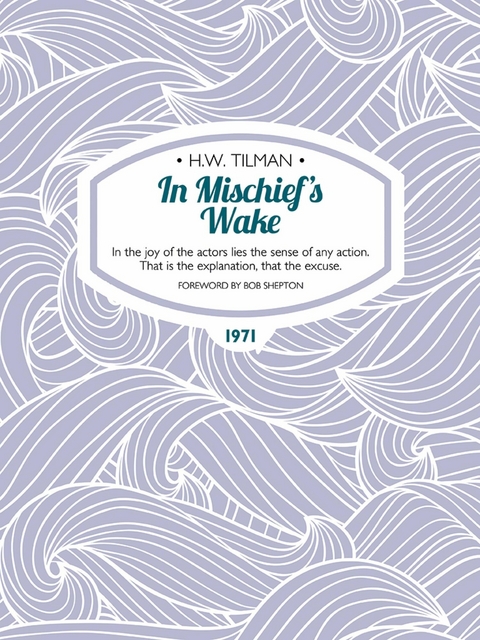
In Mischief's Wake (eBook)
Vertebrate Publishing (Verlag)
978-1-909461-37-6 (ISBN)
Harold William Bill Tilman (1898 1977) was among the greatest adventurers of his time, a pioneering mountaineer and sailor who held exploration above all else. Tilman joined the army at seventeen and was twice awarded the Military Cross for bravery during WWI. After the war Tilman left for Africa, establishing himself as a coffee grower. He met Eric Shipton and began their famed mountaineering partnership, traversing Mount Kenya and climbing Kilimanjaro. Turning to the Himalaya, Tilman went on two Mount Everest expeditions, reaching 27,000 feet without oxygen in 1938. In 1936 he made the first ascent of Nanda Devi the highest mountain climbed until 1950. He was the first European to climb in the remote Assam Himalaya, he delved into Afghanistan's Wakhan Corridor and he explored extensively in Nepal, all the while developing a mountaineering style characterised by its simplicity and emphasis on exploration. It was perhaps logical then that Tilman would eventually buy the pilot cutter Mischief, not with the intention of retiring from travelling, but to access remote mountains. For twenty-two years Tilman sailed Mischief and her successors to Patagonia, where he crossed the vast ice cap, and to Baffin Island to make the first ascent of Mount Raleigh. He made trips to Greenland, Spitsbergen and the South Shetlands, before disappearing in the South Atlantic Ocean in 1977.
'I felt like one who had first betrayed and then deserted a stricken friend; a friend with whom for the past fourteen years I had spent more time at sea than on land, and who, when not at sea, had seldom been out of my thoughts.'The first of the three voyages described in In Mischief's Wake gives H.W. 'Bill' Tilman's account of the final voyage and loss of Mischief, the Bristol Channel pilot cutter in which he had sailed over 100,000 miles to high latitudes in both Arctic and Antarctic waters. Back home, refusing to accept defeat and going against the advice of his surveyor, he takes ownership of Sea Breeze, built in 1899; 'a bit long in the tooth, but no more so, in fact a year less, than her prospective owner'. After extensive remedial work, his first attempt at departure had to be cut short when the crew 'enjoyed a view of the Isle of Wight between two of the waterline planks'. After yet more expense, Sea Breeze made landfall in Iceland before heading north toward the East Greenland coast in good shape and well stocked with supplies. A mere forty miles from the entrance to Scoresby Sound, Tilman's long-sought-after objective, 'a polite mutiny' forced him to abandon the voyage and head home. The following year, with a crew game for all challenges, a series of adventures on the west coast of Greenland gave Tilman a voyage he considered 'certainly the happiest', in a boat which was proving to be a worthy successor to his beloved Mischief.
– Chapter 2 –
To Iceland
Except for Charles, whom I have never known to be seasick, the sea next day took its toll of the crew. Ken battled on manfully in the galley and was first to recover. With a raw crew one must accept the probability that the boat will be shorthanded for most of the way down Channel, that there will be a lot of shipping around, the land not far enough away, and possibly contrary winds. By keeping the boat under easy sail we managed well enough. I even found time to start taking sights, for after eight months ashore one cannot be too quick about beginning again. The tangles that first resulted made me wonder how on earth we should find the Faeroes, or even Iceland which is quite a large island. In the Channel, by closing the land, the lost navigator can generally learn where he is, though in thick weather it would be a mistake to make too free with the shore.
Bound up or down Channel, we have on occasion taken seven days and once only two days. So we were not doing so badly when on the fourth day we rounded Land’s End and set a course for the Tuskar Rock. We had our minor worries. The barrel of the bottle screw on one of the starboard shrouds dropped off and with the usual perversity of inanimate objects found its way overboard. Happily we were on the port tack at the time and we had a spare. The mould that at this early stage attacked our stock of hard-baked bread was more serious. This is thickly sliced bread rebaked that, when so treated, usually lasts for the outward passage. This had not been rebaked enough, consequently we had to start on the ‘Lifeboat’ biscuits normally held in reserve. Baking at sea for five men on a Primus stove is not really on. There is first the difficulty of finding a warm place where the dough can rise; and then the limited oven space that would permit of only one loaf at a time, a loaf that would vanish at one meal. The cook would be at it all day and every day, and the consumption of paraffin would be frightening. If I may be permitted a toot on my own trumpet, I, who consider myself a master-baker, would not undertake it and would not guarantee the results. In one of the present writer’s Himalayan books there is a picture of the ‘Master-baker’ looking ineffably smug, standing by an ice-axe stuck in the ground on which is balanced one of his masterpieces. Making bread in the Himalaya, or at least on the approach to the Himalaya, where there is a hot enough sun to raise the dough and any amount of fuel, is child’s play compared with making it on a Primus stove in a boat. I make the bread at home but as I am the only one who eats it the task is not onerous.
With bread and iron one can get to China, as the French Revolutionary commissars (who had no intention of trying) liked to tell their ill-fed and ill-equipped troops. We were merely going to the Faeroes and had plenty of biscuit. Having passed the Tuskar and later the Arklow lightship we soon had in sight the Isle of Man and Scotland. The expensive new mainsail set beautifully and we now had it down to haul out once more the head and the foot. If this stretching is not done with a new sail the leach goes slack and may remain slack, flapping incessantly, wearing out itself and the patience of the crew. They were by now beginning to know their way about, how things should be done and what should not be done, such as, for example, reading a book or even trying to play chess when on watch. Normally we keep single watches so that the man at the helm is in sole charge of the deck and responsible for the ship’s welfare. He has not only to watch his steering but keeps an eye on the gear, the sails, any other ships, the sea, the sky, and anything else of interest. If this is done conscientiously there should be no question of boredom or any need for its relief by reading a book. Nevertheless it is not uncommon nowadays for yachts that are not going to be sailed single-handed to be fitted with self-steering gear so that the crew can avoid the tedium of having to steer. One presumes there is still someone on watch even if he is not steering. I should have thought that those who can only get away to sea for brief periods would be only too happy to steer, to feel a boat under their hands, and be jealous of time so spent.
On the evening of June 9th we were off the Maidens north of Belfast when, as had happened before, the wind died and the tide turned against us. To avoid losing ground we anchored in Glenarn Bay, a few miles south of Red Bay, the anchorage we generally used. Without waiting to be piped to ‘Bathe and Skylark’ the hands bathed and rightly complained of the cold. North of Rathlin Island, which we passed next afternoon, there are numerous overfalls marked on the chart as ‘dangerous in unsettled weather’. One could well believe it. With the weather extremely settled, the sea glassy and no wind at all, these overfalls were boiling away, showing like white water breaking on a roof. On a lovely, still summer evening, disturbed only by the fog signal from Rathlin Island, we drifted along the south coast of Islay, until at midnight, the tide in our favour and under a full moon, we shot through the Sound of Islay at five knots. This welcome spurt was but brief. Anti-cyclonic weather, haze and light airs, persisted as we slowly worked our way north through the Minches. Had we been able to see anything, the mountains of Skye for choice, it would have been pleasant enough. Too pleasant, really, because the crew were not yet fully seasoned, as they realised when at last we had cleared the Butt of Lewis and met some wind and sea. All were unwell again except, of course, Charles. Sula Sgeir is a rocky, uninhabited island about thirty-five miles north of the Butt of Lewis. We passed close by it at mid-day of the 15th, going fast under reefed main and small jib. That night, with supper reduced to soup and cold bully, one realised that speed and comfort are seldom compatible.
Approaching the Faeroes from the south on an earlier voyage we had run into trouble when we found ourselves in a fierce adverse current and a confused sea some five miles south of Syderø, the southernmost island. On that occasion we had been nominally making for Thorshavn on the east side of the Faeroes but our plans were sufficiently elastic to allow us to turn sail and make for another harbour on the west side. There are altogether eighteen islands spread over some sixty miles of sea. Harbours abound, most of them ‘summer harbours’ and a few classed as ‘winter harbours’ reputedly safe in all weather conditions. On this voyage we had some obligation to make Thorshavn, the capital, as I had promised to meet my Danish correspondent Captain Toft who would be there in his survey vessel Ole Roemer. Thorshavn is on the east side of Strømø, the largest and most important island. Owing to cloudy weather we had had no sights for latitude and only a snap sight or two for longitude so we steered to keep well to the east of the islands. When on the morning of the 17th we began closing the land the wind faded away and we soon found ourselves being swept by a swift-running current into the well-named Dimon Fjord between Syderø and Sandø. We identified our position by luckily sighting the two unmistakable islands of Lille Dimon and Store Dimon which one would naturally, and probably wrongly, translate as Small Imp and Big Imp. The Small Imp looks like a haystack and they are both over 1200 feet high. Such heights are not remarkable in the Faeroes where, especially on the northern and western islands, there are even greater cliffs, the home of innumerable sea-birds. By running the engine flat out we at last got clear of Dimon Fjord and we kept the engine going in order to catch the north-going tide that would take us into Nolsø Fjord, the approach to Thorshavn. Fog then came down in earnest, reducing visibility to less than 500 yards. All was not lost for we soon heard the foghorn from the lighthouse at the south end of Nolsø Fjord, at first ahead, then abeam, and finally drawing aft. A wraith-like steamer passed us, we caught a momentary glimpse of a mysterious ketch towing a dinghy, and then we almost ran down a lone man in a dory shooting guillemot. It is no disgrace to ask, at least not in thick fog, so we hailed him and were told to stand on until we heard the nautophone on Thorshavn pierhead.
Having passed the pierhead, vaguely visible in the fog, we made a tour of the small harbour looking for some resting place other than the wharves used by fishing and commercial vessels. At length we made fast to an untenanted buoy, having first to launch the dinghy, the buoy having no ring. All formalities were waived by both harbour-master and Customs from whom I learnt that Ole Roemer was out but would be back in two days. We had a bath and supper at the Sailors’ Home—no bar, no beer. Moored close to Mischief was a beautiful ketch named Westward Ho, built at Hull in 1880, and now maintained in tip-top order by the community as a show-piece. She has no engine and had recently sailed to Copenhagen. The Faeroes, by the way, belong to Denmark but have their own flag and a modified form of home rule. The flag is easily confused with the Icelandic flag and I once committed a faux-pas by entering Reykjavik flying the wrong courtesy flag. I gathered that Westward Ho made the Denmark voyage every summer to show her off and possibly to raise funds for her upkeep. Like most, though not necessarily all islanders, the Faeroese have the sea in their blood. Fishing is their main standby. In the harbours of West Greenland one meets Faeroe-Island boats of about the size that we would deem suitable for inshore fishing. The crew of three, augmented when hand-lining on the Greenland banks by two Greenlanders, bunk in a...
| Erscheint lt. Verlag | 26.1.2017 |
|---|---|
| Reihe/Serie | H.W. Tilman: The Collected Edition |
| H.W. Tilman: The Collected Edition | H.W. Tilman: The Collected Edition |
| Vorwort | Bob Shepton |
| Verlagsort | London |
| Sprache | englisch |
| Themenwelt | Literatur ► Biografien / Erfahrungsberichte |
| Literatur ► Briefe / Tagebücher | |
| Literatur ► Romane / Erzählungen | |
| Sachbuch/Ratgeber ► Sport ► Segeln / Tauchen / Wassersport | |
| Reisen ► Reiseberichte | |
| Reisen ► Reiseführer | |
| Schlagworte | Andrew Harwich • Antarctic • Antarctica • Arctic • Atlantic • Atlantic Ocean • baroque • Bill Tilman • Bob Comlay • Bob Shepton • Bristol Channel pilot cutter • Cape Farewell • Colin Putt • East Greenland • Eric Shipton • Evighedsfjord • Greenland • Hamborgerland • H.W. 'Bill' Tilman • H W Tillman • H W Tilman • H.W. Tilman • Iain Dillon • ice-floes • Iceland • In Mischeif's Wake • In Mischeifs Wake • In Mischiefs wake • In Mischief's Wake • Jan Mayan • Julianehaab • Lymington • mischief • mutiny • navigating book • Navigation • Patanela • pilot cutter • polite mutiny • Sailing • sailing book • sailing books • Scoresby Sound • sea breeze • Shipton • Tillman • Tilman • Torssukatak Fjord • Travel writing |
| ISBN-10 | 1-909461-37-7 / 1909461377 |
| ISBN-13 | 978-1-909461-37-6 / 9781909461376 |
| Informationen gemäß Produktsicherheitsverordnung (GPSR) | |
| Haben Sie eine Frage zum Produkt? |
 EPUB (Adobe DRM)
Kopierschutz: Adobe-DRM
Adobe-DRM ist ein Kopierschutz, der das eBook vor Mißbrauch schützen soll. Dabei wird das eBook bereits beim Download auf Ihre persönliche Adobe-ID autorisiert. Lesen können Sie das eBook dann nur auf den Geräten, welche ebenfalls auf Ihre Adobe-ID registriert sind.
Details zum Adobe-DRM
Dateiformat: EPUB (Electronic Publication)
EPUB ist ein offener Standard für eBooks und eignet sich besonders zur Darstellung von Belletristik und Sachbüchern. Der Fließtext wird dynamisch an die Display- und Schriftgröße angepasst. Auch für mobile Lesegeräte ist EPUB daher gut geeignet.
Systemvoraussetzungen:
PC/Mac: Mit einem PC oder Mac können Sie dieses eBook lesen. Sie benötigen eine
eReader: Dieses eBook kann mit (fast) allen eBook-Readern gelesen werden. Mit dem amazon-Kindle ist es aber nicht kompatibel.
Smartphone/Tablet: Egal ob Apple oder Android, dieses eBook können Sie lesen. Sie benötigen eine
Geräteliste und zusätzliche Hinweise
Buying eBooks from abroad
For tax law reasons we can sell eBooks just within Germany and Switzerland. Regrettably we cannot fulfill eBook-orders from other countries.
aus dem Bereich