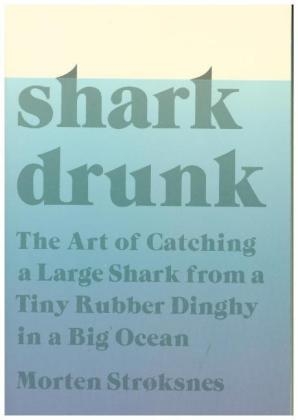
Shark Drunk
Knopf Publishing Group (Verlag)
978-1-5247-1123-8 (ISBN)
- Keine Verlagsinformationen verfügbar
- Artikel merken
The Lofoten archipelago, just North of the Arctic Circle, is a place of unsurpassed beauty-the skyline spikes with dramatic peaks; the radiant greens and purples of the Northern Lights follow summers where the sun never sets. It's a place of small villages, where the art of fishing, though evolving, is still practiced in traditional ways.
Beneath the great depths surrounding these islands lurks the infamous Greenland shark. At twenty-four feet in length and weighing more than a ton, it is truly a beast to behold. But the shark is not known just for its size: Its meat contains a toxin that, when consumed, has been known to make people drunk and hallucinatory. Shark Drunk is the true story of two friends, the author and the eccentric artist Hugo Aasjord, as they embark on a wild pursuit of the famed creature-all from a tiny rubber boat.
Together they tackle existential questions and encounter the world's most powerful maelstrom as they attempt to understand the ocean from every possible angle, drawing on poetry, science, history, ecology, mythology, and their own-sometimes intoxicated-observations, meanwhile pursuing the elusive Greenland shark. By turns thrilling, wise, and hilarious, Shark Drunk is a celebration of adventure, marine life, and, above all, friendship.
Winner of the Norwegian Brage Prize 2015
Winner of the Norwegian Critics' Prize for Literature 2015
Winner of the Norwegian Reine Ord Prize at Lofoten International Literature Festival 2016
MORTEN STRØKSNES is a Norwegian journalist and writer. He has published eight critically acclaimed books of literary reportage and contributed to several others. Translated by Tiina Nunnally.
Wanted: one medium-sized Greenland shark, ten to fifteen feet in length and weighing about thirteen hundred pounds. Latin name: Somniosus microcephalus . Blunt, rounded snout, cigar-shaped body, relatively small fins. Gives birth to live offspring. Lives in the North Atlantic and even swims under the floating ice cap at the North Pole. Prefers temperatures close to freezing but can also tolerate warmer water. Can dive to a depth of four thousand feet or more. The teeth in its lower jaw are as small as a saw blade's. The teeth in the upper jaw are equally sharp but significantly bigger, and are used to bore into the prey while the lower teeth saw their way through. In addition to saw-blade teeth, it has, like a few other types of shark, suctioning lips that "glue" larger prey to its mouth while chewing. And every mating act is violent. On the bright side, the Greenland shark does not have sex until it's about 150 years old. Scientists who have examined the stomach contents of Greenland sharks have encountered many surprises. How is it possible that in Greenland, Fridtjof Nansen (1861- 1930), the famed Norwegian scientist, explorer, and politician, opened the stomach of a shark he'd caught and found a whole seal, eight large cods, a ling four feet long, a big halibut head, and several chunks of whale blubber? Nansen claimed, by the way, that the shark was able to live for several days even after this "huge, ugly animal" had been cut open and placed on ice. The eye parasite Ommatokoita elongata , which is about two inches long, slowly devours the cornea of the Greenland shark, until it goes blind. In the folds of its belly the shark also has other parasites in the form of little yellow crabs ( Aega arctica ). Old shark fishermen have recounted how the parasites would fall off by the hundreds when the shark was hoisted aboard. The Greenland shark can be used for more than just making sandpaper and nitroglycerin. Its flesh is poisonous, smells like urine, and can serve as a potent drug. The Inuit used to feed the meat to their dogs, if nothing else was available. But the dogs would get extremely intoxicated and might even end up paralyzed for days. During World War I, there was a shortage of food in many places in the north, and people couldn't be choosy. There was more than enough meat from Greenland sharks. But if people ate the meat when it was fresh, or neglected to treat it in the proper way, they could get "shark drunk," because the flesh contains the nerve gas trimethylamine oxide. The resultant inebriated state is supposedly similar to taking in an extreme amount of alcohol or hallucinogenic drugs. Shark drunk people speak incoherently, see visions, stagger, and act very crazy. When they finally fall asleep, it's nearly impossible to wake them up. To avoid these side effects, you need to cut the main artery of a Greenland shark immediately, so that the blood drains out. Then the meat can be dried or boiled in water, which has to be changed several times. In Iceland, the shark (called hákarl ) is considered a delicacy, but there everyone is careful to prepare the meat properly. To make the poisons disappear requires repeated boiling, drying, or even burying the meat until it ferments. It should be no surprise that people living in northern Norway developed a healthy skepticism when it comes to the meat of the Greenland shark. The reason they even bothered to catch it was because the liver is extremely rich in oil. In the 1950s, Norway was the leader in commercial fishing for the Greenlandshark, but by the early 1960s, demand was already fading. Only now is it making a small comeback. Our boat is gently bobbing in the sunshine in Vestfjorden. Yesterday the sea glittered and crackled with light. Today it has a steady, calm glow. The ocean has found its lowest resting pulse, as it does only after many days of good weather in the summertime. It's also a nea
| Erscheinungsdatum | 25.06.2017 |
|---|---|
| Sprache | englisch |
| Themenwelt | Literatur ► Briefe / Tagebücher |
| Sachbuch/Ratgeber ► Freizeit / Hobby ► Angeln / Jagd | |
| Reisen ► Reiseführer | |
| Reisen ► Sport- / Aktivreisen | |
| Technik | |
| Schlagworte | adventure narrative • ART • Autobiography • Bromance • Drinking • drunk • Englisch; Romane/Erzählungen • eqalussuaq • Fishing • Friendship • Greenland shark • Hugo Aasjord • humorous • Hunting • Iceland • Inuit legends • journey • Literature • Lofoten • Marine Life • Melville • Natural History • Nature writing • North Atlantic Ocean • North Pole • Norway • ocean • personal memoir • Philosophy • relationships • Rimbaud • Science • Sea • shark • Skalugsuak • Somniosidae • Somniosus microcephalus • swimming • Travel • Travel Literature • Wilderness • Wild Life |
| ISBN-10 | 1-5247-1123-3 / 1524711233 |
| ISBN-13 | 978-1-5247-1123-8 / 9781524711238 |
| Zustand | Neuware |
| Informationen gemäß Produktsicherheitsverordnung (GPSR) | |
| Haben Sie eine Frage zum Produkt? |
aus dem Bereich