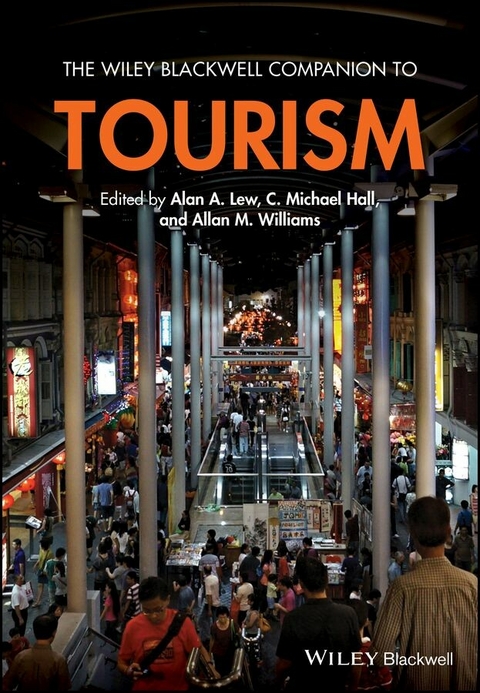
The Wiley Blackwell Companion to Tourism (eBook)
John Wiley & Sons (Verlag)
978-1-118-47462-4 (ISBN)
The Wiley Blackwell Companion to Tourism presents a collection of readings that represent an essential and authoritative reference on the state-of-the-art of the interdisciplinary field of tourism studies.
- Presents a comprehensive and critical overview of tourism studies across the social sciences
- Introduces emerging topics and reassesses key themes in tourism studies in the light of recent developments
- Includes 50 newly commissioned essays by leading experts in the social sciences from around the world
- Contains cutting-edge perspectives on topics that include tourism’s role in globalization, sustainable tourism, and the state’s role in tourism development
- Sets an agenda for future tourism research and includes a wealth of bibliographic references
Alan A. Lew is Professor in the Department of Geography, Planning and Recreation at Northern Arizona University, USA. He is Editor-in-Chief of Tourism Geographies, and co-author of Understanding and Managing Tourism Impacts: An Integrated Approach (2009), World Regional Geography (2010), and Tourism Geography (2014).
C. Michael Hall is Professor in the Department of Management, Marketing & Entrepreneurship the University of Canterbury, New Zealand; Docent, Department of Geography, University of Oulu, Finland; and Visiting Professor at Linneaus University School of Business and Economics, Kalmar, Sweden. He is Co-Editor of Current Issues in Tourism and an Associate Editor of Tourism Geographies.
Allan M. Williams is Professor of Tourism and Mobility Studies at the University of Surrey, UK. He is Co-Editor of Tourism Geographies, and co-author of several books, including Critical Issues in Tourism (2002), Tourism and Tourism Spaces (2004), and Tourism Innovation (2008).The Wiley Blackwell Companion to Tourism presents a collection of readings that represent an essential and authoritative reference on the state-of-the-art of the interdisciplinary field of tourism studies. Presents a comprehensive and critical overview of tourism studies across the social sciences Introduces emerging topics and reassesses key themes in tourism studies in the light of recent developments Includes 50 newly commissioned essays by leading experts in the social sciences from around the world Contains cutting-edge perspectives on topics that include tourism s role in globalization, sustainable tourism, and the state s role in tourism development Sets an agenda for future tourism research and includes a wealth of bibliographic references
Alan A. Lew is Professor in the Department of Geography, Planning and Recreation at Northern Arizona University, USA. He is Editor-in-Chief of Tourism Geographies, and co-author of Understanding and Managing Tourism Impacts: An Integrated Approach (2009), World Regional Geography (2010), and Tourism Geography (2014). C. Michael Hall is Professor in the Department of Management, Marketing & Entrepreneurship the University of Canterbury, New Zealand; Docent, Department of Geography, University of Oulu, Finland; and Visiting Professor at Linneaus University School of Business and Economics, Kalmar, Sweden. He is Co-Editor of Current Issues in Tourism and an Associate Editor of Tourism Geographies. Allan M. Williams is Professor of Tourism and Mobility Studies at the University of Surrey, UK. He is Co-Editor of Tourism Geographies, and co-author of several books, including Critical Issues in Tourism (2002), Tourism and Tourism Spaces (2004), and Tourism Innovation (2008).
Cover 1
Series page 4
Title page 5
Copyright page 6
Contents 7
Notes on Contributors 11
Part 1 : Introduction 21
Chapter 1: Tourism: Conceptualizations, Disciplinarity, Institutions, and Issues 23
Conceptualizing Tourism 25
The Institutionalization of Tourism Studies: Tourism as a Discipline? 28
Issues 32
References 40
Part 2 : Perspectives on Tourism 45
Introduction: Perspectives on Tourism 47
Chapter 2: Tourist Flows and Spatial Behavior 53
Modeling Interdestination Tourist Movements 53
Modeling Intradestination Movements 56
Intervening Factors 59
Distance Decay and Market Access 59
Time and Financial Budgets 61
Trip and Personal Characteristics 62
Conclusion 62
References 63
Chapter 3: Tourism Motivations and Decision Making 65
Background Issues 65
A Core History of Tourist Motivation Study 66
Adding to the Tourist Motivation Literature 68
Employing Travel Motivation Concepts 68
Decision Making 70
Conclusions: Theoretical and Methodological Reflections 70
References 71
Chapter 4: Political Economy of Tourism: Regulation Theory, Institutions, and Governance Networks 75
Tourism and Regulation Theory 76
Adapting Institutions: Transformations and Restructuring 78
Theoretical and Methodological Reflections 80
References 82
Chapter 5: Cultural Geographies of Tourism 86
Tourism as Geography Writ Large 87
Being a Tourist, Doing Tourism 90
Studying Tourism Cultures 93
Conclusions 94
References 95
Chapter 6: Tourism Mobilities 98
Global Tourism Mobilities 100
Heritage Tourism Mobilities 102
Imaginative and Communicative Tourism Mobilities 103
Mobile Methods 104
Theoretical and Methodological Reflections 104
References 105
Chapter 7: Critical Perspectives on Tourism 108
Early Critical Perspectives 108
The Development of the Critical Tourism Studies Movement 110
Critical Engagements in Tourism and Hospitality 111
Focus on the Researcher, Researcher Reflexivity 111
Critical Research Methodologies 111
Critical Tourism Pedagogy and Curriculum 111
Inclusion of Long-Ignored Voices 112
Critiques of the Critical Tourism and Hospitality Movement 112
Theoretical and Methodological Reflections 115
References 116
Part 3 : Producing Tourism and Tourism Spaces 119
Introduction: Producing Tourism and Tourism Spaces 121
Chapter 8: Economic Geographies of Tourism Revisited: From Theory to Practice 127
A Retrospective on the Economic Geography of Tourism 129
Flows of Capital 131
A Case Study: The Economic Geography of Air Transportation and Tourism 132
Discussion and Conclusion 135
References 136
Chapter 9: Entrepreneurial Cultures and Small Business Enterprises in Tourism 140
Entrepreneurship and Tourism: a Changing Research Agenda 140
Entrepreneurial Processes and the Small Firm 141
Entrepreneurial Cultures in Tourism: the Small-Scale Enterprise 142
Models of Small-Firm Growth: Innovation and Knowledge Transfer 145
Entrepreneurial Networks and Tourism Destinations 147
Theoretical and Methodological Reflections: Future Issues 148
References 149
Chapter 10: Labor Mobility and Labor Market Structures in Tourism 152
Tourism Labor Markets and Labor Mobility 152
Tourism Labor Markets 152
Labor Mobility 154
Issues in Tourism Labor Mobility 154
Tourism and Labor Migration 154
Understanding Migrant Experiences 155
Labor Mobility and Human Capital 156
Methodological Developments 156
Future Developments 157
References 159
Chapter 11: Tourism and Development: From Development Theory to Globalization 163
The Emergence of Development Theory 163
Tourism through the Lens of Development Theory 166
Theoretical and Methodological Reflections: Issues and Challenges 168
References 171
Chapter 12: Transport and Tourism 175
The Transport–Tourism–Mobility Relationship 176
The Nascent Tourism Transport Literature 177
The Relationship Between Transport, Recreation, and Tourism 178
The Car and Recreational Travel 180
Cycling as a Sustainable Form of Recreational and Tourist Transport 182
Current Research Issues for Tourism and Transport 182
Travelers’ Health Issues 182
Sustainable Transport and Tourism Issues 183
Theoretical and Methodological Reflections 184
References 184
Chapter 13: Tourism Innovation: Products, Processes, and People 188
Types of Innovation in Tourism 189
Entrepreneurs and Networks: Inspiration or Implementation 191
Employees: Close to the Customer, Close to Innovation 192
Tourists: Experts in the Tourism Experience and in Incremental Innovations 193
Conclusions: Theoretical and Methodological Reflections 195
References 196
Chapter 14: Souvenirs, Tourists, and Tourism 199
Souvenirs Scholarship 200
Souvenirs Phenomena 201
Souvenirs Consumption 202
Souvenirs Perceptions 203
Theoretical and Methodological Reflections 205
References 206
Part 4 : Globalizing People, Places, and Markets in Tourism 209
Introduction: Globalizing People, Places, and Markets in Tourism 211
Chapter 15: Transnational Corporations and the Globalization of Tourism 217
Drivers of Globalization 218
Economic Drivers 218
Technology Drivers 219
Social Drivers 219
Political Drivers 220
Effects 221
Economic Development 221
Destruction of Local Industries 222
Employment Opportunities 223
Spread of Technical Knowledge 224
New Markets 225
Spread of Education 225
Environmental Protection 225
Social Effects 226
Conclusions 227
References 228
Chapter 16: Problematizing Place Promotion and Commodification 230
Place Marketing and Management 231
Mindful Place Promotion 234
Epilogue: Theoretical, Methodological, and Practice Reflections 235
References 236
Chapter 17: Urban Tourism and the Experience Economy 240
Experience Economy and Geography: Intimate Connections 241
Experience Landscapes in Urban Tourism: Issues and Concerns 242
Experiencing Experiencescapes: Methodological Developments 245
Theoretical and Methodological Reflections: Questions for the Future 246
References 247
Chapter 18: Tourism and Creative Economies 250
Historical Antecedents 250
Synergies Between the “Creative” Industry and Tourism 251
Cultural Quarters 252
Individual Creative Industries and Forms of Special-Interest Tourism 254
Theoretical and Methodological Reflections 257
References 257
Chapter 19: Mobilities, Ethnicity, and Tourism 260
The Mobility Paradigm 260
The Tourism Imaginary 261
Defining Ethnicity 262
Ethnicity and Tourism 263
Chinatown 264
Theoretical and Methodological Reflections 266
References 268
Chapter 20: GPS, Smartphones, and the Future of Tourism Research 271
The Introduction of GPS to Social Science Research and to Tourism Studies 272
The Smartphone Revolution and it Implications for Tourists and Researchers 273
GPS Data and the Potential for Complex Spatiotemporal Modeling and Data Mining 275
Ethical Questions and the Tracking of Tourists 275
Theoretical and Methodological Reflections 277
Key Questions for Future Research 278
References 279
Chapter 21: New Territories in Information Technologies and Tourism Research 282
The Critical Turn and Technology 283
Embedded Cognition, Situated Action, and Technologies as Actors 284
The Interface of Tourism 286
Bridging Reflection and Making 289
Centers and Peripheries: Place-Centric Design 290
Theoretical and Methodological Reflections 291
References 292
Part 5 : Social Theories of Tourist Practice, Experience, and Landscapes Encounters 295
Introduction: Social Theories of Tourist Practice, Experience, and Landscapes Encounters 297
Chapter 22: Landscapes of Tourism 302
The Place of Landscape in Tourism Geography: A Critical Assessment 303
On the Relationship of Tourism and Landscape 303
The Visual Aspect of Landscape in Tourism 304
The Relational and Affective Aspects of Landscape in Tourism 305
Contemporary Trends of Landscape Globalization 305
Key Issues and Research Advances in Tourism Landscapes 306
Setting the General Context 306
The First Overarching Period 307
The Second Overarching Period 309
Theoretical and Methodological Reflections 310
References 311
Chapter 23: Tourism After the Postmodern Turn 314
“Tourism, Modernity, and Postmodernity” After a Decade 314
Where did Postmodernity Go? 315
Practice: Real Tourism 317
Theoretical and Methodological Reflections: Tourism as Analytic 321
References 321
Chapter 24: The Tourist Gaze 1.0, 2.0, and 3.0 324
1.0 325
2.0 326
3.0 328
Theoretical and Methodological Reflections: Conclusion 331
References 331
Chapter 25: Gender and Feminist Perspectives in Tourism Research 334
Tourism Research and Education 335
Women, Employment, and Empowerment 336
Tourism and the Global Sex Trade 337
Tourism and the Sexualization of Everyday Life 338
Tourism’s “Hot” Environments and Sexual Harassment 339
Epilogue: Theoretical, Methodological, and Practice Reflections 340
References 341
Chapter 26: Tourism and the Visual 345
The Grand Tour, the Picturesque, the Sublime, and Occularcentrism 346
The Tourist Gaze 346
Embodied Visualities in Tourism 347
Performances, Practice, and the Visual 348
Mediation and Technology: Repositioning Tourists as Coproducers of the Visual 349
Changing Visualities and Changing Methods 350
Conclusions 351
References 352
Chapter 27: Speaking Heritage: Language, Identity, and Tourism 356
Social: Historical Linguistic Context 359
Social: Contemporary Linguistic Usage 360
Individual Linguistic Experience 362
Theoretical and Methodological Reflections 364
References 364
Chapter 28: Religion and Spirituality in Tourism 369
Clearing the Path 369
Religious Parameters of Traveling 370
Religious Sites 371
Pilgrimages 373
Spirituality and Spiritual Tourism 375
Conclusion 376
References 377
Part 6 : Tourist Attractions Places, Spaces, and Forms 381
Introduction: Tourist Attractions: Places, Spaces, and Forms 383
Chapter 29: Material Culture and Contested Heritage in Tourism 388
Conservation Meets Development 388
The Future of the Past in the World’s Emerging Economies 390
Planning for Conservation 392
Everyday conflicts in Dubrovnik 394
Acknowledgments 396
References 396
Chapter 30: Trends in Tourism, Shopping, and Retailing 398
Shopping Tourism and Tourist Shopping 398
Contemporary Trends 399
Alternative Settings 400
Shopping as Place-Making and Branding 401
Perspectives on Demand 401
Globalized Shopping 402
Conclusion: Theoretical and Methodological Reflections 403
References 405
Chapter 31: Progress in Second-Home Tourism Research 409
A Short History of Second-Home Research 409
The Expansion of Second-Home Research 410
Meanings and Motivations 411
Location 412
Second-Home Tourism Impacts 412
The Tourism–Migration Nexus 414
International Dimensions 415
Theoretical and Methodological Reflections 415
References 416
Chapter 32: Timing Tourism: MICE, Events, and Mega-Events 421
Essential Roles of Planned Events 422
More Key Terminology 423
Event Tourism 424
Major Trends and Forces Pertaining to Event Tourism 425
Challenges and Opportunities 425
Theoretical and Methodological Reflections 428
Event-Tourism Experiences and Meanings 428
Antecedents to Event Tourism 429
Planning and Managing Event Tourism 429
Policy 430
Outcomes 430
Final Words 431
References 431
Chapter 33: Taking Stock of Sport Tourism Research 433
Essence of Sport Tourism 433
A Growing Body of Literature 434
An Analysis of Five Journals 435
Sport Tourism Type 437
Empirical, Conceptual, and Review Articles 438
Methodological Approaches 438
Empirical Methods 439
Geographic Focus 440
Theoretical and Methodological Reflections 441
References 442
Chapter 34: Medical Tourism 445
Generating Contexts 446
Receiving Contexts 448
The Space in Between 450
Theoretical and Methodological Reflections 451
References 452
Chapter 35: Gay and Lesbian Tourism Practices 455
Why Do We have Gay and Lesbian Tourists? 456
Historical Notes on the Gay and Lesbian Tourism Segment 457
Gay and Lesbian Destination Choices 459
Theoretical and Methodological Reflections 461
References 462
Part 7 : Tourism and the Environment Change, Impacts, and Response 465
Introduction: Tourism and the Environment: Change, Impacts, and Response 467
Chapter 36: The Global Footprint of Tourism 474
Biodiversity 475
Water 476
Land Use and Change 477
Climate Change 478
Geographical Scope 480
Methodological Progress 480
Theoretical and Methodological Reflections 480
References 483
Chapter 37: Climate-Change Implications for Tourism 486
The New Realties of Global Climate Change for Tourism 487
Direct Impacts of a Changed Climate 488
Indirect Climate-Induced Environmental Change 489
Indirect Climate-Induced Socioeconomic Change 489
Impacts of Climate-Change Mitigation Policy 490
The Geography of Tourism Vulnerability to Climate Change 491
Adapting to Climate Change 493
Conclusion: Is Tourism Prepared for Climate Change? 495
References 496
Chapter 38: Coastal and Marine Tourism: Emerging Issues, Future Trends, and Research Priorities 499
CMT as an Area of Academic Focus 500
Research Approaches 501
Emerging Issues and Future Trends 502
Geographical Expansion, Diversification, and the Influence of Technology 502
Human-Induced Climate Change 503
CMT as a Development Strategy 503
Environmental Impacts 504
Safety and Risk Management 504
Human-Created or -Enhanced Marine Attractions 504
Special Events, Sporting Contests, and Extreme Challenges 505
The Spread of Mass Tourism 505
Theoretical and Methodological Reflections 505
Acknowledgments 507
References 507
Chapter 39: Sociocultural Resilience and Tourism 510
Defining Resilience 511
Defining Culture 512
The Value of Social Capital 513
Resilience in Individualistic and Collectivist Societies 514
Tourism and its Sociocultural Impacts 514
Tourism and Resilience Research 515
Theoretical and Methodological Reflections 516
References 516
Chapter 40: Tourism and Tourists in Nature, National Parks, and Wilderness 520
The Role of Nature: Tourism in National Parks and Wilderness Areas 521
Demand for the Wild 521
Experiencing the Wild 525
Nature-Based Tourism Industry 526
Old and New Modes of Nature-Based Tourism 526
Evolving Conflicts 527
Conclusions: Theoretical and Methodological Reflections on Multiple Layers of Ambivalence 528
References 529
Chapter 41: Exploring the Precautionary Principle in an Environment and Tourism Context 533
The Precautionary Principle 534
Tourism and Precaution 535
Conclusions: Reflections on Theory, Methods, and Practice 539
References 541
Chapter 42: The Sustainable Development of Tourism: A State-of-the-Art Perspective 544
Alternative and Mass Tourism 545
Bhutan and Dominica: Incremental Path? 546
Benidorm and Calviá: Organic Path? 548
Saemangeum: Induced Path? 549
Theoretical and Methodological Reflections: Evolution or Revolution? 550
References 551
Part 8 : Tourism Policies, Planning, and Governance 555
Introduction: Tourism Policies, Planning, and Governance 557
Chapter 43: Tourism and Public Policy: Contemporary Debates and Future Directions 562
Background 562
Research Approaches 564
Balancing Grand Theory and the Particular 564
Academic Policy Analysis 565
From Government to Governance 566
The Era of E-Governance? 567
Digital Citizenship (Citizen 2.0) 568
Self-Governing Networks: Metagovernance 569
Third and Fourth Way Politics: Contemplating the Future 570
Theoretical and Methodological Reflections 570
References 571
Chapter 44: Local Participation in Community Tourism: A Critical and Relational Assessment 576
Practical Processes and Outcomes, and Their Difficulties 578
A Relational and Interscalar Critical Assessment: Theory and Methods 580
Assessing the Potential Significance of Community Tourism 582
Conclusion 583
References 584
Chapter 45: Partnerships, Tourism, and Community Impacts 587
The Rise of Tourism Partnerships 588
Partnerships in Tourism Scholarship: State of the Art 590
A Critical Assessment of Partnership Performance and Impacts 591
Future Research Developments in Tourism Partnerships: Reflections on Theory, Methods, and Practice 592
Partnership Continuity 593
Role of Intermediaries in Tourism Partnerships and Network Governance 593
Methods to Research Partnerships 593
Partnerships in Destination Governance Structures and Networks 594
References 594
Chapter 46: Tourism in the Development of Regional and Sectoral Innovation Systems 598
RIS 599
SIS 601
Tourism Innovation Systems 601
Tourism Sectoral and Regional Innovation Systems 602
Tourism Sectoral Innovation Systems 602
TRIS 603
Tourism as a Facilitator and Enabler of RIS 604
Conclusions 605
References 607
Chapter 47: Critical Success Factors for Creating Community-Based Tourism 609
From Local Champion-Led to Broader Community-Based Organization 611
Alleviating Dependency and Reducing the Gestation Period 613
Sustaining Commercial Viability and Developing Career Paths 614
Establishing Partnerships with Specialist Tour Operators in Mature Stages 615
Conclusions 616
References 616
Chapter 48: Strengthening Tourism–Poverty Linkages 620
Develop Policy for Linkages, Not Leakages 621
Research on Tourism–Agriculture Linkages 624
Theoretical Reflections 627
References 627
Chapter 49: Tourism Crises and Disasters: Moving the Research Agenda Forward 631
Introduction 631
Planning and Preparedness 632
Response and Recovery 633
Research Approaches and Methods 635
Conclusion and Research Futures 637
References 638
Part 9 : Conclusions 643
Chapter 50: Theoretical and Methodological Challenges for Tourism: Just Out of Sight or Just Within our Reach? 645
Reflections on this Volume 645
Tourism: Theoretical and Methodological Challenges 646
Challenges for Tourism Research 648
Looking Outside the Box: Redefining the Tourism Research Agenda 651
The Trajectory of the Tourism Academy 651
References 652
Index 655
"Graduate students and established scholars who are looking for literature, research ideas, and teaching materials on new and emerging tourism themes will find this book an extremely valuable source of information and insights." (The Canadian Geographer/Le Geographie Canadien, 26 October 2015)
" Excellent ... as far as it goes. . . Summing Up: Highly recommended. Upper-division undergraduates and above." (Choice, 1 April 2015)
Notes on Contributors
Suzanne Becken is a Professor of Sustainable Tourism at Griffith University, Australia, and an Adjunct Professor at Lincoln University, New Zealand. Susanne is on the editorial boards of Annals of Tourism Research, Journal of Travel Research, Journal of Sustainable Tourism, Journal of Policy Research in Tourism, Leisure and Events, and Tourism Review. She is actively involved in debates on climate change, resilience, risk management, and tourism.
Mads Bødker works as an associate professor at the Copenhagen Business School, Department of IT Management. His primary interests lie in the fields of human–computer interaction (HCI) and interaction design. Focusing on the domain of tourism, his current research challenges dominant assumptions within IT, HCI, and technical work previously applied to tourism by focusing on experiential, affective, and sensory perspectives. Inspired by human geography and phenomenology, his work emphasizes the understanding of tourist places as performances, and aims to inspire and derive implications for design of mobile IT services from place-oriented research methods.
Bill Bramwell is Professor of International Tourism Studies at Sheffield Hallam University, UK. He is coeditor of the Journal of Sustainable Tourism, and he has edited books on tourism's relationships with partnerships, sustainability in Europe, rural development, governance and policy-making, and coastal areas in Southern Europe. His research interests include tourism policy and planning, tourism and environmental politics, governance in tourism, tourism development and society in China, and political economy and tourism development.
T.C. Chang is associate professor at the Department of Geography of the National University of Singapore where he is also Vice-Dean (External Relations and Student Life) of the Faculty of Arts and Social Sciences. He is also the associate editor of the Singapore Journal of Tropical Geography and is on the editorial board of Current Issues in Tourism. His research and publications focus mainly on urbanization and heritage conservation, tourism, and arts and culture (focusing mainly on Asia).
Prem Chhetri is Professor of Geologistics in the College of Business at RMIT University in Melbourne, Australia. His recent research has centered on urban and spatial modeling, tourism cluster and governance, emergency logistics and policy response, and application of GIS and GPS technologies in survey analytics, tourism potential modeling, and transport planning. He is the Deputy Head of School for industry engagement.
Joanne Connell is Senior Lecturer in Tourism Management, University of Exeter Business School, UK. She is coauthor of Tourism: A Modern Synthesis and edited the Routledge Handbook of Events (both with Stephen Page).
Mike Crang is Professor of Geography at Durham University. He was the founding editor of Tourist Studies, coedited The Mediterranean in the Age of Mass Tourism with (Pau Obdrador and Penny Travlou) and has written on film tourism in Greece and heritage tourism.
Keith G. Debbage is Professor of Geography at the University of North Carolina at Greensboro. He received his PhD in geography from the University of Georgia in 1988. His principal research interests include the economic geography of tourism, air transportation, and urban development. Dr Debbage has published in many leading academic journals including the Annals of Tourism Research and Tourism Management and he has been the recipient of dozens of research grants focused on urban development.
Larry Dwyer is President of the International Academy for the Study of Tourism and president of the International Association for Tourism Economics. His research interests include economics of tourism, tourism management, and tourism planning.
Eke Eijgelaar has been a researcher at the NHTV Centre for Sustainable Tourism and Transport (www.cstt.nl) since 2008. His main research interests concern the environmental impacts of tourism, particularly the monitoring and mitigation of its carbon footprint. This includes related topics like carbon management, carbon offsetting, and low-carbon tourism such as cycle tourism. Eke has published on these topics and also lectures on tourism–environment relations at NHTV.
David A. Fennell teaches and researches in the Department of Tourism and Environment, Brock University, Canada. He has written widely on ecotourism, tourism ethics, and moral issues tied to the use of animals in tourism. He is editor in chief of the Journal of Ecotourism.
Donald Getz received his PhD in social sciences from the University of Edinburgh (1981) and has subsequently held full-time appointments at the University of Waterloo and University of Calgary, followed by a 50% position at the University of Queensland. He is author of a number of books on events including two editions of Festival Management and Event Tourism, two editions of Event Studies, and most recently (2013) Event Tourism.
Chris Gibson is Professor of Human Geography at the University of Wollongong and Director of UOW's Global Challenges Research Program. His recent books include Music Festivals and Regional Development in Australia (cowritten with John Connell) and Creativity in Peripheral Places: Redefining the Creative Industries.
C. Michael Hall is a Professor in the Department of Management, Marketing and Entrepreneurship, University of Canterbury, New Zealand; Docent, University of Oulu, Finland; and a Visiting Professor at Linneaus University, Sweden and the University of Eastern Finland. He is coeditor of Current Issues of Tourism, an associate editor for Tourism Geographies, and book review editor for Journal of Sustainable Tourism and has published widely in tourism, environmental history, and gastronomy.
Lauren A. Hall-Lew is Lecturer in Sociolinguistics in the Department of Linguistics and English Language at the University of Edinburgh, where she teaches courses in sociolinguistics and empirical methods. Her interests and writings focus on the role of social factors (aspects of community histories and individual identities) in models of phonetic variation and change in varieties of English.
Amran Hamzah is a Professor in Tourism Planning and the Director of the Centre for Innovative Planning and Development (CiPD) at Universiti Teknologi Malaysia, Skudai, Malaysia. His area of specialization is the interface between community-based tourism (CBT) and ecotourism. Amran has been researching CBT since 1998 and has worked as a tourism consultant in the planning and developing CBT standards and in related projects in the Southeast Asia region.
Kevin Hannam is Professor of Tourism Mobilities at Leeds Metropolitan University, UK, and Visiting Senior Research Fellow at the University of Johannesburg, South Africa. With John Urry and Mimi Sheller he is a founding coeditor of the journal Mobilities. He is the coauthor of the recent books Understanding Tourism and Tourism and India. He is currently collaborating on a research project on walking, art, and landscape.
David Harrison is Professor of Tourism at the University of the South Pacific. Author of The Sociology of Modernization and Development (1988), many peer-reviewed papers and book chapters, and editor of several books, including Tourism and the Less Developed World: Issues and Case Studies (2001), he has researched the impacts of tourism in the Caribbean, Eastern Europe, Southern Africa, Southeast Asia, and the South Pacific and is especially interested in tourism's impacts in islands and small states.
Freya Higgins-Desbiolles is senior lecturer in the Department of Tourism of the University of Otago and the School of Management of the University of South Australia. She came to academia after 10 years working in the development arena with nongovernmental organizations such as the Peace Corps, Community Aid Abroad, and the Global Education Centre of South Australia. She has coedited a volume titled Peace Through Tourism and authored a number of journal articles and book chapters offering critical perspectives on tourism and hospitality.
James Higham is a professor in the Department of Tourism, School of Business, University of Otago, and Visiting Professor of Sustainable Tourism, University of Stavanger. His research interests address tourism and global environmental change (focusing on global to local scales of analysis including tourist interactions with wildlife, tourism, and wilderness, and the relationship between tourism, recreation, and climate change) and sport and tourism (sport and spatial travel flows, sport and tourism seasonality, sport and authentic experiences, and globalization, sport, and place).
Tom Hinch is a professor and associate dean in the Faculty of Physical Education and Recreation at the University of Alberta. His research interests are focused in the area of sport and tourism particularly in terms of the way sport tourists relate to and experience the places that they visit. Recent publications include two books coauthored with James Higham: Sport Tourism Development, 2nd edn (2011) and Sport and Tourism: Globalization, Mobility and Identity (2009).
Debbie Hopkins is a PhD candidate at the University of Otago, New Zealand. Her research broadly addresses the human–environment relationship and applies social and cultural frames...
| Erscheint lt. Verlag | 2.4.2014 |
|---|---|
| Reihe/Serie | Blackwell Companions to Geography |
| Blackwell Companions to Geography | Wiley Blackwell Companions to Geography |
| Sprache | englisch |
| Themenwelt | Reisen |
| Sozialwissenschaften ► Soziologie ► Mikrosoziologie | |
| Wirtschaft | |
| Schlagworte | Anthropogeographie • Geographie • Geography • Geography of tourism, tourism, tourists, tourism studies, tourist studies, human geography, sports tourism, medical tourism, tropical tourism, international tourism, environmental tourism, sustainable tourism, heritage studies, tourism and environment, community tourism, tourism 3.0, tourism and technology • Hospitality • Hotelgewerbe, Gastronomie u. Touristik • Human geography • Reise u. Tourismus • Tourismus • Travel & Tourism |
| ISBN-10 | 1-118-47462-7 / 1118474627 |
| ISBN-13 | 978-1-118-47462-4 / 9781118474624 |
| Informationen gemäß Produktsicherheitsverordnung (GPSR) | |
| Haben Sie eine Frage zum Produkt? |
 PDF (Adobe DRM)
Größe: 6,1 MB
Kopierschutz: Adobe-DRM
Adobe-DRM ist ein Kopierschutz, der das eBook vor Mißbrauch schützen soll. Dabei wird das eBook bereits beim Download auf Ihre persönliche Adobe-ID autorisiert. Lesen können Sie das eBook dann nur auf den Geräten, welche ebenfalls auf Ihre Adobe-ID registriert sind.
Details zum Adobe-DRM
Dateiformat: PDF (Portable Document Format)
Mit einem festen Seitenlayout eignet sich die PDF besonders für Fachbücher mit Spalten, Tabellen und Abbildungen. Eine PDF kann auf fast allen Geräten angezeigt werden, ist aber für kleine Displays (Smartphone, eReader) nur eingeschränkt geeignet.
Systemvoraussetzungen:
PC/Mac: Mit einem PC oder Mac können Sie dieses eBook lesen. Sie benötigen eine
eReader: Dieses eBook kann mit (fast) allen eBook-Readern gelesen werden. Mit dem amazon-Kindle ist es aber nicht kompatibel.
Smartphone/Tablet: Egal ob Apple oder Android, dieses eBook können Sie lesen. Sie benötigen eine
Geräteliste und zusätzliche Hinweise
Zusätzliches Feature: Online Lesen
Dieses eBook können Sie zusätzlich zum Download auch online im Webbrowser lesen.
Buying eBooks from abroad
For tax law reasons we can sell eBooks just within Germany and Switzerland. Regrettably we cannot fulfill eBook-orders from other countries.
 EPUB (Adobe DRM)
Kopierschutz: Adobe-DRM
Adobe-DRM ist ein Kopierschutz, der das eBook vor Mißbrauch schützen soll. Dabei wird das eBook bereits beim Download auf Ihre persönliche Adobe-ID autorisiert. Lesen können Sie das eBook dann nur auf den Geräten, welche ebenfalls auf Ihre Adobe-ID registriert sind.
Details zum Adobe-DRM
Dateiformat: EPUB (Electronic Publication)
EPUB ist ein offener Standard für eBooks und eignet sich besonders zur Darstellung von Belletristik und Sachbüchern. Der Fließtext wird dynamisch an die Display- und Schriftgröße angepasst. Auch für mobile Lesegeräte ist EPUB daher gut geeignet.
Systemvoraussetzungen:
PC/Mac: Mit einem PC oder Mac können Sie dieses eBook lesen. Sie benötigen eine
eReader: Dieses eBook kann mit (fast) allen eBook-Readern gelesen werden. Mit dem amazon-Kindle ist es aber nicht kompatibel.
Smartphone/Tablet: Egal ob Apple oder Android, dieses eBook können Sie lesen. Sie benötigen eine
Geräteliste und zusätzliche Hinweise
Buying eBooks from abroad
For tax law reasons we can sell eBooks just within Germany and Switzerland. Regrettably we cannot fulfill eBook-orders from other countries.
aus dem Bereich