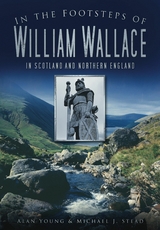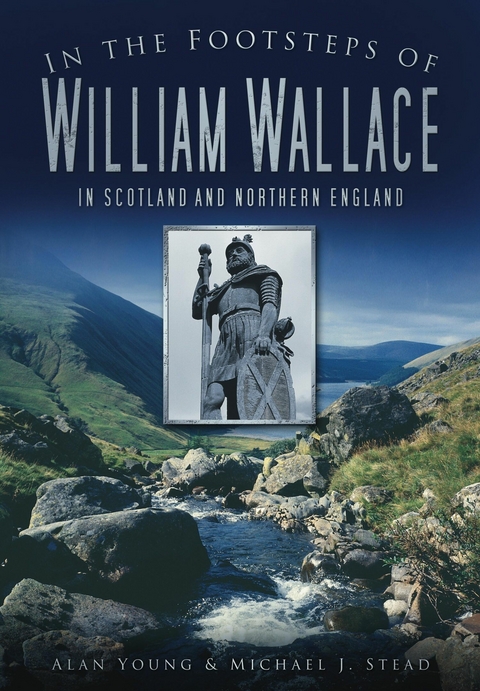
In the Footsteps of William Wallace (eBook)
208 Seiten
The History Press (Verlag)
9780750951432 (ISBN)
For nearly 700 years debate has raged over the true nature of William Wallace and his role in Scotland's turbulent history. Was he the Braveheart of Blind Harry's legendary account, the bold, but savage, hero of the Scottish wars? Or, as some contemporary chroniclers attested, nothing but a villainous thief and vagrant fugitive? This book draws on a wide range of contemporary and modern sources to look behind the figure of legend to find Wallace's true character. Through superb photographs, we trace the journey of Wallace from his modest upbringing in south-west Scotland and his first victory as a 'guerilla' leader and military commander at Stirling Bridge to his painful death seven years later. We see his 'invasion' of Northumberland and Cumberland. This is an essential travelling companion for a journey through Wallace's kingdom and to learn more about the myth and the man.
1
WILLIAM WALLACE – THE MAKING OF A LEGEND
Anyone attempting to understand the William Wallace phenomenon in Scottish history must, first of all, establish how Wallace was viewed by his contemporaries. Only then can it be seen exactly when, how and why the legend and traditions now surrounding this character have evolved and developed over the last 700 years. As part of this process of unfolding layers of history and tradition that most significant source on the life of William Wallace the epic poem The Wallace, written in the 1470s by Henry the Minstrel (better known as Blind Harry), will be closely examined. The Wallace will be set in both the political and cultural context of the day, noting too the sources that had an effect on Blind Harry’s work. In turn it will be seen what impact this late fifteenth-century poem has had on the late twentieth-century film Braveheart (1995) in terms of its portrayal of William Wallace. A number of questions arise. Why has Blind Harry’s view of Wallace remained such a powerful, indeed dominant, influence on the popular perceptions of William Wallace? What other interpretations are there and why have these remained in the background? How far does this accepted view of William Wallace distort what is known of the historical Wallace?
Contemporary evidence for the historical William Wallace is restricted narrowly to the years between his sudden emergence onto the military scene in 1297 and his death in 1305. Within this time information is unevenly spread. Most material relates to the period from the summer of 1297, just before his triumph over the English army at the Battle of Stirling Bridge (11 September 1297), until shortly after his defeat at the Battle of Falkirk (22 July 1298). It is to these years that the only four historical documents emanating from William Wallace himself belong. After defeat at Falkirk, Wallace left Scotland, acting as a roving ambassador for the Scottish cause, principally at the French and papal courts between 1298 and 1302. Little is known in detail of his activities during these years. Following his return to Scotland in late 1302 or early 1303, Wallace can be traced only through fragmentary references to his appearance in skirmishes with the English and in reports of Edward I’s efforts to capture him. This pursuit ended with Wallace’s capture by John of Menteith in 1305, after which Wallace was taken south to London where he was tried and executed. Reports of Wallace’s trial and savage death form the bulk of the surviving contemporary comments on him.
The Braveheart Statue. This representation of Mel Gibson as William Wallace was placed in the car park of the National Wallace Monument in 1998. It is the work of Tom Church and is a reminder of how significant Mel Gibson’s film Braveheart has been in the development of the Wallace legend.
One very interesting aspect of contemporary evidence on William Wallace is how little emanates from Scottish sources. The main Scottish strand in the standard narrative of Scottish medieval history was John of Fordun, whose Chronicle of the Scots Nation was compiled in the 1380s. Though written long after Wallace’s death, Fordun’s Chronicle is now acknowledged as an invaluable source of information for the period of William Wallace’s influence. He had access to original thirteenth-century material and therefore must be recognised as the closest Scottish source to Wallace himself. Yet, though Fordun’s reporting of facts may be accurate, his interpretation of events was naturally affected by the politics of his time. After Robert Bruce’s (King Robert I’s) death in 1329, Scotland had endured some years of great political instability – there had been a minority period, civil war and the constant threat of English invasion to support Edward Balliol’s attempt to gain the Scottish throne. All of these threats to the Scottish situation seemed to be replicating the events that followed the death of Alexander III in 1286 which led to Edward I’s interference in Scottish affairs. To make matters worse, the Scottish King David II had been captured by the English at Neville’s Cross (near Durham) in 1346 and was subsequently held in lengthy captivity. As a result of these circumstances, Fordun’s narrative strongly emphasises three themes – the growth of the Scottish nation and patriotism, the cause of Scottish independence and the importance of the Scottish monarchy in supporting these objectives. In view of the latter point, it is hardly surprising that Fordun’s chief hero was Robert Bruce, who restored an independent Scottish monarchy in 1306, rather than William Wallace.
The Kinghorn Monument. This monument to King Alexander III, who died mysteriously on 18 March 1286 while travelling in a storm from Edinburgh to Kinghorn in Fife, is a reminder of the political uncertainty in Scotland during William Wallace’s early years.
When Fordun’s text is examined for information on William Wallace, he gives only a framework for his activities, an outline of his actions with little material about his background and, interestingly, in respect to later writings, nothing on his appearance. Undoubtedly, William Wallace was a hero, as can be seen in the following extract:
The Abbey Craig Monument, close to the scene of his great triumph at Stirling Bridge, features this bronze statue of Wallace in chain mail holding aloft a huge sword.
From that time there flocked to him all who were in bitterness of spirit and were weighed down beneath the burden of bondage under the unbearable domination of English despotism, and he [Wallace] became their leader. He was wondrously brave and bold, of goodly mien and boundless liberality . . .
However, to Fordun Robert Bruce was the hero of his Chronicle. Significantly, Fordun makes no connection between Wallace and Bruce in his narrative – they acted quite separately.
Though there are the beginnings of hero-worship contained within Fordun’s descriptions of Wallace’s actions, these can hardly be considered the foundations of a legend. Ironically, it is to contemporary English sources that the historian must go to gain not only more details of Wallace’s activities but also to trace the origins of the legend. Foremost among these English sources are two northern chronicles, the Guisborough Chronicle (North Yorkshire) and the Lanercost Chronicle (Cumbria), while the annals of Peter Langtoft, which derive from Bridlington, are also of use. All English material is biased against William Wallace, targeting him as a hate figure. This surely reflects Edward I’s attitude to Wallace at the time – to the English King Wallace came to symbolise, in 1297 and 1298, the spirit of the Scottish opposition and this became even more apparent between 1303 and 1305 when most Scottish resistance was crumbling away. It is interesting, if hardly surprising, that the most extreme English anti-Wallace sentiments were expressed by chroniclers living much further south, such as William Rishanger (St Albans Abbey in Hertfordshire), Nicholas Trivet (Oxfordshire), Matthew of Westminster and the Norwich monk Bartholomew Cotton. The anonymous author of the poem Song on the Scottish Wars shared their opinions too. Whatever the degree of hostility shown towards Wallace by contemporary English sources, there was a common desire generally to discredit Wallace’s reputation both during his life and after his execution. To the Guisborough chronicler, Wallace was ‘a common thief . . . a vagrant fugitive’. To the Lanercost chronicler he was ‘a bloody man . . . who had formerly been a chief of brigands’. Within the Lanercost Chronicle was published a song describing Wallace:
Thou pillager of many a holy shrine
Butcher of thousands, threefold death be thine
Similar views, if more extreme, were voiced by Matthew of Westminster, who referred to Wallace as:
. . . a man void of pity, a robber given to sacrilege, arson and homicide, more hardened in cruelty than Herod, more raging in madness than Nero . . .
The anonymous author of the political song On the Execution of Sir Simon Fraser pointed to Edward I’s motives in using Wallace’s death as a lesson to the Scots:
Sir Edward our king, who is full of piety
sent the Wallace’s quarters to his own country
to hang in four parts (of the country) to be their mirror
thereupon to think, in order that many might see and dread
The targeting of Wallace as a hate figure and the triumphalism of England’s popular songwriters at his death probably had the opposite effect to that intended. Instead of destroying Wallace’s reputation, it heightened it, made Wallace a martyr for the Scottish cause and helped to create the legend of his life and deeds.
In Scotland it was not until the fifteenth century that the successors and amplifiers of John of Fordun began to promote a more detailed picture of William Wallace as patriot hero. The Scottish enhancers of Wallace’s reputation were, principally, Andrew Wyntoun – Oryginale Cronykil of Scotland (c. 1420), Walter Bower – Scotichronicon (c. 1440) and most famously Henry the Minstrel (Blind Harry) – the vernacular poem The Wallace (1470s). It is clear that well before The Wallace was written there were tales, or ‘gestis’, circulating about William Wallace. Andrew Wyntoun comments:
Of his good deeds and his manliness
Great Gestis, I heard say, are made . . .
Whoever his deeds would all endite
Would need a mighty book to write
Unfortunately, no traces of these ‘gestis’ have been discovered.
Dunfermline Abbey, famous as the burial place of Robert Bruce and...
| Erscheint lt. Verlag | 23.4.2010 |
|---|---|
| Verlagsort | London |
| Sprache | englisch |
| Themenwelt | Literatur ► Biografien / Erfahrungsberichte |
| Literatur ► Romane / Erzählungen | |
| Sachbuch/Ratgeber ► Geschichte / Politik ► Mittelalter | |
| Reisen ► Karten / Stadtpläne / Atlanten ► Welt / Arktis / Antarktis | |
| Geschichte ► Allgemeine Geschichte ► Mittelalter | |
| Geisteswissenschaften ► Geschichte ► Regional- / Ländergeschichte | |
| Sozialwissenschaften ► Politik / Verwaltung | |
| Schlagworte | battle of falkirk • Battle of Stirling Bridge • Braveheart • Cumberland • military commander • military leader • Northern England • Northumberland • Scotland • Scots • Scottish • Scottish knight • Wars of Scottish Independence • Wars of Scottish Independence, william wallace, braveheart, scotland, northern england, scottish, scots, battle of stirling bridge, battle of falkirk, scottish knight • Wars of Scottish Independence, william wallace, braveheart, scotland, northern england, scottish, scots, battle of stirling bridge, battle of falkirk, scottish knight, military leader, military commander, northumberland, cumberland • William Wallace |
| ISBN-13 | 9780750951432 / 9780750951432 |
| Informationen gemäß Produktsicherheitsverordnung (GPSR) | |
| Haben Sie eine Frage zum Produkt? |
DRM: Digitales Wasserzeichen
Dieses eBook enthält ein digitales Wasserzeichen und ist damit für Sie personalisiert. Bei einer missbräuchlichen Weitergabe des eBooks an Dritte ist eine Rückverfolgung an die Quelle möglich.
Dateiformat: EPUB (Electronic Publication)
EPUB ist ein offener Standard für eBooks und eignet sich besonders zur Darstellung von Belletristik und Sachbüchern. Der Fließtext wird dynamisch an die Display- und Schriftgröße angepasst. Auch für mobile Lesegeräte ist EPUB daher gut geeignet.
Systemvoraussetzungen:
PC/Mac: Mit einem PC oder Mac können Sie dieses eBook lesen. Sie benötigen dafür die kostenlose Software Adobe Digital Editions.
eReader: Dieses eBook kann mit (fast) allen eBook-Readern gelesen werden. Mit dem amazon-Kindle ist es aber nicht kompatibel.
Smartphone/Tablet: Egal ob Apple oder Android, dieses eBook können Sie lesen. Sie benötigen dafür eine kostenlose App.
Geräteliste und zusätzliche Hinweise
Buying eBooks from abroad
For tax law reasons we can sell eBooks just within Germany and Switzerland. Regrettably we cannot fulfill eBook-orders from other countries.
aus dem Bereich