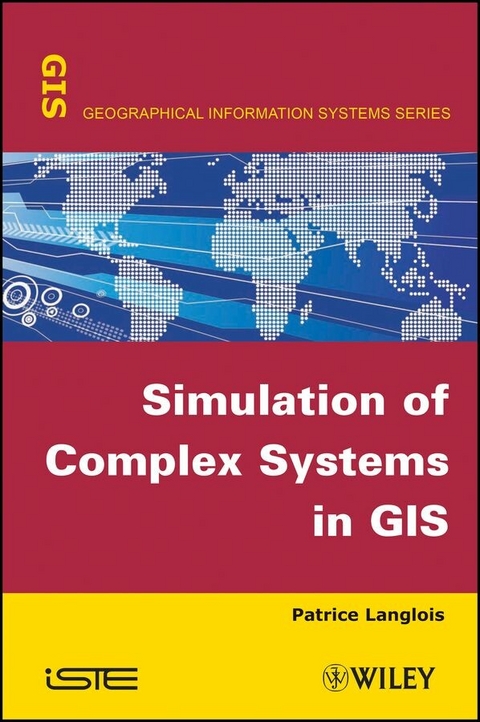
Simulation of Complex Systems in GIS (eBook)
John Wiley & Sons (Verlag)
978-1-118-60096-2 (ISBN)
This book provides a comprehensive view of the field of geographical modeling by dividing the topic into three parts. The first part of the work establishes the foundations of geographical modeling through the use of more general concepts, including: structure, organization, system, geometries, topologies, metrics, material, and object. Finally, introduction of the concept of time leads to the theories of process and spatial interaction, which are fundamental in geography. The second part of the book tackles the use of computer tools for dynamic model building, which are the geographic cellular automata (GCA), and presents several models applied to various themes, such as urban growth, natural risks by flood simulations, as well as more political themes, such as the use of European funds, or the development of voting patterns in France. Finally, a general model of the geographic agents system (GAS) which can be used as a basis for the construction of a model-building platform for dynamic spatial models is presented.
Patrice Langlois, Professor in the Department of Geography and director of the MTG (Modeling and Graphic process in Geography) team, has been a teacher-researcher at the University of Rouen since 1982. He specializes in modeling in geography and in the development of data-processing tools for geographers, thematic cartography coupled with data processing, and the automatic digitization of vector maps. A general study of the structures and concepts of geographic modeling has led him to develop an integrated platform (framework) of modeling and simulation of spatial dynamics, based on a language of rules coupled with graphical modeling.
General Introduction xi
PART 1. THE STRUCTURE OF THE GEOGRAPHIC SPACE 1
Part 1. Introduction 3
Chapter 1. Structure and System Concepts 5
1.1. The notion of structure 5
1.2. The systemic paradigm 10
1.3. The notion of organization 13
Chapter 2. Space and Geometry 29
2.1. Different theories of space 29
2.2. Geometry and its data structures 43
2.3. "Neat" geometry and "fuzzy"geometry 60
Chapter 3. Topological Structures: How Objects are Organizedin Spatial Systems 67
3.1. Topology 67
3.2. Metrics and topologies 68
3.3. Calculated topology, structural topology 71
3.4. Hierarchization 78
Chapter 4. Matter and Geographical Objects 79
4.1. Geographic matter 79
4.2. The notion of observation 82
4.3. The geographic object: Definitions and principles 84
Chapter 5. Time and Dynamics 97
5.1. Time 97
5.2. Temporalities 100
5.3. Events, processes 105
5.4. Decomposition of a complex process 115
5.5. An epistemic choice: reciprocal dependency between thecomplexity levels of a phenomenon 117
Chapter 6. Spatial Interaction 121
6.1. Presentation of the concept 121
6.2. Definition of macroscopic interaction 125
6.3. The four elementary (inter)actions 127
6.4. Microscopic interaction like a multigraph 128
6.5. Composition of successive interactions 130
6.6. The configurations and the trajectories of a simulation arecategories 131
6.7. Intermediary level matrix representation 133
6.8. Examples of interactions 134
6.9. First definition of the notion of spatial system 138
Part 1. Conclusion: Stages of the Ontogenesis 141
PART 2. MODELING THROUGH CELLULAR AUTOMATA 145
Chapter 7. Concept and Formalization of a CA 147
7.1. Cellular automata paradigm 148
7.2. Notion of finite-state automata 150
7.3. Mealy and Moore automata 151
7.4. A simple example of CA: the game of life 152
7.5. Different decompositions of the functions of a cell 153
7.6. Threshold automaton, window automaton 155
7.7. Micro level and Stochastic automaton 156
7.8. Macro level and deterministic automaton 156
7.9. General definition of a geographic cellular automaton157
7.10. Different scheduling regimes of the internal tasks of thesystem 160
7.11. Ports, channels, encapsulation 162
7.12. Interaction 164
7.13. Space associated with a geographic cellular automaton168
7.14. Topology and neighborhood operator of a GCA 168
7.15. The notion of cellular layer 168
7.16. Hierarchized GCA models 169
Chapter 8. Examples of Geographic Cellular Automaton Models171
8.1. SpaCelle, multi-layer cellular automaton 172
8.2. Example: the evolution model of the Rouen agglomeration181
8.3. RuiCells 189
8.4. GeoCells 207
Part 2. Conclusion 235
PART 3. A GENERAL MODEL OF GEOGRAPHIC AGENT SYSTEMS237
Part 3. Introduction 239
Chapter 9. Theoretical Approach of an Integrated SimulationPlatform 241
9.1. For an integrated platform of simulation 241
9.2. General specifications 242
Chapter 10. A Formal Ontology of Geographic Agent Systems245
10.1. The conceptual framework 245
10.2. The notion of a geographic agent system 247
10.3. A generalization of the notion of process 249
10.4. The notion of a geographic agent 250
10.5. The formalization of the notion of organization 258
10.6. The formalization of behavior 268
10.7. Formalization of a general AOC model 279
10.8. The Schelling model example 280
Part 3. Conclusion 283
General Conclusion 285
Acronyms 291
Bibliography 293
Index 299
| Erscheint lt. Verlag | 4.2.2013 |
|---|---|
| Sprache | englisch |
| Themenwelt | Reisen |
| Naturwissenschaften ► Geowissenschaften ► Geografie / Kartografie | |
| Technik | |
| Schlagworte | Geographie • Geography • GIS, Fernerkundung u. Kartographie • GIS, Remote Sensing & Cartography • Simulation of Complex Systems in GIS, geographic information system, GIS, geographic modeling, dynamic model building, geographic cellular automata, GCA, geographic agents system, GAS, |
| ISBN-10 | 1-118-60096-7 / 1118600967 |
| ISBN-13 | 978-1-118-60096-2 / 9781118600962 |
| Informationen gemäß Produktsicherheitsverordnung (GPSR) | |
| Haben Sie eine Frage zum Produkt? |
 PDF (Adobe DRM)
Kopierschutz: Adobe-DRM
Adobe-DRM ist ein Kopierschutz, der das eBook vor Mißbrauch schützen soll. Dabei wird das eBook bereits beim Download auf Ihre persönliche Adobe-ID autorisiert. Lesen können Sie das eBook dann nur auf den Geräten, welche ebenfalls auf Ihre Adobe-ID registriert sind.
Details zum Adobe-DRM
Dateiformat: PDF (Portable Document Format)
Mit einem festen Seitenlayout eignet sich die PDF besonders für Fachbücher mit Spalten, Tabellen und Abbildungen. Eine PDF kann auf fast allen Geräten angezeigt werden, ist aber für kleine Displays (Smartphone, eReader) nur eingeschränkt geeignet.
Systemvoraussetzungen:
PC/Mac: Mit einem PC oder Mac können Sie dieses eBook lesen. Sie benötigen eine
eReader: Dieses eBook kann mit (fast) allen eBook-Readern gelesen werden. Mit dem amazon-Kindle ist es aber nicht kompatibel.
Smartphone/Tablet: Egal ob Apple oder Android, dieses eBook können Sie lesen. Sie benötigen eine
Geräteliste und zusätzliche Hinweise
Buying eBooks from abroad
For tax law reasons we can sell eBooks just within Germany and Switzerland. Regrettably we cannot fulfill eBook-orders from other countries.
aus dem Bereich