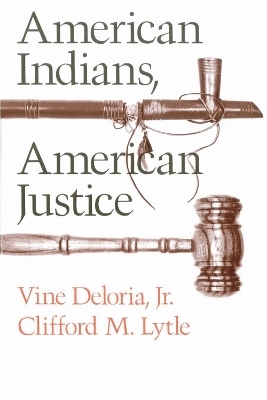
American Indians, American Justice
University of Texas Press (Verlag)
978-0-292-73834-8 (ISBN)
American Indians, American Justice explores the complexities of the present Indian situation, particularly with regard to legal and political rights. It is the first book to present an overview of federal Indian law in language readably accessible to the layperson. Remarkably comprehensive, it is destined to become a standard sourcebook for all concerned with the plight of the contemporary Indian.
Beginning with an examination of the historical relationship of Indians and the courts, the authors describe how tribal courts developed and operate today, and how they relate to federal and state governments. They define such key legal concepts as tribal sovereignty and Indian Country. By comparing and contrasting the workings of Indian and non-Indian legal institutions, the authors illustrate how Indian tribes have adapted their customs, values, and institutions to the demands of the modern world. Describing the activities of attorneys and Indian advocates in asserting and defending Indian rights, they identify the difficulties typically faced by Indians in the criminal and civil legal arenas and explore the public policy and legal rights of Indians as regards citizenship, voting rights, religious freedom, and basic governmental services.
Vine Deloria, Jr. (1933–2005) and Clifford M. Lytle (1932–2014) were professors of political science at the University of Arizona at Tucson. Deloria is author of such classic works on Indian affairs as Custer Died for Your Sins and Behind the Trail of Broken Treaties; Lytle is author of The Warren Court and Its Critics. Both Lytle and Deloria are attorneys at law.
Introduction
1. American Indians in Historical Perspective
Discovery, Conquest, and Treaty-Making (1532-1828)
Removal and Relocation (1828-1887)
Allotment and Assimilation (1887-1928)
Reorganization and Self-Government (1928-1945)
Termination (1945-1961)
Self-Determination (1961-Present)
2. Federal Responsibility and Power over Indian Affairs
Roots of Federal Responsibility
The Sources of Federal Power
3. Indian Country
4. The Evolution of Tribal Governments
Traditional Forms of Tribal Government
Transitional Tribal Governments
Tribal Government in Modern Perspective
Tribal Government and Contemporary Problems
5. The Indian Judicial System
The Development of the Indian Court System
Tribal Judges
Tribal Courts and the 1968 Indian Civil Rights Act
Federal Review of Tribal Court Decisions
The Tribal Court System: An Assessment
6. The Role of Attorneys, Advocates, and Legal Interest Groups in the Indian System of Law
Indian Attorneys and American Society
Attorneys and Advocates in an Indian Setting
Indian Legal Services Attorneys
Indian Legal Interest Groups
7. The Criminal System of Justice in Indian Country
Federal Statutes and Criminal Law
Criminal Jurisdiction: Bringing Order to a Complex Maze
Law Enforcement and Criminal Prosecution
Special Problems in Law Enforcement
8. The Civil System of Justice in Indian Country
Traditional Civil Law
The Civil System in Operation
Immunity from State Encroachment
The Indian-State Conflict of Laws
9. Public Policy and the Legal Rights of Indians
The Civil Liberties of American Indians
American Indian Religious Freedom
The Right to Basic Governmental Services
Bibliographic References
Index of Cases
Index of Topics
| Erscheint lt. Verlag | 1.10.1983 |
|---|---|
| Verlagsort | Austin, TX |
| Sprache | englisch |
| Maße | 152 x 229 mm |
| Gewicht | 399 g |
| Themenwelt | Recht / Steuern ► EU / Internationales Recht |
| Recht / Steuern ► Privatrecht / Bürgerliches Recht | |
| ISBN-10 | 0-292-73834-X / 029273834X |
| ISBN-13 | 978-0-292-73834-8 / 9780292738348 |
| Zustand | Neuware |
| Informationen gemäß Produktsicherheitsverordnung (GPSR) | |
| Haben Sie eine Frage zum Produkt? |
aus dem Bereich