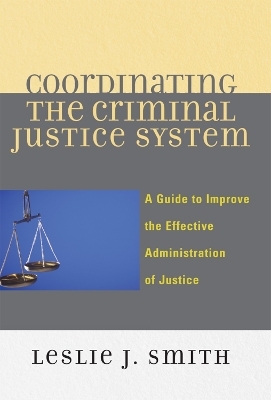
Coordinating the Criminal Justice System
University Press of America (Verlag)
978-0-7618-3939-2 (ISBN)
Leslie J. Smith advocates that the performance of the criminal justice system should be measured in terms of achieving the goals and objectives of each component collectively. Although the legislative, judicial, and executive branches of the U.S. government are constitutionally independent and not required to engage in any coordinated planning activities, these requirements should not lead to poor performance. It is essential to promote positive government through increased collaboration by identifying philosophical principles that will promote the participation of citizens, law enforcement, judiciary, prosecution, corrections, victims, treatment providers, and educators in the development of strategies to prevent, reduce and control crime. There are approximately twenty states throughout the United States that have fostered criminal justice collaborations of this type. The key to accomplishing this objective is effective leadership. This approach is growing in popularity and this book will assist in the further development of this strategy.
This guide provides a step-by-step strategy that simplifies the aforementioned issues. It will be especially advantageous for newly appointed criminal coordinators, planners, and others that are charged with creating a hands-on approach to coordinating their local criminal justice processes. Above all, as criminal justice presses forward to the future, the guide will assist in "bridging the gap" between traditional and contemporary approaches to criminal justice plann
Leslie J. Smithis a criminal justice systems consultant and creator of Policy Briefs, a problem-solving policy and program development lecture series using Strawman Proposals.He is he former adjunct faculty at Texas Christian University and Tarleton State University in the Department of Criminal Justice. He is a former Criminal Justice Coordinator in Tarrant County Texas.
Part 1 Figures
Part 2 Preface
Chapter 3 Introduction
Chapter 4 Step 1: View the Criminal Justice System as One Organization
Chapter 5 Step 2: Have a Complete Understanding of the Origins of the Criminal Justice System
Chapter 6 Step 3: Become Familiar with Each Component of the Criminal Justice System and Use It as a Frame of Reference
Chapter 7 Step 4: A Coordinated Approach to Develop Mission Statements
Chapter 8 Step 5: Quality Decision Making at Each Level of the System
Chapter 9 Step 6: Establish Organized and Coordinated Planning Strategies
Chapter 10 Step 7: An Analysis Model that Measures the Performance of the Criminal Justice System
Chapter 11 Step 8: Monitor the Organizational Environment
Chapter 12 Step 9: A Planning Process at the Government and Community Level
Chapter 13 Step 10: Criminal Justice Administrators Should Understand the Causes of Crime
Chapter 14 Step 11 & 12: Evaluate Organizational Needs and Motivations within the Context of the Organizational Mission
Chapter 15 Step 13: Improve the Justice Administration Process through Effective Programs
Chapter 16 Steps 13A-13H: Examples of Programs that Positively Impact the Criminal Justice System's Total System Outcomes
Chapter 17 Steps 14-15: Accomplishment of Goals and Objectives are the Primary Mission for the Organization
Chapter 18 Step 16: Utilize the Available Technology
Chapter 19 Step 17: Design a Community Based Justice Model and Incorporate into the Integrated Justice Model
Part 20 Appendices
Part 21 About the Author
| Erscheint lt. Verlag | 12.1.2008 |
|---|---|
| Verlagsort | Lanham, MD |
| Sprache | englisch |
| Maße | 154 x 229 mm |
| Gewicht | 195 g |
| Themenwelt | Recht / Steuern ► Allgemeines / Lexika |
| Recht / Steuern ► EU / Internationales Recht | |
| Recht / Steuern ► Öffentliches Recht ► Verfassungsrecht | |
| ISBN-10 | 0-7618-3939-9 / 0761839399 |
| ISBN-13 | 978-0-7618-3939-2 / 9780761839392 |
| Zustand | Neuware |
| Informationen gemäß Produktsicherheitsverordnung (GPSR) | |
| Haben Sie eine Frage zum Produkt? |
aus dem Bereich