


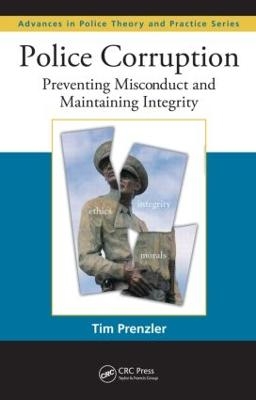
Police Corruption
Preventing Misconduct and Maintaining Integrity
Seiten
2009
Crc Press Inc (Verlag)
978-1-4200-7796-4 (ISBN)
Crc Press Inc (Verlag)
978-1-4200-7796-4 (ISBN)
Designed for administrators at all levels, this book presents proven strategies to prevent police corruption and to maintain an ethical culture in policing.
While many police officers undertake their work conforming to the highest ethical standards, the fact remains that unethical police conduct continues to be a recurring problem around the world. With examples from a range of jurisdictions, Police Corruption: Preventing Misconduct and Maintaining Integrity examines the causes of police misconduct and explores applied strategies designed to maximize ethical conduct and identify and prevent corruption.
Analyzes the roots of corruption
Introducing the phenomenon of police officer misconduct, the book provides an analysis of unethical behavior, its effects, and different causal factors. The author examines the impact on the community and the police themselves, the dilemma of establishing universal ethical principles, and ways of identifying and measuring misconduct problems. The remainder of the text examines applied strategies designed to maximize ethical conduct and prevent corruption.
A myriad of proven strategies
Exploring a wide range of approaches, the book discusses best practices in the recruitment of ethical applicants, strategies for dealing with misconduct, risk reduction strategies and early warning and intervention systems, along with advanced strategies such as drug and alcohol testing, integrity tests, and the use of covert surveillance. The text also explores the role of independent external oversight bodies that audit police strategies and conduct their own investigation. The final chapter on ethical leadership emphasizes the need to go beyond a checklist of rules with leadership that values, requires, and models integrity in all aspects of police work.
Examples from around the world
Taking a global approach, this volume recognizes that policing is prone to the same potential problems of corruption and misconduct everywhere in the world. Highlighting the importance of establishing robust and enduring anti-corruption protocols in new and emerging democracies, the book provides a model comprehensive integrity system, underscoring the need for a sustained commitment to combat corruption.
While many police officers undertake their work conforming to the highest ethical standards, the fact remains that unethical police conduct continues to be a recurring problem around the world. With examples from a range of jurisdictions, Police Corruption: Preventing Misconduct and Maintaining Integrity examines the causes of police misconduct and explores applied strategies designed to maximize ethical conduct and identify and prevent corruption.
Analyzes the roots of corruption
Introducing the phenomenon of police officer misconduct, the book provides an analysis of unethical behavior, its effects, and different causal factors. The author examines the impact on the community and the police themselves, the dilemma of establishing universal ethical principles, and ways of identifying and measuring misconduct problems. The remainder of the text examines applied strategies designed to maximize ethical conduct and prevent corruption.
A myriad of proven strategies
Exploring a wide range of approaches, the book discusses best practices in the recruitment of ethical applicants, strategies for dealing with misconduct, risk reduction strategies and early warning and intervention systems, along with advanced strategies such as drug and alcohol testing, integrity tests, and the use of covert surveillance. The text also explores the role of independent external oversight bodies that audit police strategies and conduct their own investigation. The final chapter on ethical leadership emphasizes the need to go beyond a checklist of rules with leadership that values, requires, and models integrity in all aspects of police work.
Examples from around the world
Taking a global approach, this volume recognizes that policing is prone to the same potential problems of corruption and misconduct everywhere in the world. Highlighting the importance of establishing robust and enduring anti-corruption protocols in new and emerging democracies, the book provides a model comprehensive integrity system, underscoring the need for a sustained commitment to combat corruption.
Tim Prenzler is Chief Investigator, Center of Excellence in Policing and Security, Griffith University, Brisbane, Australia.
The Misconduct Problem in Policing. Understanding Police Misconduct. Setting Standards. Measuring Misconduct and Integrity. Recruitment and Training. An Advanced Complaints and Discipline System. Alternative Dispute Resolution. System Controls and Risk Management. Advanced Techniques. External Oversight. Leadership for Integrity. References. Index.
| Erscheint lt. Verlag | 31.3.2009 |
|---|---|
| Reihe/Serie | Advances in Police Theory and Practice |
| Zusatzinfo | 4 Tables, black and white; 4 Illustrations, black and white |
| Verlagsort | Bosa Roca |
| Sprache | englisch |
| Maße | 156 x 234 mm |
| Gewicht | 476 g |
| Themenwelt | Recht / Steuern ► Allgemeines / Lexika |
| Recht / Steuern ► EU / Internationales Recht | |
| Recht / Steuern ► Strafrecht ► Kriminologie | |
| Recht / Steuern ► Strafrecht ► Strafverfahrensrecht | |
| Sozialwissenschaften ► Politik / Verwaltung | |
| Wirtschaft | |
| ISBN-10 | 1-4200-7796-1 / 1420077961 |
| ISBN-13 | 978-1-4200-7796-4 / 9781420077964 |
| Zustand | Neuware |
| Informationen gemäß Produktsicherheitsverordnung (GPSR) | |
| Haben Sie eine Frage zum Produkt? |
Mehr entdecken
aus dem Bereich



aus dem Bereich
Mein Leben zwischen Kokain und Waffen
Buch | Softcover (2025)
Piper (Verlag)
CHF 24,90
zwei Essays
Buch | Softcover (2025)
Reclam, Philipp (Verlag)
CHF 9,80
der berühmte FBI-Profiler über die Fahndung nach Serienmördern und …
Buch | Softcover (2023)
riva (Verlag)
CHF 20,95


