


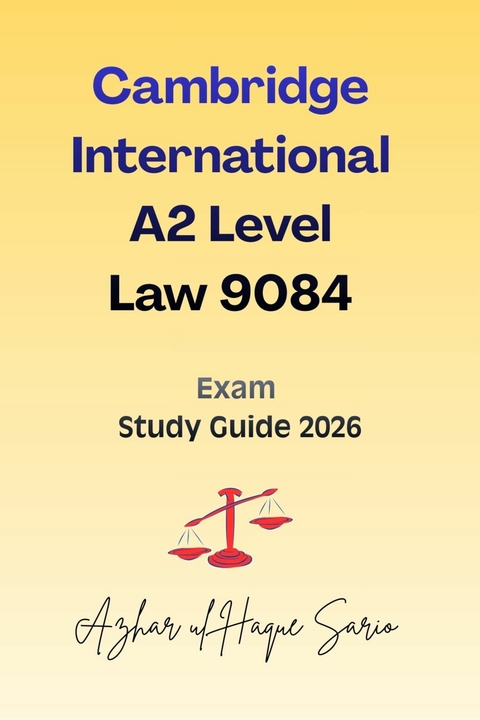
Cambridge International A2 Level Law 9084 (eBook)
210 Seiten
Azhar Sario Hungary (Verlag)
978-3-384-79040-8 (ISBN)
Step into the future of legal studies with a guide that treats the law as a living, breathing digital entity.
This book serves as a comprehensive and forward-looking study companion specifically crafted for the Cambridge International A2 Level Law 9084 syllabus for the 2026 examination series. Inside, you will find a complete breakdown of the Law of Contract and the Law of Tort. It starts with the formation of contracts, explaining offer and acceptance in a world of algorithmic trading. It covers the critical rules of intention and consideration. It explains legal capacity, focusing on the rights of minors in the digital economy. It dissects contract terms, including the latest on exclusion clauses and consumer rights. It details how contracts are discharged by performance or frustration. It explores remedies like damages and specific performance. In Tort, it covers negligence, including the modern approach to duty of care. It explains occupiers' liability and private nuisance. It looks at strict liability under Rylands v Fletcher. It covers trespass to the person, including assault and false imprisonment. It finishes with a deep dive into general defences and legal remedies.
What sets this book apart is its refusal to remain stuck in the past; it provides a competitive advantage by applying classic legal principles to the reality of 2026. While other textbooks might rely solely on 19th-century cases, this guide synthesizes them with the 'smart contracts' and blockchain realities of the mid-21st century. It bridges the gap between the 'reasonable man' of the Victorian era and the tech-savvy consumer of today. It discusses modern issues like 'bug bounty' programs as unilateral contracts. It analyzes the impact of the Digital Markets, Competition and Consumers Act. It explains how the law handles 'click-wrap' agreements and digital signatures. It includes critical updates from 2024 and 2025 Supreme Court judgments that outdated books will miss, such as the Paul v Royal Wolverhampton ruling on psychiatric injury. It simplifies complex ideas into short, digestible sentences. It uses real-world examples involving drones, AI, and crypto assets to make the law relatable. This freshness makes it an essential tool for any student wanting to ace their exams in 2026.
This guide is written in a conversational and accessible tone, ensuring that even the most complex legal doctrines are easy to understand. You will learn about the 'battle of the forms' in supply chains and how modern courts view email revocations. It explores the 'gig economy' and how it affects employment status in tort claims. It breaks down the 'eggshell skull' rule and how it applies to mental health today. You will read about the 'right to repair' and how it changes the definition of satisfactory quality for goods. The book also clarifies the confusing 'but for' test in causation with clear examples. It discusses the strict liability of 'Rylands v Fletcher' and how it applies to modern industrial escapes. It even touches on 'urban exploration' and the liability of occupiers towards trespassers. Every chapter is designed to help you think like a lawyer in the modern world. It encourages you to critique the law, not just memorize it.
Disclaimer: This book is an independent publication by Azhar ul Haque Sario. It is not affiliated with, endorsed by, or connected to Cambridge Assessment International Education or the Cambridge exam board. Any use of the trade name 'Cambridge' or the syllabus code '9084' is for nominative fair use purposes only to indicate the scope and suitability of the study material.
Law of tort
Advanced Analysis of Liability in Negligence (2026 Perspective)
Introduction to Negligence
In the landscape of English Tort Law as we enter 2026, the concept of negligence remains the dominant mechanism for compensating accidental harm. Negligence is not just about being careless; it is a specific legal structure. It requires a claimant to prove that a defendant failed to meet a required legal standard, resulting in damage.
The classic definition comes from the 19th-century case of Blyth v Birmingham Waterworks Co (1856). Baron Alderson defined negligence as the omission to do something which a reasonable man would do, or doing something which a prudent and reasonable man would not do. This "reasonable man" test is still the bedrock of the law today.
For a student writing in 2026, it is vital to understand the procedural burden. The burden of proof rests on the claimant. They must prove their case "on the balance of probabilities." This means it must be more likely than not (more than 50%) that the defendant was negligent.
This coursework deep dive will explore three specific areas: the nature of liability (including personal, vicarious, and joint liability), the duty of care (focusing on the evolution from the neighbour principle to the modern application of Caparo and Robinson), and the crucial role of policy considerations in judicial decision-making.
Part 1: Nature of Liability in Negligence
Liability in negligence is not a monolith. It can attach to individuals, organisations, or groups depending on the relationship between the parties and the nature of the fault.
1. Personal Liability
Personal liability is the most straightforward form of liability. It is based on the "fault principle." In English law, a person is generally only liable if they are at fault. This means the defendant personally breached a duty of care owed to the claimant.
For example, if a driver speeds through a red light and hits a pedestrian, that driver is personally liable. They were the one who acted negligently. The law focuses on their individual conduct compared to the standard of the reasonable driver.
However, in practice, personal liability is often covered by insurance. While the driver is "liable" in court, their insurance company pays the damages. This is a practical reality, but legally, the judgment is against the individual.
2. Vicarious Liability (Outline)
Vicarious liability is a strict liability doctrine. It is distinct because it imposes liability on a person (usually an employer) for the torts committed by someone else (usually an employee), even if the employer was not personally at fault.
As of 2026, the justification for this is "social justice." Employers generally have deeper pockets (insurance) and benefit from the employee's work, so they should bear the risk of harm that work causes.
There is a two-stage test for vicarious liability:
Stage 1: Is the relationship between the defendant and the wrongdoer "akin to employment"?
Stage 2: Was there a "close connection" between the employment and the wrongful act?
Recent Developments (2025/2026 Context): The law has tightened significantly in the mid-2020s. The Supreme Court decision in Barclays Bank plc v Various Claimants (2020) clarified that vicarious liability does not apply to true independent contractors.
Even more recently, the Supreme Court judgment in X v The Lord Advocate [2025] UKSC 44 (decided December 2025) provided a crucial update. The Court held that the Crown was not vicariously liable for the acts of a Scottish Sheriff (judge). The Court reasoned that because the judiciary is constitutionally independent of the government, the government does not have the necessary "control" to make the relationship akin to employment.
This 2025 case is a vital example for students. It shows that constitutional principles can override the general trend of expanding liability. If there is no control due to separation of powers, there is no vicarious liability.
3. Joint Liability
Joint liability arises when two or more people are responsible for the same damage. This often happens in complex accidents.
Imagine two cars, driven negligently by Driver A and Driver B, crash into each other, and a piece of debris flies off and hits a pedestrian (Claimant C). Both drivers caused the injury.
In this scenario, they are "jointly and severally liable." This is a powerful tool for the claimant. It means Claimant C can sue Driver A for 100% of the damages, or Driver B for 100%, or both of them. If Driver A has no money and no insurance, C can get full compensation from Driver B.
The drivers then sort out the "fair shares" between themselves using the Civil Liability (Contribution) Act 1978. Under this Act, the court can apportion damages between the defendants based on their relative blameworthiness. If Driver A was 90% at fault and Driver B was 10%, but Driver A is bankrupt, Driver B might have to pay the victim in full and simply lose out on the contribution from A. This prioritises the innocent victim over the negligent defendants.
Part 2: Duty of Care
The "duty of care" is the first hurdle in a negligence claim. If you do not owe a legal duty to the person you injured, you cannot be liable, no matter how careless you were.
1. The Neighbour Principle (Historical Context)
Before 1932, a duty of care generally only existed if there was a contract or a specific relationship (like doctor-patient). This changed with the most famous case in English law: Donoghue v Stevenson (1932).
Mrs Donoghue drank ginger beer containing a decomposing snail. She fell ill. She had no contract with the cafe or the manufacturer (her friend bought the drink). The House of Lords created the "Neighbour Principle."
Lord Atkin stated: "You must take reasonable care to avoid acts or omissions which you can reasonably foresee would be likely to injure your neighbour."
He defined "neighbours" as persons who are so closely and directly affected by my act that I ought reasonably to have them in contemplation. This established a general principle that liability could arise outside of contracts.
2. The Modern Approach: From Caparo to Robinson
For many years, courts used a three-stage test from Caparo Industries plc v Dickman (1990) to decide all duty of care cases.
However, as we look at the law in 2026, students must be careful. The Supreme Court in Robinson v Chief Constable of West Yorkshire Police (2018) clarified that the Caparo test should not be used in every case.
The Current Rule (2026):
Existing Precedent: If a case falls within an established category (e.g., doctor-patient, driver-pedestrian), the court simply applies the existing precedent. You do not need to use the Caparo test.
Novel Cases: The Caparo test is only used when the case is "novel"—meaning the court has never seen a situation like this before.
Therefore, when analysing a standard car accident, do not use Caparo. The duty is already established. But for a complex new scenario involving AI robotics or a unique economic loss, Caparo is the correct tool.
Part 3: The Three-Part Test (The Caparo Test)
When a situation is novel, the court uses the three stages of Caparo to determine if a duty exists.
Stage 1: Foreseeability of Harm
The court asks: Was it reasonably foreseeable that the defendant's actions would cause damage to the claimant?
This is an objective test. It doesn't matter what the defendant actually thought; it matters what a reasonable person would foresee.
Example: in Kent v Griffiths (2000), an ambulance was called for a patient suffering an asthma attack. The ambulance arrived late without a valid reason. The court held it was reasonably foreseeable that a delay would cause the patient further harm. Duty of care was established.
Stage 2: Proximity
Proximity refers to the legal closeness between the parties. It can be physical closeness (space and time) or relational closeness.
If the harm is physical (like a car crash), proximity is usually easy to prove. If the harm is psychiatric or economic, proximity is much harder to prove.
Example (Psychiatric Harm): The law here has seen a massive shift recently. In Paul v Royal Wolverhampton NHS Trust [2024] UKSC 1, the Supreme Court tightened the rules on proximity for "secondary victims" (people who witness a loved one die).
The Court held that witnessing a "medical crisis" (like a heart attack caused by earlier malpractice) does not create sufficient proximity.
To claim proximity, the claimant must witness an "accident" (a violent external event). This 2024 ruling ended decades of uncertainty and made it very difficult for relatives to sue doctors for the trauma of witnessing death.
Stage 3: Fair, Just, and Reasonable
This is the "safety valve" of the test. Even if harm is foreseeable and there is proximity, the court can deny a duty of care if it believes it would be bad for society (public...
| Erscheint lt. Verlag | 1.1.2026 |
|---|---|
| Sprache | englisch |
| Themenwelt | Recht / Steuern |
| ISBN-10 | 3-384-79040-5 / 3384790405 |
| ISBN-13 | 978-3-384-79040-8 / 9783384790408 |
| Informationen gemäß Produktsicherheitsverordnung (GPSR) | |
| Haben Sie eine Frage zum Produkt? |
 EPUB (Adobe DRM)
Größe: 271 KB
Kopierschutz: Adobe-DRM
Adobe-DRM ist ein Kopierschutz, der das eBook vor Mißbrauch schützen soll. Dabei wird das eBook bereits beim Download auf Ihre persönliche Adobe-ID autorisiert. Lesen können Sie das eBook dann nur auf den Geräten, welche ebenfalls auf Ihre Adobe-ID registriert sind.
Details zum Adobe-DRM
Dateiformat: EPUB (Electronic Publication)
EPUB ist ein offener Standard für eBooks und eignet sich besonders zur Darstellung von Belletristik und Sachbüchern. Der Fließtext wird dynamisch an die Display- und Schriftgröße angepasst. Auch für mobile Lesegeräte ist EPUB daher gut geeignet.
Systemvoraussetzungen:
PC/Mac: Mit einem PC oder Mac können Sie dieses eBook lesen. Sie benötigen eine
eReader: Dieses eBook kann mit (fast) allen eBook-Readern gelesen werden. Mit dem amazon-Kindle ist es aber nicht kompatibel.
Smartphone/Tablet: Egal ob Apple oder Android, dieses eBook können Sie lesen. Sie benötigen eine
Geräteliste und zusätzliche Hinweise
Buying eBooks from abroad
For tax law reasons we can sell eBooks just within Germany and Switzerland. Regrettably we cannot fulfill eBook-orders from other countries.
aus dem Bereich


