


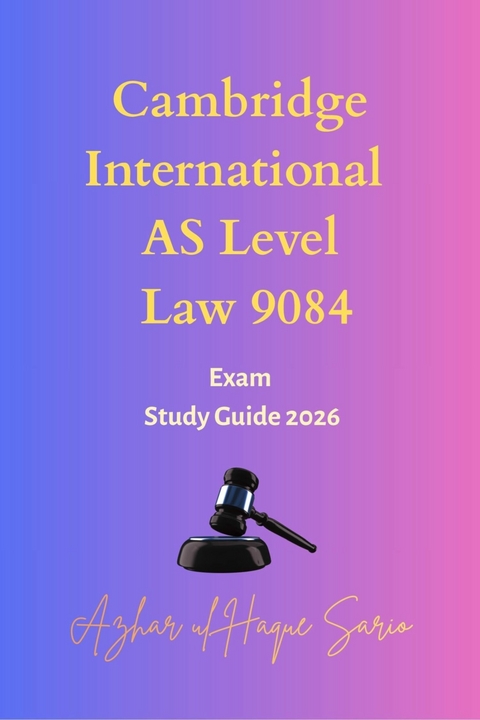
Cambridge International AS Level Law 9084 (eBook)
198 Seiten
Azhar Sario Hungary (Verlag)
978-3-384-79038-5 (ISBN)
Master the future of the Cambridge International AS Level Law 9084 syllabus with a study guide built strictly for the 2026 exams.
This book provides a complete roadmap of the English Legal System and Criminal Law. It starts with a clear view of global legal ecosystems. You will learn the difference between Common Law and Civil Law. It explains the machinery of justice in simple terms. You will explore the roles of the Civil and Criminal courts. It details the work of judges, magistrates, and juries. It explains the distinct roles of barristers and solicitors. It covers the vital police powers under PACE 1984. You will understand the rules of Stop and Search. It explains Arrest, Detention, and Treatment in custody. The book then dives deep into Criminal Law. It breaks down Actus Reus and Mens Rea. It explains the rules of causation and omissions. You will study offences against property in great detail. This includes Theft, Robbery, and Burglary. It covers Blackmail and Handling Stolen Goods. It analyzes the complex laws of Fraud. It explains Criminal Damage and Arson. It also covers the full Sentencing framework. It explains how adults and young offenders are treated. It uses short sentences to make learning easy. It plans every paragraph to help you remember facts. It covers all the key topics for your exam.
This book provides value that other textbooks miss by focusing entirely on the 2026 legal landscape. Most guides recycle old cases, but this book is fresh. It includes the latest statutes like the Employment Rights Act 2025. It explains the impact of the Property (Digital Assets etc) Act 2025. It discusses modern crimes like crypto-theft and AI copyright liability. It explores the 'Failure to Prevent Fraud' offence affecting corporations. It explains the new 'Online Procedure Rules' for civil courts. It looks at the 2026 sentencing trends for digital crimes. It moves beyond traditional examples to discuss autonomous vehicles and smart contracts. It explains the 'why' behind the law, not just the 'what.' It connects legal theory to the real world of 2026. It is written in natural language to help you understand quickly. It is designed to give you a competitive edge in your exams. It makes complex law simple and accessible.
Copyright Disclaimer: This book is an independently produced study guide by Azhar ul Haque Sario. It is not affiliated with, endorsed by, or connected to Cambridge Assessment International Education. All trademarks, service marks, and trade names are the property of their respective owners and are used here for descriptive and educational purposes under the doctrine of nominative fair use.
Section 2: Criminal law
1. Introduction: The Physical Element of Criminal Liability
In the landscape of English Criminal Law as we understand it in 2026, the fundamental maxim actus non facit reum nisi mens sit rea—"an act does not make a person guilty unless the mind is also guilty"—remains the bedrock of liability. While the legal system has evolved significantly with the introduction of new statutory frameworks like the Crime and Policing Act 2026 and the Victims and Courts Bill 2025, the core architecture of crime continues to rest on two pillars: the mens rea (guilty mind) and the actus reus (guilty act).
This coursework provides a comprehensive, deep-dive analysis of the actus reus. Far from being a simple "act," the actus reus is a complex assembly of conduct, circumstances, and consequences. In the modern era, where digital crimes and corporate failures to prevent fraud are as prominent as traditional assaults, understanding the nuance of "conduct" is more critical than ever. We will dissect the three primary components required by the Cambridge A Level syllabus: the voluntary nature of the act, the controversial liability for omissions (failures to act), and the intricate chain of causation that links a defendant's behavior to a prohibited result.
2. Actus Reus as the Conduct Element of a Crime
The term actus reus is somewhat misleading in modern legal discourse because it implies a requirement for a positive "act." However, in 2026, legal scholars and the courts prefer the term "conduct element." This shift reflects the reality that criminal liability can arise from a positive action, a failure to act (omission), or even a "state of affairs."
The Requirement of Voluntariness
The first and most absolute principle of the actus reus is that the conduct must be voluntary. The criminal law respects human autonomy; it punishes choices, not spasms. For a defendant to be held liable, their bodily movements must be directed by a conscious mind. If a person loses control of their muscles, they are not "acting" in the legal sense.
A seminal example that remains the authority today is Hill v Baxter (1958). In this case, the court provided hypothetical examples of involuntary conduct: a driver losing control because they were stung by a swarm of bees, or suffering a sudden heart attack. In such scenarios, the physical movement of the car is not the "act" of the driver. This principle was further reinforced in Broome v Perkins (1987), where a driver suffering from diabetic acts was still found liable because he retained some control, illustrating the high threshold the courts set for "total" loss of control.
Involuntariness and Automatism
In contemporary 2026 legal practice, this concept is often argued under the defence of "automatism." If a defendant acts while in a state of impaired consciousness—perhaps due to a concussive blow or a medical episode—they have not formed the actus reus. A striking illustration is R v T (1990), where a victim of rape committed a robbery while in a PTSD-induced dissociative state. The court accepted that her actions were not fully voluntary.
However, the law draws a sharp, often criticized line between "insane automatism" (caused by an internal disease of the mind, leading to a special verdict) and "non-insane automatism" (caused by an external factor, leading to acquittal). This distinction remains a subject of intense academic debate in 2026, particularly with the rise of complex neurological evidence in courtrooms.
State of Affairs Crimes (Status Offences)
There exists a rare but draconian category of actus reus known as "state of affairs" or "absolute liability" cases. Here, the defendant is punished not for what they did voluntarily, but for the situation they were found in.
The classic, and still troubling, authority is R v Larsonneur (1933). The defendant, a French citizen, was deported from Ireland against her will and brought by police to the UK. Upon arrival, she was immediately charged with being an "alien found in the United Kingdom." Despite her presence being entirely involuntary—she was physically forced there by police—she was convicted. Even in 2026, this case stands as a reminder that in specific statutory contexts (often relating to immigration or strict regulatory offences), the requirement for voluntary conduct can be bypassed by Parliament, prioritizing public policy over individual justice.
3. Actus Reus by Omission
If the general rule is that an act must be voluntary, the second major area of inquiry is whether a person can be criminalized for doing nothing. The "Good Samaritan" debate is central here. Unlike France or Germany, English law traditionally has no general duty to rescue. If a bystander watches a child drown in a shallow pool and does nothing, they commit no legal wrong, though they may be morally reprehensible.
However, this general rule has been significantly eroded. By 2026, the list of exceptions where a "duty to act" is imposed has grown, reflecting a society that increasingly demands accountability, especially from those in positions of trust or corporate power.
The Exceptions: When Silence is Criminal
Liability for omissions arises only when the law recognizes a pre-existing duty. We can categorize these duties into six primary areas:
1. Statutory Duty Parliament frequently creates offences that can be committed by omission. A standard example is the Road Traffic Act 1988, which makes it a crime to fail to provide a breath sample or to stop after an accident.
2026 Context: The most significant recent development is the full implementation of the Economic Crime and Corporate Transparency Act 2023 (fully operational in late 2025). This Act introduced the "Failure to Prevent Fraud" offence. Large organizations now face criminal liability if they fail to stop employees from committing fraud. This is a massive shift in corporate actus reus, effectively criminalizing a company's omission to implement reasonable prevention procedures.
2. Contractual Duty A duty can arise from a contract of employment. The leading case is R v Pittwood (1902). A railway gatekeeper failed to close the gate, leading to a train collision that killed a cart driver. His defence—that he merely did nothing—failed because he was contractually paid to act. This principle applies broadly today; a lifeguard who ignores a drowning swimmer or a nurse who ignores a patient alarm is liable because their contract creates a legal expectation of action.
3. Relationship Duty The law presumes a duty of care between parents and children. In R v Gibbins and Proctor (1918), a father and his partner starved his child to death. Their failure to feed the child was murder.
Modern Application: This duty has evolved to include "reciprocal" relationships between adults. In R v Smith (1979), a husband failed to call a doctor for his ill wife. The court held that while partners are independent, a duty arises when one becomes helpless and the other is the sole potential rescuer.
4. Voluntary Assumption of Care If a person voluntarily undertakes to care for another, they cannot simply abandon that duty when it becomes inconvenient. The tragic case of R v Stone and Dobinson (1977) illustrates this. The defendants took in an elderly, anorexic relative. They initially tried to care for her but eventually stopped, leaving her to die in squalor. The court held that by starting to care for her, they had assumed a duty and their subsequent omission was criminal gross negligence.
5. Creation of a Dangerous Situation This is perhaps the most dynamic area of omissions law. If a defendant accidentally creates a dangerous situation, they incur a duty to take reasonable steps to mitigate it. This is the Miller principle, derived from R v Miller (1983). A squatter fell asleep with a lit cigarette, setting a mattress on fire. Instead of putting it out, he moved to another room. The House of Lords held that his "act" was the whole sequence of events; once he woke up and realized the danger he caused, his failure to act became the actus reus.
2026 Analysis: This principle was expanded in R v Evans (2009), where a sister supplied heroin to her younger sibling, who then overdosed. The sister didn't call for help due to fear of police. The court ruled that by supplying the drug, she created a "dangerous situation" and thus had a duty to summon aid. This logic is increasingly relevant in modern drug-related manslaughter cases.
6. Misconduct in a Public Office Public officials—police officers, paramedics, judges—have a duty to act to protect the public. In R v Dytham (1979), a police officer on duty watched a bouncer kick a man to death and did nothing, later leaving the scene. He was convicted because his position required intervention.
4. Causation: The Link Between Act and Consequence
For "result crimes" (like murder, manslaughter, or Section 18 GBH), proving the conduct is not enough. The prosecution must prove that the defendant’s conduct caused the prohibited consequence. This is established through a two-stage test: Factual Causation and Legal Causation.
Factual Causation: The "But For" Test
The starting point is the "But For" test established in R v White (1910). The question asked is: "But for the defendant's actions, would the result have occurred?" In White, the...
| Erscheint lt. Verlag | 1.1.2026 |
|---|---|
| Sprache | englisch |
| Themenwelt | Recht / Steuern |
| ISBN-10 | 3-384-79038-3 / 3384790383 |
| ISBN-13 | 978-3-384-79038-5 / 9783384790385 |
| Informationen gemäß Produktsicherheitsverordnung (GPSR) | |
| Haben Sie eine Frage zum Produkt? |
 EPUB (Adobe DRM)
Größe: 237 KB
Kopierschutz: Adobe-DRM
Adobe-DRM ist ein Kopierschutz, der das eBook vor Mißbrauch schützen soll. Dabei wird das eBook bereits beim Download auf Ihre persönliche Adobe-ID autorisiert. Lesen können Sie das eBook dann nur auf den Geräten, welche ebenfalls auf Ihre Adobe-ID registriert sind.
Details zum Adobe-DRM
Dateiformat: EPUB (Electronic Publication)
EPUB ist ein offener Standard für eBooks und eignet sich besonders zur Darstellung von Belletristik und Sachbüchern. Der Fließtext wird dynamisch an die Display- und Schriftgröße angepasst. Auch für mobile Lesegeräte ist EPUB daher gut geeignet.
Systemvoraussetzungen:
PC/Mac: Mit einem PC oder Mac können Sie dieses eBook lesen. Sie benötigen eine
eReader: Dieses eBook kann mit (fast) allen eBook-Readern gelesen werden. Mit dem amazon-Kindle ist es aber nicht kompatibel.
Smartphone/Tablet: Egal ob Apple oder Android, dieses eBook können Sie lesen. Sie benötigen eine
Geräteliste und zusätzliche Hinweise
Buying eBooks from abroad
For tax law reasons we can sell eBooks just within Germany and Switzerland. Regrettably we cannot fulfill eBook-orders from other countries.
aus dem Bereich


