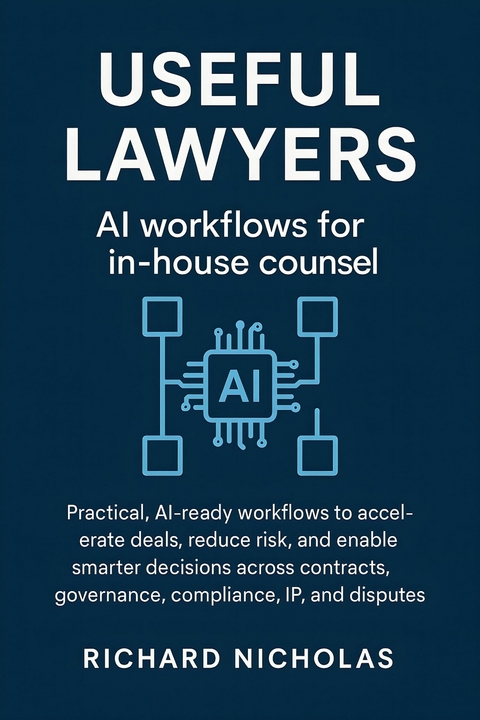
Useful Lawyers (eBook)
136 Seiten
Publishdrive (Verlag)
978-0-00-110493-8 (ISBN)
Useful Lawyers - Workflows for In House Counsel is the essential guide for in-house legal teams looking to quickly harness the power of artificial intelligence in everyday legal practice.
Written by AI lawyer Richard Nicholas, it delivers 21 clear, ready-to-use full AI workflows across ten critical areas - including risk management, corporate governance, regulation, contract management, intellectual property, litigation strategy, M&A, ethics and financial management.
Designed for In-House Counsel, GCs and CLOs, this accessible handbook offers shortcuts to increase efficiency, speed decision-making, and reduce risk - all while maintaining high professional standards and data governance.
If you're looking to get started quickly with some ready made, downloadable ideas for moving legal processes to AI (whichever AI tool you're using) this is the guide that you're looking for.
Note - this is a human-written book containing 21 AI-generated, ready-made (human-tested) workflows. It is not a substitute for legal advice, but could well be a substitute for hours spent putting a first draft together!
Chapter 2 - An introduction to AI
AI is capable of incredible efficiencies in every area of an In-House lawyer’s role - from reviewing the initial client instruction for relevance and pre-qualifying instructions before they reach the legal team, to learning from past negotiations, summarising and marking up documents, flagging legal and regulatory risk ahead of time (and just ahead of any meeting you might have) and reporting back to the board the risks avoided, deals won and financial benefit of the legal team.
And yet - before we look at everything that AI can do, and how you might go about making these changes, there are a few questions worth answering first - such as “What is AI”, “How does it differ from automation” “How do I go about implementing it”, “Do I need to buy bespoke tools” and “is it Safe?”
These are questions raised by in-house lawyers that I work with and are covered in this chapter.
First of all - What is Generative AI & what do I do with it?
Generative AI is only one form of AI, with others including computer vision, machine learning and robotics.
For the sake of this book we’re going to be looking at the use of large language models, such as OpenAI's ChatGPT, Anthropic's Claude, or Google's Gemini. These have been trained on massive datasets of text and code, which allows them to learn the patterns and structures of human language and gives them the ability to understand and generate human-like text, making them a powerful tool for a wide range of tasks.
These models can be further fine-tuned on specific datasets (such as legal agreements, templates and policies) to improve their performance on particular tasks, such as drafting and reviewing legal agreements. This work has been done by various third party suppliers who have created solutions specifically for the legal market (current examples being Co-Counsel, Harvey, Legora, GC.ai, Wordsmith and others).
But it is also possible - as we’ll explore - to fine-tune publicly available LLMs on your own business data and contracts and to learn processes in your own business. Whilst this would previously have seemed an extremely daunting task, requiring coding skills and specialist computer knowledge, the fact that the LLMs respond to natural language (i.e. English) and can create computer code from instructions given in English means that the process is open to anyone, including those with limited technical skills.
In fact as lawyers with a good understanding of the business problems to be solved (and the business in which they are faced) we are in as good a position as any to develop AI tools to solve those problems for the business.
AI vs Automation
Automation is a process whereby repetitive processes can be carried out by software. Typically data is moved from one place to another but not changed.
An example in a legal context would be the completion of a template document. If an NDA template has the words “Company” and “Supplier” for instance then an automation would allow those words to be completed with each party’s name. Similarly placeholders for [date], [purpose], [jurisdiction] might all be set up in the document and when a person puts the relevant information into a form the computer might complete all of the details in the document. This does not require AI, but simply the recognition of, and replacement of words.
Similarly an email addressed to “Dear [First Name]”, with the help of a CRM system can pull the first names from a large number of people in order to send personalised emails.
Both of the examples above are potentially useful and when applied to a process of creating NDAs or sending out . Both can save time and make an in-house team much more efficient - but in both cases data is simply being “moved” from one place (a form or a CRM system) to another ( the template document or the email).
When combined with AI however Automation can become very powerful as it allows whole processes to be mapped and provided to AI tools. This allows entire processes can be “mapped out” in order to make them more efficient.
Implementing AI in Business - the process
One mistake that some businesses seem to make is to find, or be persuaded to buy an AI solution before they have identified the right problem for it to solve. They are persuaded by a solution and rush to buy before testing if it is what the business wants or needs.
Unfortunately I have seen this “shiny object” syndrome in practice - with AI and automation being introduced into some processes where it simply wasn’t appropriate (because the process required human intervention, empathy or understanding) or where the sharing of personal, confidential data meant that users are not simply not ready to accept an AI solution and will actively find ways of avoiding it.
It is therefore working through a process to determine if an AI solution is appropriate. This starts with deciding what problem to solve with AI.
Deciding on the right problem to solve
If you are looking to solve a problem that will affect multiple people in the organisation (such as getting contracts or requests turned around quicker, or filtering out questions that the legal team do not need to answer) it is worth ensuring that you have those people involved from the outset.
You may find that the problem isn’t what you think it is (a simple example - an in-house lawyer I know was looking to ensure that frequently asked questions did not always come to her. She created policies dealing with typical issues such as signing authority, contract variations and the like. It made no difference as the teams already knew the answers to the questions they were asking – the thing that her clients were looking for was to get the answers that they already had “confirmed by legal”). In that case it was the managers of the relevant teams that needed to change their practice and empower their team rather than the lawyer providing more information. This was an ”authority” problem rather than a knowledge problem.
So it can be with AI projects. You want to find the “root cause” of the problem before you seek to tackle it, otherwise you may find that you’ve answered the “wrong” question.
A simple test (particularly if you’re the only lawyer and the person most likely to be affected by any solution) is to ask what are you spending the most time on that you wish you weren’t?
Once you have the right problem you can work out how a process (or “workflow”) currently works and how that might possibly work differently.
Mapping out the workflow
If you’ve not yet done this for yourself you may be unaware of the different steps that go into the everyday work that you do as an in-house lawyer. Particularly if you’re forever “putting out the latest fire” (dealng with the next most urgent thing) then you might not have had the chance to work through the process by which work comes to you and therefore the problem that you are looking to solve.
Let’s take, for example the “problem” of having to respond to the same request over and over again and how you might deal with it.
You might have a process that involves the following:
You receive an email from the business
You respond to that email (to confirm receipt)
You read the email to see if is a question that is frequently asked of the legal team
If so then you respond quickly, but if not you allocate to the right person
That person provides an answer directly to the person that sent the query.
Typically this process would be mapped out using a series of boxes and lines and then the AI and Automation steps added in, for instance:
Steps 1 and 2 - the response to the email, acknowledging receipt, could be automated
Step 3 - reading of the email to understand the nature of the question - could be replaced with an AI chatbot solution that “sorts” questions
Step 4 - the response could either be automated (by sending the relevant part of the policy) or generated each time using a simple AI solution
Step 5 - allocation to the relevant person could be triggered by the AI understanding the meaning of the message, realising that it is not a simple answer and sending to the relevant person
Steps 6 and 7 are where the more difficult legal response takes place and would be reserved to the (human) lawyer.
To put this into practice however, you would first need to take a couple more steps:
Check what data is needed and your own rights to it
So for steps 3, 4 and 5 to work you would need to work out here the types of frequently asked questions, the right responses and might want to build in some guardrails (to prevent clients from seeking to override the process!)
For questions that you’d typically answer using third party data, you might need to check that you are able to use that data for the purpose of training an AI solution. Here you might need to check the terms of any licences that you might have with third parties and might need to seek agreement to that use if the purpose is limited (for instance you might have access to data relating to a customer or supplier, but your right to use that data might be strictly limited).
Buy OR build - the tools
Once you’ve identified the areas of the process that are suitable for automation or an AI solution it is a question of identifying the tools (if any) that you might want to use and/or suitable prompts to get the...
| Erscheint lt. Verlag | 5.11.2025 |
|---|---|
| Sprache | englisch |
| Themenwelt | Recht / Steuern ► Wirtschaftsrecht |
| ISBN-10 | 0-00-110493-4 / 0001104934 |
| ISBN-13 | 978-0-00-110493-8 / 9780001104938 |
| Informationen gemäß Produktsicherheitsverordnung (GPSR) | |
| Haben Sie eine Frage zum Produkt? |
 EPUB (Adobe DRM)
Größe: 1,1 MB
Kopierschutz: Adobe-DRM
Adobe-DRM ist ein Kopierschutz, der das eBook vor Mißbrauch schützen soll. Dabei wird das eBook bereits beim Download auf Ihre persönliche Adobe-ID autorisiert. Lesen können Sie das eBook dann nur auf den Geräten, welche ebenfalls auf Ihre Adobe-ID registriert sind.
Details zum Adobe-DRM
Dateiformat: EPUB (Electronic Publication)
EPUB ist ein offener Standard für eBooks und eignet sich besonders zur Darstellung von Belletristik und Sachbüchern. Der Fließtext wird dynamisch an die Display- und Schriftgröße angepasst. Auch für mobile Lesegeräte ist EPUB daher gut geeignet.
Systemvoraussetzungen:
PC/Mac: Mit einem PC oder Mac können Sie dieses eBook lesen. Sie benötigen eine
eReader: Dieses eBook kann mit (fast) allen eBook-Readern gelesen werden. Mit dem amazon-Kindle ist es aber nicht kompatibel.
Smartphone/Tablet: Egal ob Apple oder Android, dieses eBook können Sie lesen. Sie benötigen eine
Geräteliste und zusätzliche Hinweise
Buying eBooks from abroad
For tax law reasons we can sell eBooks just within Germany and Switzerland. Regrettably we cannot fulfill eBook-orders from other countries.
aus dem Bereich