


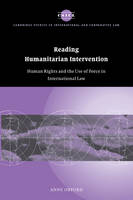
Reading Humanitarian Intervention
Human Rights and the Use of Force in International Law
Seiten
2007
Cambridge University Press (Verlag)
978-0-521-04766-1 (ISBN)
Cambridge University Press (Verlag)
978-0-521-04766-1 (ISBN)
During the 1990s, humanitarian intervention seemed to promise a world in which human rights would be privileged over national interests or imperial ambitions. Orford argues that humanitarian intervention had far more exploitative effects. What, if anything, has been lost in the move from humanitarian intervention to the war on terror?
During the 1990s, humanitarian intervention seemed to promise a world in which democracy, self-determination and human rights would be privileged over national interests or imperial ambitions. Orford provides critical readings of the narratives that accompanied such interventions and shaped legal justifications for the use of force by the international community. Through a close reading of legal texts and institutional practice, she argues that a far more circumscribed, exploitative and conservative interpretation of the ends of intervention was adopted during this period. The book draws on a wide range of sources, including critical legal theory, feminist and postcolonial theory, psychoanalytic theory and critical geography, to develop ways of reading directed at thinking through the cultural and economic effects of militarized humanitarianism. The book concludes by asking what, if anything, has been lost in the move from the era of humanitarian intervention to an international relations dominated by wars on terror.
During the 1990s, humanitarian intervention seemed to promise a world in which democracy, self-determination and human rights would be privileged over national interests or imperial ambitions. Orford provides critical readings of the narratives that accompanied such interventions and shaped legal justifications for the use of force by the international community. Through a close reading of legal texts and institutional practice, she argues that a far more circumscribed, exploitative and conservative interpretation of the ends of intervention was adopted during this period. The book draws on a wide range of sources, including critical legal theory, feminist and postcolonial theory, psychoanalytic theory and critical geography, to develop ways of reading directed at thinking through the cultural and economic effects of militarized humanitarianism. The book concludes by asking what, if anything, has been lost in the move from the era of humanitarian intervention to an international relations dominated by wars on terror.
Anne Orford is Senior Lecturer in the Law School at the University of Melbourne.
Preface; 1. Watching East Timor; 2. Misreading the texts of international law; 3. Localizing the other: the imaginative geography of humanitarian intervention; 4. Self-determination after intervention: the international community and post-conflict reconstruction; 5. The constitution of the international community: colonial stereotypes and humanitarian narratives; 6. Dreams of human rights; Bibliography; Index.
| Erscheint lt. Verlag | 3.12.2007 |
|---|---|
| Reihe/Serie | Cambridge Studies in International and Comparative Law |
| Zusatzinfo | Worked examples or Exercises |
| Verlagsort | Cambridge |
| Sprache | englisch |
| Maße | 153 x 229 mm |
| Gewicht | 388 g |
| Themenwelt | Recht / Steuern ► EU / Internationales Recht |
| Recht / Steuern ► Öffentliches Recht ► Völkerrecht | |
| ISBN-10 | 0-521-04766-8 / 0521047668 |
| ISBN-13 | 978-0-521-04766-1 / 9780521047661 |
| Zustand | Neuware |
| Informationen gemäß Produktsicherheitsverordnung (GPSR) | |
| Haben Sie eine Frage zum Produkt? |
Mehr entdecken
aus dem Bereich
aus dem Bereich
Die Rechtsprechung des Gerichtshofs der Europäischen Union, deutscher …
Buch | Softcover (2025)
Nomos (Verlag)
CHF 53,50


