


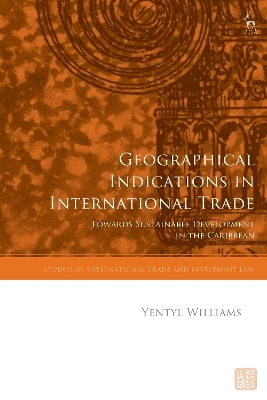
Geographical Indications in International Trade
Towards Sustainable Development in the Caribbean
Seiten
2026
Hart Publishing (Verlag)
978-1-5099-9135-8 (ISBN)
Hart Publishing (Verlag)
978-1-5099-9135-8 (ISBN)
- Noch nicht erschienen (ca. August 2026)
- Versandkostenfrei
- Auch auf Rechnung
- Artikel merken
Do Geographical Indications truly serve the interests of the Global South? Can they foster meaningful change in former colonial societies?
Geographical Indications (GIs), widely used in the European context, are being promoted as vehicles for local development: but do they truly serve the interests of the Global South? Can they foster meaningful change in former colonial societies?
This open access book interrogates these questions through a critical legal lens grounded in Third World Approaches to International Law (TWAIL), to assess whether GIs—codified in international trade agreements like the EU-CARIFORUM Economic Partnership Agreement—can support ‘development from within’ for the small island developing states of the Caribbean.
Providing a fresh perspective on the colonial roots, current utility, and future potential of GI laws, the book engages with Caribbean realities and includes global case studies from Demerara rum in Guyana, Ethiopian coffee, Indian Darjeeling tea, Colombian coffee, Mexican Tequila, and Barbados Rum.
In a world shaped by international trade rules, GIs and Sustainable Development offer a powerful lens into how the law of origin-linked products—like Champagne, Tequila, and Jamaican Rum—can shape futures for postcolonial states.
Geographical Indications in International Trade is essential reading for academics, policymakers, legal practitioners, and development professionals seeking to understand the tensions between intellectual property law and sustainable development. It challenges readers to rethink international trade rules and consider how GI law can be reclaimed by third-world nations as a transformative tool for heritage-based, sustainable economic development.
The ebook editions of this book are available open access under a CC BY-NC-ND 4.0 licence on bloomsburycollections.com. Open access was funded by UKRI.
Geographical Indications (GIs), widely used in the European context, are being promoted as vehicles for local development: but do they truly serve the interests of the Global South? Can they foster meaningful change in former colonial societies?
This open access book interrogates these questions through a critical legal lens grounded in Third World Approaches to International Law (TWAIL), to assess whether GIs—codified in international trade agreements like the EU-CARIFORUM Economic Partnership Agreement—can support ‘development from within’ for the small island developing states of the Caribbean.
Providing a fresh perspective on the colonial roots, current utility, and future potential of GI laws, the book engages with Caribbean realities and includes global case studies from Demerara rum in Guyana, Ethiopian coffee, Indian Darjeeling tea, Colombian coffee, Mexican Tequila, and Barbados Rum.
In a world shaped by international trade rules, GIs and Sustainable Development offer a powerful lens into how the law of origin-linked products—like Champagne, Tequila, and Jamaican Rum—can shape futures for postcolonial states.
Geographical Indications in International Trade is essential reading for academics, policymakers, legal practitioners, and development professionals seeking to understand the tensions between intellectual property law and sustainable development. It challenges readers to rethink international trade rules and consider how GI law can be reclaimed by third-world nations as a transformative tool for heritage-based, sustainable economic development.
The ebook editions of this book are available open access under a CC BY-NC-ND 4.0 licence on bloomsburycollections.com. Open access was funded by UKRI.
Yentyl Williams is Lecturer at the Faculty of Law, UWI Mona, Jamaica.
1. Introduction
2. GIs as Colonial Constructs in International Law
3. The EU as a GI Exporter in the Caribbean
4. The CARIFORUM-EU EPA: Monitoring and Evaluating GI Implementation
5. GIs in the Third World: Lessons for a Strategic Approach to GIs as IP Assets in the Caribbean
6. Can Caribbean Rum GIs Learn Lessons from Mexico's Tequila GI? Insights from Demerara and Barbados
7. Conclusion
| Erscheint lt. Verlag | 20.8.2026 |
|---|---|
| Reihe/Serie | Studies in International Trade and Investment Law |
| Verlagsort | Oxford |
| Sprache | englisch |
| Maße | 156 x 234 mm |
| Themenwelt | Recht / Steuern ► EU / Internationales Recht |
| Recht / Steuern ► Wirtschaftsrecht ► Urheberrecht | |
| ISBN-10 | 1-5099-9135-2 / 1509991352 |
| ISBN-13 | 978-1-5099-9135-8 / 9781509991358 |
| Zustand | Neuware |
| Informationen gemäß Produktsicherheitsverordnung (GPSR) | |
| Haben Sie eine Frage zum Produkt? |
Mehr entdecken
aus dem Bereich



aus dem Bereich
gewerblicher Rechtsschutz, Urheberrecht, Wettbewerbsrecht
Buch | Softcover (2025)
UTB (Verlag)
CHF 82,55


