


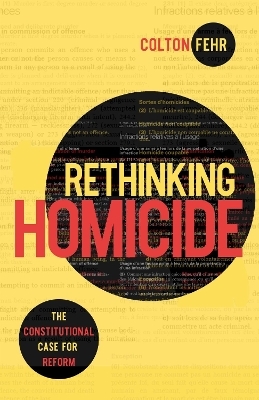
Rethinking Homicide
The Constitutional Case for Reform
Seiten
2026
McGill-Queen's University Press (Verlag)
978-0-2280-2775-1 (ISBN)
McGill-Queen's University Press (Verlag)
978-0-2280-2775-1 (ISBN)
- Noch nicht erschienen (ca. Juni 2026)
- Versandkostenfrei
- Auch auf Rechnung
- Artikel merken
Critics describe homicide law in Canada as outdated and unprincipled in application. While early jurisprudence compelled limited reform, constitutional challenges subsided near the turn of the twentieth century, and legislative amendments have been rare and piecemeal.
Rethinking Homicide makes a compelling case for constitutionally restructuring homicide law and considers how Parliament might respond. Colton Fehr contends that the distinctions between first- and second-degree murder and manslaughter unfairly label some offenders, challenges the infanticide provision, and explains why the provocation defence has no constitutional status and should be repealed. He also contends that murder’s exclusion from the duress defence is inconsistent with the principle prohibiting conviction for morally involuntary conduct. From that principle, Fehr develops a broader constitutional structure for substantive defences implicated by homicide offences. He further contends that the minimum sentences applicable to homicide constitute cruel and unusual punishment. In response, Parliament will have to choose between a sentencing safety valve and a diminished responsibility defence, with the former option being the preferable policy.
The arguments offered in Rethinking Homicide provide a timely and important contribution to criminal law. Scholars, judges, and lawyers alike will appreciate its much-needed contemplation of the Charter to this core area of criminal law.
Rethinking Homicide makes a compelling case for constitutionally restructuring homicide law and considers how Parliament might respond. Colton Fehr contends that the distinctions between first- and second-degree murder and manslaughter unfairly label some offenders, challenges the infanticide provision, and explains why the provocation defence has no constitutional status and should be repealed. He also contends that murder’s exclusion from the duress defence is inconsistent with the principle prohibiting conviction for morally involuntary conduct. From that principle, Fehr develops a broader constitutional structure for substantive defences implicated by homicide offences. He further contends that the minimum sentences applicable to homicide constitute cruel and unusual punishment. In response, Parliament will have to choose between a sentencing safety valve and a diminished responsibility defence, with the former option being the preferable policy.
The arguments offered in Rethinking Homicide provide a timely and important contribution to criminal law. Scholars, judges, and lawyers alike will appreciate its much-needed contemplation of the Charter to this core area of criminal law.
Colton Fehr is assistant professor at the University of Saskatchewan's College of Law.
| Erscheint lt. Verlag | 23.6.2026 |
|---|---|
| Verlagsort | Montreal |
| Sprache | englisch |
| Maße | 152 x 229 mm |
| Themenwelt | Recht / Steuern ► EU / Internationales Recht |
| Recht / Steuern ► Strafrecht | |
| ISBN-10 | 0-2280-2775-6 / 0228027756 |
| ISBN-13 | 978-0-2280-2775-1 / 9780228027751 |
| Zustand | Neuware |
| Informationen gemäß Produktsicherheitsverordnung (GPSR) | |
| Haben Sie eine Frage zum Produkt? |
Mehr entdecken
aus dem Bereich



aus dem Bereich
Textausgabe mit einer Einführung von Prof. em. Dr. Roland Bieber
Buch | Softcover (2024)
Nomos (Verlag)
CHF 27,85
Gesetz über das Verfahren in Familiensachen und in den …
Buch | Softcover (2025)
dtv Verlagsgesellschaft
CHF 29,25


